, http://s.wordpress.com/mshots/v1/https%3A%2F%2Fwww.dailysignal.com%2F2024%2F08%2F16%2Frising-home-prices-leave-more-americans-nowhere-live%2F?w=600&h=450, The cost of housing rose again last month, making it even more difficult for Americans to afford a home of their own. Inflation is just… Read More The post Why More Americans Have Nowhere to Live appeared first on The Daily Signal.,
The cost of housing rose again last month, making it even more difficult for Americans to afford a home of their own. Inflation is just… Read More
, The cost of housing rose again last month, making it even more difficult for Americans to afford a home of their own. Inflation is just… Read More The post Why More Americans Have Nowhere to Live appeared first on The Daily Signal., , , https://first-heritage-foundation.s3.amazonaws.com/live_files/2024/08/240816_ForSale.jpg, The Daily Signal, Policy News, Conservative Analysis and Opinion, , https://www.dailysignal.com/rss, ,
On the latest episode of “The Tony Kinnett Cast,” we cover the latest news from the biggest election in decades with the Harris-Walz campaign’s refusing… Read More
, http://s.wordpress.com/mshots/v1/https%3A%2F%2Fwww.dailysignal.com%2F2024%2F08%2F15%2Ftony-kinnett-cast-chicken%2F?w=600&h=450, On the latest episode of “The Tony Kinnett Cast,” we cover the latest news from the biggest election in decades with the Harris-Walz campaign’s refusing… Read More The post WATCH: Harris Spurns Trump’s Debate Offers appeared first on The Daily Signal.,
On the latest episode of “The Tony Kinnett Cast,” we cover the latest news from the biggest election in decades with the Harris-Walz campaign’s refusing… Read More
, On the latest episode of “The Tony Kinnett Cast,” we cover the latest news from the biggest election in decades with the Harris-Walz campaign’s refusing… Read More The post WATCH: Harris Spurns Trump’s Debate Offers appeared first on The Daily Signal., , , https://first-heritage-foundation.s3.amazonaws.com/live_files/2024/08/TKC_WP_Chicken.jpg, The Daily Signal, Policy News, Conservative Analysis and Opinion, , https://www.dailysignal.com/rss, ,
U.S.-backed forces in eastern Syria launched a major attack on three posts manned by pro-government gunmen on Aug. 12, 2024, killing at least 18 fighters in a rare provocation near the border with Iraq.
The assault marked the worst clashes in eastern Syria in nearly a year. Earlier in August, eight U.S. personnel stationed in Syria were injured in a drone attack purportedly carried out by Iranian-backed militants.
These incidents highlight a fact that is often forgotten: The U.S. still has an active presence in Syria. The Deir ez-Zor Military Council behind the Aug. 12 attack is part of the Syrian Democratic Forces – a Kurdish-led alliance that has been a major U.S. partner in Syria. The group and its local affiliates now control much of the territory that the terrorist Islamic State group once controlled.
And as of the beginning of 2024, the U.S. still had close to 1,000 military personnel in the eastern part of Syria. Recent reports suggest that amid the growing tension in the region, additional resources and soldiers have made their way to the civil war-torn country.
U.S. troops in Syria serve various purposes: helping prevent the resurgence of the Islamic State group, supporting Washington’s Kurdish allies and containing the influence of Iran and Russia – both of which also have a military presence in Syria.
But the costs and risks associated with this indefinite U.S. involvement could be significant. A continued presence risks prolonging America’s entanglement in a protracted and costly conflict with no clear end in sight, while antagonizing NATO ally Turkey, which views Syria’s Kurdish groups as a cross-border threat.
As an expert on Middle East security, I focus on the evolving geopolitical landscape and argue that the U.S. must carefully weigh its commitments in Syria against the broader goals of regional stability and its relationships with allies and adversaries alike. Ultimately, whether the U.S. decides to stay or withdraw, the decision will have profound implications for Syria as well as for regional and global actors involved in the country’s ongoing civil war.
Growing US engagement
U.S. involvement in the Syrian civil war is a complex story. Shortly after the civil war began in 2011, the Obama administration placed sanctions on Syrian President Bashar al-Assad and supported factions of the opposition.
However, the administration was largely indecisive about when, how and to what extent it should intervene against the Assad regime. In part, this reflected growing war-weariness among the American public following a decade of engagement in Afghanistan and Iraq. Meanwhile, Washington struggled at first to find reliable partners on the ground in Syria.
A U.S. soldier looks out from the top of a fighting vehicle at an American military base in northeastern Syria.AP Photo/Darko Bandic
As popular protests grew into a full-scale military conflict in 2012, President Barack Obama declared that the use of chemical weapons would be a “red line” for the U.S. The following year, the Syrian military did just that, deploying chemical weapons during an attack on Ghouta, a rebel-held area, resulting in the deaths of an estimated 1,500 civilians, including more than 400 children.
Yet the Obama administration hesitated to involve the U.S. militarily in the conflict, fearing escalation due to increasing Russian and Iranian support for the regime.
The U.S. military involvement in Syria began in September 2014, when a U.S.-led coalition, including the United Kingdom, France, Jordan, Turkey, Canada, Australia and others, launched an air campaign against the Islamic State group and fellow radical group al-Nusra Front inside Syria.
Following the airstrikes, American troops entered northeast Syria to back a Syrian Kurdish force known as the People’s Protection Units, or YPG, and later the Syrian Democratic Forces, an umbrella group that consists of majority Kurdish and other ethnic and rebel groups.
The U.S. did not take direct military action against the Assad regime until April 2017, when the Trump administration launched a missile strike on Shayrat Airbase in response to a suspected chemical attack in the town of Khan Shaykhun in Idlib province.
In December 2018, President Donald Trump ordered the withdrawal of the 2,000 to 2,500 U.S. ground troops in Syria, believing the coalition’s operations against the Islamic State group had been largely successful and that the U.S. presence in eastern Syria was unnecessary.
However, instead of a total withdrawal, the U.S. announced that a contingency force would remain indefinitely.
Military presence today
As of 2024, around 900 U.S. soldiers, along with an undisclosed number of contractors, are operating in Syria, according to the Defense Department. Most U.S. forces are deployed in northeast Syria in support of the Syrian Democratic Forces, with some supporting the Free Syrian Army at the al-Tanf garrison in southeast Syria, along a transit route between Iraq and Syria used by both Islamic State group fighters and Iran-backed militias.
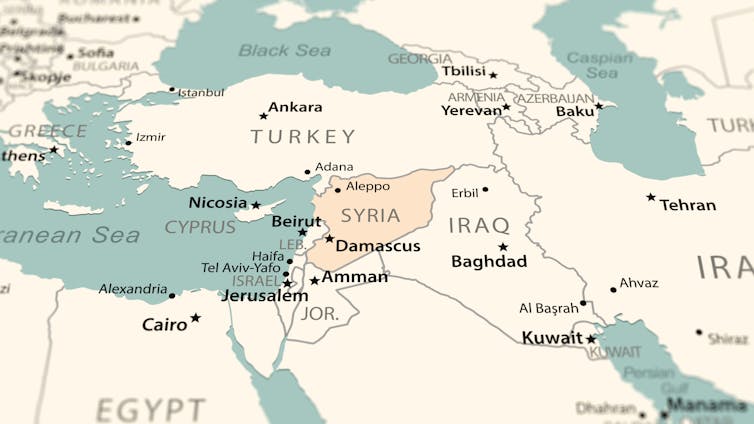
Syria and its surrounding region.Getty Images
But U.S. military support for Kurdish groups in Syria has angered its NATO ally Turkey, which views the YPG as an offshoot of the Kurdistan Workers’ Party (PKK), a designated terrorist organization.
Prioritizing Turkey’s security concerns, the Trump administration ordered all U.S. forces to withdraw from Rojava in early October 2019 ahead of a Turkish incursion into the region. But the move also damaged the U.S. alliance with the Syrian Democratic Forces.
Meanwhile, to appease their Kurdish allies, U.S. troops repositioned to eastern Syria, reinforcing their presence in the al-Hasakah and Deir ez-Zor governorates – two Syrian Democratic Forces-controlled regions of Syria that are rich in oil and gas.
What an American withdrawal could mean
The U.S. military presence currently serves three purposes.
First, its presence in northeast Syria acts as a deterrent to military incursions by either the Syrian regime or Turkey into the Autonomous Administration of North and East Syria (AANES). If U.S. forces were to withdraw, the Syrian Democratic Forces, which acts as the AANES’ de facto military, would need to negotiate the region’s autonomy with Turkey and the Syrian regime, both of which have made their opposition to Kurdish autonomy very clear.
Recent rapprochement attempts between Turkey and Syria have also fed Kurdish fears that a complete American withdrawal would tip the balance of power in divided Syria against them, risking their very survival.
Second, the U.S.’s presence in southeast Syria puts pressure on neighboring Iran, whose influence the U.S. seeks to limit in the region. The U.S. presence also serves as a counterbalance to Russian influence and ambitions in Syria and the Middle East. Notably, Russian airstrikes in 2015 over opposition-held areas of Aleppo and the bombing of hospitals were crucial in helping Assad regain territory and stay in power.
Third, the U.S. and its local partners have reportedly detained around 5,000 Islamic State group fighters and 50,000 indoctrinated family members. If these detainees were freed by any authority, the group could be reconstituted and grow. Underscoring the threat, the U.S., along with the Syrian Democratic Forces, thwarted a major prison break by Islamic State group fighters in early 2022.
Nonetheless, continued U.S. presence in Syria is not assured. In 2023, Republicans in the House attempted to force the Biden administration to withdraw the remaining troops. They failed. But Trump, again the Republican presidential candidate in 2024, has made it clear that he sees no role for the U.S. in “endless wars.”
Meanwhile, a U.S. troop pullout, despite the consequences, has precedence. The Biden administration withdrew all American troops from Afghanistan in 2021 and is formally transitioning to an advisory role in Iraq.
But for the time being, U.S. military presence in Syria continues and is emblematic of the broader challenges facing American foreign policy in the Middle East. The decision to stay or withdraw is a strategic one that will reverberate across the region.
2024-08-16 09:57:00, http://s.wordpress.com/mshots/v1/https%3A%2F%2Ftheconversation.com%2Fus-military-presence-in-syria-carries-substantial-risks-but-so-does-complete-withdrawal-235569?w=600&h=450, U.S.-backed forces in eastern Syria launched a major attack on three posts manned by pro-government gunmen on Aug. 12, 2024, killing at least 18 fighters in a rare provocation near the border with Iraq. The assault marked the worst clashes in eastern Syria in nearly a year. Earlier in August, eight U.S. personnel stationed in,
U.S.-backed forces in eastern Syria launched a major attack on three posts manned by pro-government gunmen on Aug. 12, 2024, killing at least 18 fighters in a rare provocation near the border with Iraq.
The assault marked the worst clashes in eastern Syria in nearly a year. Earlier in August, eight U.S. personnel stationed in Syria were injured in a drone attack purportedly carried out by Iranian-backed militants.
These incidents highlight a fact that is often forgotten: The U.S. still has an active presence in Syria. The Deir ez-Zor Military Council behind the Aug. 12 attack is part of the Syrian Democratic Forces – a Kurdish-led alliance that has been a major U.S. partner in Syria. The group and its local affiliates now control much of the territory that the terrorist Islamic State group once controlled.
And as of the beginning of 2024, the U.S. still had close to 1,000 military personnel in the eastern part of Syria. Recent reports suggest that amid the growing tension in the region, additional resources and soldiers have made their way to the civil war-torn country.
U.S. troops in Syria serve various purposes: helping prevent the resurgence of the Islamic State group, supporting Washington’s Kurdish allies and containing the influence of Iran and Russia – both of which also have a military presence in Syria.
But the costs and risks associated with this indefinite U.S. involvement could be significant. A continued presence risks prolonging America’s entanglement in a protracted and costly conflict with no clear end in sight, while antagonizing NATO ally Turkey, which views Syria’s Kurdish groups as a cross-border threat.
As an expert on Middle East security, I focus on the evolving geopolitical landscape and argue that the U.S. must carefully weigh its commitments in Syria against the broader goals of regional stability and its relationships with allies and adversaries alike. Ultimately, whether the U.S. decides to stay or withdraw, the decision will have profound implications for Syria as well as for regional and global actors involved in the country’s ongoing civil war.
Growing US engagement
U.S. involvement in the Syrian civil war is a complex story. Shortly after the civil war began in 2011, the Obama administration placed sanctions on Syrian President Bashar al-Assad and supported factions of the opposition.
However, the administration was largely indecisive about when, how and to what extent it should intervene against the Assad regime. In part, this reflected growing war-weariness among the American public following a decade of engagement in Afghanistan and Iraq. Meanwhile, Washington struggled at first to find reliable partners on the ground in Syria.
A U.S. soldier looks out from the top of a fighting vehicle at an American military base in northeastern Syria.AP Photo/Darko Bandic
As popular protests grew into a full-scale military conflict in 2012, President Barack Obama declared that the use of chemical weapons would be a “red line” for the U.S. The following year, the Syrian military did just that, deploying chemical weapons during an attack on Ghouta, a rebel-held area, resulting in the deaths of an estimated 1,500 civilians, including more than 400 children.
Yet the Obama administration hesitated to involve the U.S. militarily in the conflict, fearing escalation due to increasing Russian and Iranian support for the regime.
The U.S. military involvement in Syria began in September 2014, when a U.S.-led coalition, including the United Kingdom, France, Jordan, Turkey, Canada, Australia and others, launched an air campaign against the Islamic State group and fellow radical group al-Nusra Front inside Syria.
Following the airstrikes, American troops entered northeast Syria to back a Syrian Kurdish force known as the People’s Protection Units, or YPG, and later the Syrian Democratic Forces, an umbrella group that consists of majority Kurdish and other ethnic and rebel groups.
The U.S. did not take direct military action against the Assad regime until April 2017, when the Trump administration launched a missile strike on Shayrat Airbase in response to a suspected chemical attack in the town of Khan Shaykhun in Idlib province.
In December 2018, President Donald Trump ordered the withdrawal of the 2,000 to 2,500 U.S. ground troops in Syria, believing the coalition’s operations against the Islamic State group had been largely successful and that the U.S. presence in eastern Syria was unnecessary.
However, instead of a total withdrawal, the U.S. announced that a contingency force would remain indefinitely.
Military presence today
As of 2024, around 900 U.S. soldiers, along with an undisclosed number of contractors, are operating in Syria, according to the Defense Department. Most U.S. forces are deployed in northeast Syria in support of the Syrian Democratic Forces, with some supporting the Free Syrian Army at the al-Tanf garrison in southeast Syria, along a transit route between Iraq and Syria used by both Islamic State group fighters and Iran-backed militias.
Syria and its surrounding region.Getty Images
But U.S. military support for Kurdish groups in Syria has angered its NATO ally Turkey, which views the YPG as an offshoot of the Kurdistan Workers’ Party (PKK), a designated terrorist organization.
Prioritizing Turkey’s security concerns, the Trump administration ordered all U.S. forces to withdraw from Rojava in early October 2019 ahead of a Turkish incursion into the region. But the move also damaged the U.S. alliance with the Syrian Democratic Forces.
Meanwhile, to appease their Kurdish allies, U.S. troops repositioned to eastern Syria, reinforcing their presence in the al-Hasakah and Deir ez-Zor governorates – two Syrian Democratic Forces-controlled regions of Syria that are rich in oil and gas.
What an American withdrawal could mean
The U.S. military presence currently serves three purposes.
First, its presence in northeast Syria acts as a deterrent to military incursions by either the Syrian regime or Turkey into the Autonomous Administration of North and East Syria (AANES). If U.S. forces were to withdraw, the Syrian Democratic Forces, which acts as the AANES’ de facto military, would need to negotiate the region’s autonomy with Turkey and the Syrian regime, both of which have made their opposition to Kurdish autonomy very clear.
Recent rapprochement attempts between Turkey and Syria have also fed Kurdish fears that a complete American withdrawal would tip the balance of power in divided Syria against them, risking their very survival.
Second, the U.S.’s presence in southeast Syria puts pressure on neighboring Iran, whose influence the U.S. seeks to limit in the region. The U.S. presence also serves as a counterbalance to Russian influence and ambitions in Syria and the Middle East. Notably, Russian airstrikes in 2015 over opposition-held areas of Aleppo and the bombing of hospitals were crucial in helping Assad regain territory and stay in power.
Third, the U.S. and its local partners have reportedly detained around 5,000 Islamic State group fighters and 50,000 indoctrinated family members. If these detainees were freed by any authority, the group could be reconstituted and grow. Underscoring the threat, the U.S., along with the Syrian Democratic Forces, thwarted a major prison break by Islamic State group fighters in early 2022.
Nonetheless, continued U.S. presence in Syria is not assured. In 2023, Republicans in the House attempted to force the Biden administration to withdraw the remaining troops. They failed. But Trump, again the Republican presidential candidate in 2024, has made it clear that he sees no role for the U.S. in “endless wars.”
Meanwhile, a U.S. troop pullout, despite the consequences, has precedence. The Biden administration withdrew all American troops from Afghanistan in 2021 and is formally transitioning to an advisory role in Iraq.
But for the time being, U.S. military presence in Syria continues and is emblematic of the broader challenges facing American foreign policy in the Middle East. The decision to stay or withdraw is a strategic one that will reverberate across the region.
, U.S.-backed forces in eastern Syria launched a major attack on three posts manned by pro-government gunmen on Aug. 12, 2024, killing at least 18 fighters in a rare provocation near the border with Iraq. The assault marked the worst clashes in eastern Syria in nearly a year. Earlier in August, eight U.S. personnel stationed in Syria were injured in a drone attack purportedly carried out by Iranian-backed militants. These incidents highlight a fact that is often forgotten: The U.S. still has an active presence in Syria. The Deir ez-Zor Military Council behind the Aug. 12 attack is part of the Syrian Democratic Forces – a Kurdish-led alliance that has been a major U.S. partner in Syria. The group and its local affiliates now control much of the territory that the terrorist Islamic State group once controlled. And as of the beginning of 2024, the U.S. still had close to 1,000 military personnel in the eastern part of Syria. Recent reports suggest that amid the growing tension in the region, additional resources and soldiers have made their way to the civil war-torn country. U.S. troops in Syria serve various purposes: helping prevent the resurgence of the Islamic State group, supporting Washington’s Kurdish allies and containing the influence of Iran and Russia – both of which also have a military presence in Syria. But the costs and risks associated with this indefinite U.S. involvement could be significant. A continued presence risks prolonging America’s entanglement in a protracted and costly conflict with no clear end in sight, while antagonizing NATO ally Turkey, which views Syria’s Kurdish groups as a cross-border threat. As an expert on Middle East security, I focus on the evolving geopolitical landscape and argue that the U.S. must carefully weigh its commitments in Syria against the broader goals of regional stability and its relationships with allies and adversaries alike. Ultimately, whether the U.S. decides to stay or withdraw, the decision will have profound implications for Syria as well as for regional and global actors involved in the country’s ongoing civil war. Growing US engagement U.S. involvement in the Syrian civil war is a complex story. Shortly after the civil war began in 2011, the Obama administration placed sanctions on Syrian President Bashar al-Assad and supported factions of the opposition. However, the administration was largely indecisive about when, how and to what extent it should intervene against the Assad regime. In part, this reflected growing war-weariness among the American public following a decade of engagement in Afghanistan and Iraq. Meanwhile, Washington struggled at first to find reliable partners on the ground in Syria. A U.S. soldier looks out from the top of a fighting vehicle at an American military base in northeastern Syria. AP Photo/Darko Bandic As popular protests grew into a full-scale military conflict in 2012, President Barack Obama declared that the use of chemical weapons would be a “red line” for the U.S. The following year, the Syrian military did just that, deploying chemical weapons during an attack on Ghouta, a rebel-held area, resulting in the deaths of an estimated 1,500 civilians, including more than 400 children. Yet the Obama administration hesitated to involve the U.S. militarily in the conflict, fearing escalation due to increasing Russian and Iranian support for the regime. The U.S. military involvement in Syria began in September 2014, when a U.S.-led coalition, including the United Kingdom, France, Jordan, Turkey, Canada, Australia and others, launched an air campaign against the Islamic State group and fellow radical group al-Nusra Front inside Syria. Following the airstrikes, American troops entered northeast Syria to back a Syrian Kurdish force known as the People’s Protection Units, or YPG, and later the Syrian Democratic Forces, an umbrella group that consists of majority Kurdish and other ethnic and rebel groups. The U.S. did not take direct military action against the Assad regime until April 2017, when the Trump administration launched a missile strike on Shayrat Airbase in response to a suspected chemical attack in the town of Khan Shaykhun in Idlib province. In December 2018, President Donald Trump ordered the withdrawal of the 2,000 to 2,500 U.S. ground troops in Syria, believing the coalition’s operations against the Islamic State group had been largely successful and that the U.S. presence in eastern Syria was unnecessary. However, instead of a total withdrawal, the U.S. announced that a contingency force would remain indefinitely. Military presence today As of 2024, around 900 U.S. soldiers, along with an undisclosed number of contractors, are operating in Syria, according to the Defense Department. Most U.S. forces are deployed in northeast Syria in support of the Syrian Democratic Forces, with some supporting the Free Syrian Army at the al-Tanf garrison in southeast Syria, along a transit route between Iraq and Syria used by both Islamic State group fighters and Iran-backed militias. Syria and its surrounding region. Getty Images But U.S. military support for Kurdish groups in Syria has angered its NATO ally Turkey, which views the YPG as an offshoot of the Kurdistan Workers’ Party (PKK), a designated terrorist organization. Prioritizing Turkey’s security concerns, the Trump administration ordered all U.S. forces to withdraw from Rojava in early October 2019 ahead of a Turkish incursion into the region. But the move also damaged the U.S. alliance with the Syrian Democratic Forces. Meanwhile, to appease their Kurdish allies, U.S. troops repositioned to eastern Syria, reinforcing their presence in the al-Hasakah and Deir ez-Zor governorates – two Syrian Democratic Forces-controlled regions of Syria that are rich in oil and gas. What an American withdrawal could mean The U.S. military presence currently serves three purposes. First, its presence in northeast Syria acts as a deterrent to military incursions by either the Syrian regime or Turkey into the Autonomous Administration of North and East Syria (AANES). If U.S. forces were to withdraw, the Syrian Democratic Forces, which acts as the AANES’ de facto military, would need to negotiate the region’s autonomy with Turkey and the Syrian regime, both of which have made their opposition to Kurdish autonomy very clear. Recent rapprochement attempts between Turkey and Syria have also fed Kurdish fears that a complete American withdrawal would tip the balance of power in divided Syria against them, risking their very survival. Second, the U.S.’s presence in southeast Syria puts pressure on neighboring Iran, whose influence the U.S. seeks to limit in the region. The U.S. presence also serves as a counterbalance to Russian influence and ambitions in Syria and the Middle East. Notably, Russian airstrikes in 2015 over opposition-held areas of Aleppo and the bombing of hospitals were crucial in helping Assad regain territory and stay in power. Third, the U.S. and its local partners have reportedly detained around 5,000 Islamic State group fighters and 50,000 indoctrinated family members. If these detainees were freed by any authority, the group could be reconstituted and grow. Underscoring the threat, the U.S., along with the Syrian Democratic Forces, thwarted a major prison break by Islamic State group fighters in early 2022. Nonetheless, continued U.S. presence in Syria is not assured. In 2023, Republicans in the House attempted to force the Biden administration to withdraw the remaining troops. They failed. But Trump, again the Republican presidential candidate in 2024, has made it clear that he sees no role for the U.S. in “endless wars.” Meanwhile, a U.S. troop pullout, despite the consequences, has precedence. The Biden administration withdrew all American troops from Afghanistan in 2021 and is formally transitioning to an advisory role in Iraq. But for the time being, U.S. military presence in Syria continues and is emblematic of the broader challenges facing American foreign policy in the Middle East. The decision to stay or withdraw is a strategic one that will reverberate across the region., , , https://images.theconversation.com/files/613369/original/file-20240813-23-u6b1a2.jpg?ixlib=rb-4.1.0&rect=0%2C925%2C5431%2C2711&q=45&auto=format&w=1356&h=668&fit=crop, Politics + Society – The Conversation, , , https://theconversation.com/us/politics/articles.atom, Sefa Secen, Postdoctoral Scholar in Political Science, The Ohio State University,
What must David Mamet think of The Decameron, Netflix’s laughless comedy of medieval prurience and plague? In the 1990s, long before his turn as a conservative provocateur, the dramatist was famous in iconoclastic circles for his condemnation of modern acting, with its endless “funny voices.” Yet strained artificiality is the new production’s primary mode, not least in the performance of Mamet fille, Zosia, formerly co-star of HBO’s Girls. An exceptionally loose adaptation of Boccaccio’s 14th-century masterpiece, the show is a veritable feast of screeches, squeals, gasps, and unlikely accents. If the high priest of “just say the line” directing has a kind word for his daughter’s recent project, I can’t imagine what it is.
Is pop-Freudianism an odd beginning for a television review? I suppose so. It is a mark of how little The Decameron offers, however, that the critic is reduced to speculative family counseling. Not so much anchored by the young Mamet’s performance as dragged by it to the sea floor, Netflix’s latest is a disaster not only of casting but of form and style as well. Set in bubonic Italia, 1348, the series is Monty Python without the guffaws and Bridgerton without the sizzle. If pressed, I would concede that the costumes are interesting. Beyond that, the show is so pestilentially stupid that I left it to die in the street after three episodes.
Zosia Mamet and Saoirse-Monica Jackson in The Decameron. (Giulia Parmigiani/Netflix)
Like its literary progenitor, The Decameron follows Florentine noblepersons to a country villa, where our heroes hope to wait out the Black Death in style. Unlike that source material, the series produces abundant dialogue in the “Yeah, no, you’re right” vein, seemingly laboring under the delusion that anachronisms must be funny. (“F*** yeah, signora,” declares some poor bastard halfway through the pilot.) Among the production’s other attempts at humor are catfights, insults of the “mouth-breather” variety, and visual gags involving, e.g., a character’s perfume allergy. Dare I say these jokes don’t land? Indeed, The Decameron plays more than anything like an economic experiment on the part of its host platform. What is the minimum amount of talent, effort, and money that can be exploited to produce eight new hours of streaming content?
The show stars Zosia Mamet as Pampinea, a not-entirely-fresh aristocrat on the verge of a favorable marriage. Unbeknownst to our protagonist, her intended, Leonardo, has succumbed to the plague, leaving his scheming servants to run his manor. When, in a move that recalls the stock plots of commedia dell’arte, these underlings announce that Leonardo is merely traveling, Pampinea hits upon an idea. If she can persuade her fellow refugees that the wedding has already taken place, the estate, and safety, will be hers.
If The Decameron is not quite an inheritance saga, many of its players nevertheless have pecuniary motives. Tindaro (Douggie McMeekin) is Leonardo’s formal heir and wants the estate despite his crippling hypochondria. Licisca (Tanya Reynolds), a penniless maid, has begun to impersonate her mistress (Jessica Plummer) after pushing the latter off a bridge. For those ensemblists ungoverned by money, carnality provides a handy substitute. Both Neifile (Lou Gala) and her husband (Karan Gill) lust after Dioneo (Amar Chadha-Patel), Tindaro’s attendant physician and friend. Dioneo himself wants Licisca, whether or not she is who she claims to be.
Though the faces in question are memorable enough, the viewer is unlikely to keep these names straight. Neither is he liable to experience any cast member as more than a one-note caricature. In part, this is due to The Decameron’s incurable silliness, which prevents our taking seriously any given fear or desire. Yet it is also true that the performances on display are simply bad. God’s own model of ironic detachment, Zosia Mamet is woefully out of place as a 14th-century anything. (One is reminded of Cynthia Nixon’s disastrous work in HBO’s The Gilded Age.) Other actors appear barely to be trying, having been instructed, one assumes, to aim for petulant shrillness above all. It is at this point that the critic typically reaches for an exception, if only to prove himself unbiased. There aren’t any. Unwatchably lazy and brainless, The Decameron isn’t even almost entertaining. It’s just a sad, unengaging dud.
The show is, if television executives know what’s good for them, one of the last outings of its kind. Ever since Hamilton blew the doors off American theaters in 2015, showrunners have been sprinting to create the latest in race-blind historical programming. That trend is now exhausted. The problem isn’t, let us be clear, the presence of minority actors in “white” roles. It’s that unlikely casting decisions have tended to inspire far less successful distortions. Thus is Hulu’s The Great a target-free “satire” rather than the perfectly functional costume drama it might have been. Thus have recent Bridgerton seasons been shameless exercises in progressive fan service. To be sure, the gonzo historical comedy can work: See Yorgos Lanthimos’s The Favourite (2018) for proof of concept. Note, however, that that film is 120 minutes long. The Decameron’s minutes add up to more than 400.
Is length the real problem here? It doesn’t help. Still, I suspect that Netflix’s newest offering would have failed as a six-minute Saturday Night Live skit, never mind a television series of any reasonable span. “Richer by far in coin than in wit,” Boccaccio writes of one of The Decameron’s many characters. How well he understood the world. Nearly 700 years later, the series he inspired may make a dollar or two for someone, but it doesn’t deserve to.
Graham Hillard is editor at the James G. Martin Center for Academic Renewal and a Washington Examiner magazine contributing writer.
2024-08-16 08:20:00, http://s.wordpress.com/mshots/v1/https%3A%2F%2Fwww.washingtonexaminer.com%2Fpremium%2F3118197%2Fa-pox-on-netflixs-plague-comedy%2F?w=600&h=450, What must David Mamet think of The Decameron, Netflix’s laughless comedy of medieval prurience and plague? In the 1990s, long before his turn as a conservative provocateur, the dramatist was famous in iconoclastic circles for his condemnation of modern acting, with its endless “funny voices.” Yet strained artificiality is the new production’s primary mode, not,
What must David Mamet think of The Decameron, Netflix’s laughless comedy of medieval prurience and plague? In the 1990s, long before his turn as a conservative provocateur, the dramatist was famous in iconoclastic circles for his condemnation of modern acting, with its endless “funny voices.” Yet strained artificiality is the new production’s primary mode, not least in the performance of Mamet fille, Zosia, formerly co-star of HBO’s Girls. An exceptionally loose adaptation of Boccaccio’s 14th-century masterpiece, the show is a veritable feast of screeches, squeals, gasps, and unlikely accents. If the high priest of “just say the line” directing has a kind word for his daughter’s recent project, I can’t imagine what it is.
Is pop-Freudianism an odd beginning for a television review? I suppose so. It is a mark of how little The Decameron offers, however, that the critic is reduced to speculative family counseling. Not so much anchored by the young Mamet’s performance as dragged by it to the sea floor, Netflix’s latest is a disaster not only of casting but of form and style as well. Set in bubonic Italia, 1348, the series is Monty Python without the guffaws and Bridgerton without the sizzle. If pressed, I would concede that the costumes are interesting. Beyond that, the show is so pestilentially stupid that I left it to die in the street after three episodes.
Zosia Mamet and Saoirse-Monica Jackson in The Decameron. (Giulia Parmigiani/Netflix)
Like its literary progenitor, The Decameron follows Florentine noblepersons to a country villa, where our heroes hope to wait out the Black Death in style. Unlike that source material, the series produces abundant dialogue in the “Yeah, no, you’re right” vein, seemingly laboring under the delusion that anachronisms must be funny. (“F*** yeah, signora,” declares some poor bastard halfway through the pilot.) Among the production’s other attempts at humor are catfights, insults of the “mouth-breather” variety, and visual gags involving, e.g., a character’s perfume allergy. Dare I say these jokes don’t land? Indeed, The Decameron plays more than anything like an economic experiment on the part of its host platform. What is the minimum amount of talent, effort, and money that can be exploited to produce eight new hours of streaming content?
The show stars Zosia Mamet as Pampinea, a not-entirely-fresh aristocrat on the verge of a favorable marriage. Unbeknownst to our protagonist, her intended, Leonardo, has succumbed to the plague, leaving his scheming servants to run his manor. When, in a move that recalls the stock plots of commedia dell’arte, these underlings announce that Leonardo is merely traveling, Pampinea hits upon an idea. If she can persuade her fellow refugees that the wedding has already taken place, the estate, and safety, will be hers.
If The Decameron is not quite an inheritance saga, many of its players nevertheless have pecuniary motives. Tindaro (Douggie McMeekin) is Leonardo’s formal heir and wants the estate despite his crippling hypochondria. Licisca (Tanya Reynolds), a penniless maid, has begun to impersonate her mistress (Jessica Plummer) after pushing the latter off a bridge. For those ensemblists ungoverned by money, carnality provides a handy substitute. Both Neifile (Lou Gala) and her husband (Karan Gill) lust after Dioneo (Amar Chadha-Patel), Tindaro’s attendant physician and friend. Dioneo himself wants Licisca, whether or not she is who she claims to be.
Though the faces in question are memorable enough, the viewer is unlikely to keep these names straight. Neither is he liable to experience any cast member as more than a one-note caricature. In part, this is due to The Decameron’s incurable silliness, which prevents our taking seriously any given fear or desire. Yet it is also true that the performances on display are simply bad. God’s own model of ironic detachment, Zosia Mamet is woefully out of place as a 14th-century anything. (One is reminded of Cynthia Nixon’s disastrous work in HBO’s The Gilded Age.) Other actors appear barely to be trying, having been instructed, one assumes, to aim for petulant shrillness above all. It is at this point that the critic typically reaches for an exception, if only to prove himself unbiased. There aren’t any. Unwatchably lazy and brainless, The Decameron isn’t even almost entertaining. It’s just a sad, unengaging dud.
The show is, if television executives know what’s good for them, one of the last outings of its kind. Ever since Hamilton blew the doors off American theaters in 2015, showrunners have been sprinting to create the latest in race-blind historical programming. That trend is now exhausted. The problem isn’t, let us be clear, the presence of minority actors in “white” roles. It’s that unlikely casting decisions have tended to inspire far less successful distortions. Thus is Hulu’s The Great a target-free “satire” rather than the perfectly functional costume drama it might have been. Thus have recent Bridgerton seasons been shameless exercises in progressive fan service. To be sure, the gonzo historical comedy can work: See Yorgos Lanthimos’s The Favourite (2018) for proof of concept. Note, however, that that film is 120 minutes long. The Decameron’s minutes add up to more than 400.
Is length the real problem here? It doesn’t help. Still, I suspect that Netflix’s newest offering would have failed as a six-minute Saturday Night Live skit, never mind a television series of any reasonable span. “Richer by far in coin than in wit,” Boccaccio writes of one of The Decameron’s many characters. How well he understood the world. Nearly 700 years later, the series he inspired may make a dollar or two for someone, but it doesn’t deserve to.
Graham Hillard is editor at the James G. Martin Center for Academic Renewal and a Washington Examiner magazine contributing writer.
, What must David Mamet think of The Decameron, Netflix’s laughless comedy of medieval prurience and plague? In the 1990s, long before his turn as a conservative provocateur, the dramatist was famous in iconoclastic circles for his condemnation of modern acting, with its endless “funny voices.” Yet strained artificiality is the new production’s primary mode, not least in the performance of Mamet fille, Zosia, formerly co-star of HBO’s Girls. An exceptionally loose adaptation of Boccaccio’s 14th-century masterpiece, the show is a veritable feast of screeches, squeals, gasps, and unlikely accents. If the high priest of “just say the line” directing has a kind word for his daughter’s recent project, I can’t imagine what it is. Is pop-Freudianism an odd beginning for a television review? I suppose so. It is a mark of how little The Decameron offers, however, that the critic is reduced to speculative family counseling. Not so much anchored by the young Mamet’s performance as dragged by it to the sea floor, Netflix’s latest is a disaster not only of casting but of form and style as well. Set in bubonic Italia, 1348, the series is Monty Python without the guffaws and Bridgerton without the sizzle. If pressed, I would concede that the costumes are interesting. Beyond that, the show is so pestilentially stupid that I left it to die in the street after three episodes. Zosia Mamet and Saoirse-Monica Jackson in The Decameron. (Giulia Parmigiani/Netflix) Like its literary progenitor, The Decameron follows Florentine noblepersons to a country villa, where our heroes hope to wait out the Black Death in style. Unlike that source material, the series produces abundant dialogue in the “Yeah, no, you’re right” vein, seemingly laboring under the delusion that anachronisms must be funny. (“F*** yeah, signora,” declares some poor bastard halfway through the pilot.) Among the production’s other attempts at humor are catfights, insults of the “mouth-breather” variety, and visual gags involving, e.g., a character’s perfume allergy. Dare I say these jokes don’t land? Indeed, The Decameron plays more than anything like an economic experiment on the part of its host platform. What is the minimum amount of talent, effort, and money that can be exploited to produce eight new hours of streaming content? The show stars Zosia Mamet as Pampinea, a not-entirely-fresh aristocrat on the verge of a favorable marriage. Unbeknownst to our protagonist, her intended, Leonardo, has succumbed to the plague, leaving his scheming servants to run his manor. When, in a move that recalls the stock plots of commedia dell’arte, these underlings announce that Leonardo is merely traveling, Pampinea hits upon an idea. If she can persuade her fellow refugees that the wedding has already taken place, the estate, and safety, will be hers. If The Decameron is not quite an inheritance saga, many of its players nevertheless have pecuniary motives. Tindaro (Douggie McMeekin) is Leonardo’s formal heir and wants the estate despite his crippling hypochondria. Licisca (Tanya Reynolds), a penniless maid, has begun to impersonate her mistress (Jessica Plummer) after pushing the latter off a bridge. For those ensemblists ungoverned by money, carnality provides a handy substitute. Both Neifile (Lou Gala) and her husband (Karan Gill) lust after Dioneo (Amar Chadha-Patel), Tindaro’s attendant physician and friend. Dioneo himself wants Licisca, whether or not she is who she claims to be. Though the faces in question are memorable enough, the viewer is unlikely to keep these names straight. Neither is he liable to experience any cast member as more than a one-note caricature. In part, this is due to The Decameron’s incurable silliness, which prevents our taking seriously any given fear or desire. Yet it is also true that the performances on display are simply bad. God’s own model of ironic detachment, Zosia Mamet is woefully out of place as a 14th-century anything. (One is reminded of Cynthia Nixon’s disastrous work in HBO’s The Gilded Age.) Other actors appear barely to be trying, having been instructed, one assumes, to aim for petulant shrillness above all. It is at this point that the critic typically reaches for an exception, if only to prove himself unbiased. There aren’t any. Unwatchably lazy and brainless, The Decameron isn’t even almost entertaining. It’s just a sad, unengaging dud. The show is, if television executives know what’s good for them, one of the last outings of its kind. Ever since Hamilton blew the doors off American theaters in 2015, showrunners have been sprinting to create the latest in race-blind historical programming. That trend is now exhausted. The problem isn’t, let us be clear, the presence of minority actors in “white” roles. It’s that unlikely casting decisions have tended to inspire far less successful distortions. Thus is Hulu’s The Great a target-free “satire” rather than the perfectly functional costume drama it might have been. Thus have recent Bridgerton seasons been shameless exercises in progressive fan service. To be sure, the gonzo historical comedy can work: See Yorgos Lanthimos’s The Favourite (2018) for proof of concept. Note, however, that that film is 120 minutes long. The Decameron’s minutes add up to more than 400. Is length the real problem here? It doesn’t help. Still, I suspect that Netflix’s newest offering would have failed as a six-minute Saturday Night Live skit, never mind a television series of any reasonable span. “Richer by far in coin than in wit,” Boccaccio writes of one of The Decameron’s many characters. How well he understood the world. Nearly 700 years later, the series he inspired may make a dollar or two for someone, but it doesn’t deserve to. CLICK HERE TO READ MORE FROM THE WASHINGTON EXAMINER Graham Hillard is editor at the James G. Martin Center for Academic Renewal and a Washington Examiner magazine contributing writer., , , https://www.washingtonexaminer.com/wp-content/uploads/2024/08/LA.TV_.decameron-082124.webp, Washington Examiner, Political News and Conservative Analysis About Congress, the President, and the Federal Government, https://www.washingtonexaminer.com/wp-content/uploads/2023/11/cropped-favicon-32×32.png, https://www.washingtonexaminer.com/feed/, Graham Hillard,
Timothy W. Ryback, a Dutch historian and the director of the Hague-based Institute for Historical Justice and Reconciliation, has written numerous excellent books about the Holocaust, including his latest, Takeover: Hitler’s Final Rise to Power. Ryback’s 12-month snapshot of a pivotal period in Germany’s descent into totalitarianism carefully and persuasively captures the nuance of what might have been had a determined, monomaniacal Hitler not steamrolled the entire political class.
Indeed, perhaps surprisingly, the Nazis’ standing in late 1932 was parlous, and the Weimar system squandered a golden opportunity to stamp them out entirely. The party’s rise had been meteoric: Membership exploded from 27,000 in 1925 to 800,000 in 1931, and the July 31, 1932, Reichstag election saw the Nazis secure a stunning 37% vote share, amounting to 230 seats in the 600-member body. In August, Reich President Paul von Hindenburg summoned Hitler to intensive discussions about forming a governing coalition, urging him to embrace the Weimar spirit. This effort flopped abjectly, though, as Hitler spurned Hindenburg’s offer, prompting the elder statesman’s warning “to conduct yourself in opposition in an honorable manner and remember your responsibility and duty to the Fatherland.”
(Getty Images; Illustration by Amanda Boston Trypanis/Washington Examiner)
Alas, honor, respect, and responsibility held no place in the Nazi worldview. “The aspirational sentiments embedded in this foundational federal document,” Ryback writes of the Reich Constitution, “appeared to be failing on every count, thanks at least in part to the fearmongering and fomenting of one man.” So it was that a triumphant Hitler unapologetically declared his intention to employ democratic means to destroy democracy. “The National Socialist movement will achieve power in Germany by methods permitted by the present Constitution — in a purely legal way,” the Fuhrer told the New York Times. “It will then give the German people the form of organization and government that suits our purposes.” Or, as Goebbels put it, “The big joke on democracy is that it gives its mortal enemies the tools to its own destruction.”
But the Nazis suffered significant reversals during the second half of 1932. When Nazi opposition, combined with Communist intransigency, gridlocked the Reichstag, Hindenburg dissolved parliament and called new elections for Nov. 6. Perhaps weary of Hitler’s antics, the German electorate handed the Nazis what one newspaper called a “crushing defeat.” The party lost 2 million voters, including tens of thousands in its traditional strongholds, and its coffers were severely depleted. “Hitler’s movement was essentially bankrupt,” Ryback contends, “not only financially but also politically.” The following month, local elections saw an even more precipitous erosion of Nazi support. “Hitler’s decline began with August 13,” the mainstream daily Vossische Zeitung wrote, “slowly at first, then with increasing speed.” Many Germans were cautiously breathing sighs of relief, while Goebbels lamented that “the situation in the Reich is catastrophic.”
Yet the winds shifted again in early 1933, as Kurt von Schleicher, the newly elected Reich chancellor, sought to cobble together a Cabinet comprising a wide range of centrists and traditional right-wingers in opposition to the Social Democrats and Communists. To this end, he sought to install as vice chancellor, and cleave from the Nazis, Gregor Strasser, Hitler’s key rival within the party and a relative moderate (who nevertheless railed against Jews and the Weimar Constitution; after all, Strasser was still a Nazi). But after a slightly better electoral showing for the Nazis in January in the tiny central province of Lippe, an empowered Hitler scotched the Strasser plan and demanded from Hindenburg the chancellorship for himself.
A thwarted Schleicher, in turn, urged the 85-year-old war hero president, exhausted by the unending political strife engulfing his country, to dissolve the Reichstag, suspend the constitution, and declare a state of emergency. But Hindenburg refused his former protégé’s request, prompting Schleicher to resign and empowering Franz von Papen, the center-right previous chancellor who himself had been ousted by the Nazi-Communist alliance, to broker a new coalition. Papen turned to Hitler and offered him the chancellorship, but only in alliance with other, more centrist parties from the Right who Papen, naively, hoped would restrain him. “In two months,” Papen vowed, “we will have pressed Hitler into a corner so tight that he’ll squeak.” Instead, two months later, a rejuvenated Nazi Party won big in parliamentary elections marred by the Reichstag fire — a vote that would be the Reich’s last. The Fuhrer had escaped his corner.
Ryback wisely doubts “whether any democracy could have withstood an assault on its structures and processes by a demagogue as fiercely determined as Hitler” or whether a “better-designed constitution,” “a less polarized electorate,” or “a political leadership more committed to democratic values” wouldn’t have succumbed so easily. In short, Ryback meticulously chronicles the tragedy of Germany’s liberal collapse while attributing all due weight to the uniqueness of the Nazi threat without drawing strained parallels to shortcomings in the American political system.
But even Ryback’s sparkling analysis of Germany’s fateful year has been enlisted in the service of aims not its own. I first encountered the book earlier this year when I read Adam Gopnik’s review in the New Yorker. Gopnik focuses his analysis on what he labels “Hitler’s establishment enablers,” such as Schleicher and Papen and the conservative media magnate Alfred Hugenberg, who “regarded Hitler as manic and unreliable but found him essential for the furtherance of their common program.” In Gopnik’s view, the Nazis rose to power because, like today’s Republicans have done with former President Donald Trump, center-right leaders saw Hitler as someone they could do business with. Gopnik also highlights efforts by Western journalists to “normalize the Nazi ascent,” including by depicting Hitler as “an out-of-his-depth simpleton [who] was not the threat he seemed to be.”
The implications for today’s woebegone politics are plain. “We see through a glass darkly,” Gopnik argues, “as patterns of authoritarian ambition seem to flash before our eyes: the demagogue made strong not by conviction but by being numb to normal human encouragements and admonitions; the aging center left; the media lords who want something like what the demagogue wants but in the end are controlled by him; the political maneuverers who think they can outwit the demagogue; the resistance and sudden surrender.” Gopnik’s review doesn’t use the word “Trump,” but it might as well have. He blasts the paladins of the contemporary center-right who “fall back on familiarities and make faint offers to authoritarians and say a firm and final no — and then wake up a few days later and say, ‘Well, maybe this time, it might all work out, and look at the other side!’” Maybe, Gopnik argues, Hitler’s rise wasn’t so extraordinary after all. Maybe it can happen here.
And in using Hitler this way, nudge-nudging about Trump or outright screaming about him any time the subject of Nazism comes up since 2016, Gopnik is very much not the exception. Ryback, in fact, is the exception in taking Hitler historically seriously rather than putting him to present political use. For instance: “We tend to see Hitler as a genocidal mass murderer, which of course he was, but not so much as a populist,” the Dutch academic Henk de Berg, author of the new book Trump and Hitler: A Comparative Study in Lying, told a Guardian reporter in June. “I thought looking at it through the perspective of Trump can help us wrap our heads around the idea as to why so many people actually supported Hitler and vice versa.”
Why do so many contemporary scholars insist, like Gopnik and de Berg, on likening our current perilous political situation to that of Weimar Germany? Why do they insist on comparing the incomparable horrors of the Holocaust and the incurable evil of its leaders to the problematic and disturbing but hardly existentially threatening state of modern-day Western liberal society? At the surface level, it’s easy to understand: the lazy impulse to discredit argumentative or political opponents by drawing surface-level comparisons between them and Hitler was first described by Leo Strauss in 1951, if the Wikipedia entry for what internet culture later named the “Reductio ad Hitlerum” is to be believed. But as we will see, this tendency by even the most highly pedigreed historians transcends mere abhorrence of Donald Trump, Brexit, and Marine Le Pen and has its psychological roots in something more troubling about the way that liberalism sees the world — or insists on not seeing it.
History gone wrong
Perhaps the most discreditable exemplar of the propensity for faulty Hitler analogies is Timothy Snyder, a Yale history professor and a renowned scholar of the Holocaust, whose lessons he urges his readers to apply to contemporary society. For Snyder, almost everything deplorable about contemporary society can be attributed to an impulse toward Nazism. In his 2015 book Black Earth: The Holocaust as History and Warning, Snyder argues that “the world is now changing, reviving fears that were familiar in Hitler’s time, and to which Hitler responded.” Dedicating several chapters to an in-depth and fascinating analysis of the Nazi concept of Lebensraum, Snyder attempts to caution us against adopting Hitler’s approach to resolving 21st-century challenges. (An earlier book, Bloodlands, likened Hitler’s and Stalin’s respective reigns of terror.)
Today, Snyder argues, with climate change intensifying global conflict over dwindling resources, we must steel ourselves against scapegoating vulnerable groups. “In a scenario of mass killing that resembled the Holocaust,” he writes, “leaders of a developed country might follow or induce panic about future shortages and act preemptively, specifying a human group as the source of an ecological problem, destroying other states by design or by accident.” In Snyder’s view, scarcity could cause even mature democracies to target ethnic groups. Overall, Snyder insists that “we share Hitler’s planet and several of his preoccupations; we have changed less than we think. We like our living space, we fantasize about destroying governments, we denigrate science, we dream of catastrophe.” Indeed, “if we think that we are victims of some planetary conspiracy, we edge towards Hitler.” (As stretches go, “we share Hitler’s planet” is perhaps the only argument even thinner than the canonical Reductio ad Hitlerum, Do you know who elsewas a vegetarian?)
Snyder published Black Earth in 2015, shortly before a certain real estate mogul and television star descended a now-famous escalator to declare a long-shot bid for the presidency. And as Trump was elected as the 45th president, Snyder found a new and highly popular target for his favorite analogy. His 2017 book On Tyranny, whichbecame an instant favorite of the #Resistance, urged readers not to “obey in advance” the wishes of would-be autocrats, cautioning that “most of the power of authoritarianism is freely given” and exhorting everyday Americans to “defend institutions.”
Then, following the Jan. 6 attack on the Capitol, Snyder argued in a lengthy New York Times essay titled “The American Abyss” that “post-truth is pre-fascism, and Trump has been our post-truth president.” Less subtly, he contended that:
Like historical fascist leaders, Trump has presented himself as the single source of truth. His use of the term “fake news” echoed the Nazi smear Lügenpresse, or “lying press.” Like the Nazis, he referred to reporters as “enemies of the people.” Like Adolf Hitler, he came to power at a moment when the conventional press had taken a beating.
All that prevented Trump from embracing and applying a complete version of fascism, Snyder argued, were the would-be dictator’s own personal shortcomings: egotism, anger, and rank disorganization. He echoed these themes in otherop-edpieces and his 2021 book, The Road to Unfreedom. Most recently, he lamented that the Trump-Vance “platform is essentially one of dismantling the American state into chaos.”
Snyder, however, is not a unique case but rather one example of a type. Historians of this type found after Trump’s election that TV appearances, book sales, and attention came along with drawing connections between Hitler’s time and place and our own — never mind the damage to the integrity of historical truth itself or public trust in academic historical credentials. Another exhibit in disgrace is the decorated presidential historian Michael Beschloss, who has fallen prey to a similar temptation. A trustee of the White House Historical Association and a board member of the Smithsonian’s National Museum of American History, Beschloss has authored or edited more than 10 award-winning books and represents the quintessential Beltway establishmentarian. But the 2016 election triggered a break from his staid professional ways and thrust him into an anti-Trump role that leveraged his historical knowledge. “Until roughly 2017,” he acknowledged years later, “I was not inclined to take public positions on current events. And that is because I did not feel that democracy was under immediate and serious threat.”
No longer. “Conspiracy theories,” he contended, “bring down the temples of government including rule of law and institutions of democracy — that’s been there consistently all this time. This was an important, urgent danger and we might see it explode during our lifetimes.” As Michael Schaffer wrote in a 2022 Politico Magazine profile, Beschloss’s Twitter feed is replete with “photos of Mussolini and Hitler, allegations of fascism and racism, insinuations of ex-presidential criminality.” In 2018, he told Vox that “one sure thing about Donald Trump is that he will grab for as much power as is available to him.” In the wake of Jan. 6, he posted photos of the Munich Beer Hall Putsch and the Reichstag fire.
Urgent and immediate turned out to be bad prognostications, but seven years after Trump first took to the Oval Office and four years after Trump neglected to take a golden opportunity to seize pretextual emergency powers in the form of the COVID-19 pandemic, Beschloss has not achieved any humility about his ability to understand the present moment in its historical context. Recently, Beschloss has sounded the alarm about the potential Nazification of the 2024 presidential contest. In a December 2023 MSNBC appearance, he likened Trump’s (odious) comment that immigrants are “poisoning the blood of our country” to Hitlerian rhetoric. “For Donald Trump as a former president and possible future president to use that language,” he tutted, “to know that that language led to the Holocaust, he knows what he’s doing, and he thinks it works.”
Following more loathsome Trumpist pronouncements in March, Beschloss again waxed indignant. “In a way,” he said on MSNBC’s Morning Joe in March, “Donald Trump has made it easier because when he tells you he’ll be a dictator for a day — we all know that dictators don’t resign after a day. When he uses the word ‘bloodbath,’ yes, it was in the context of an automobile industry speech, but he knew exactly what he was saying.” The most plausible reading of Trump’s comments is that he was referring to firing executive branch employees, a plan to lessen, not increase, the powers of the office of the president relative to Congress on day one of his next administration. As reprehensible as many of Trump’s statements may be, in my opinion, outrageous or trashy rhetorical choices do not presage another Holocaust. Like Snyder, Beschloss’s historical acumen far outstrips his understanding of contemporary politics.
And it’s not just #Resistance darlings who’ve succumbed to the modern Hitlerism sirens. In The Holocaust: An Unfinished History, an otherwise brilliant book surveying underappreciated aspects of the Shoah, which I reviewed favorably for Commentary early this year, the British historian Dan Stone also fell victim to the presentist impulse. “How can we argue that Nazism and what it means have been refuted,” he wondered, “when we witness the rise of the far right across the world, from Brazil to Poland, the shocking slide of America’s Republican Party into fascism, and the triumph or threat of authoritarian policies in many countries, from Myanmar to Georgia?”
But why do some of our most historically literate observers surrender to such deeply flawed analogies? Why will they rely on the thinnest connection, if only that connection runs between Trump and Hitler? Have they simply been radicalized by Trump’s rise? Or is something deeper at work?
The hole in the liberal imaginary
In his 2003 masterpiece Terror and Liberalism, historian and political philosopher Paul Berman advanced a bold claim: Contemporary liberals struggle to truly understand totalitarian movements precisely because totalitarians are so inveterately irrational and unyielding. How can it be, modern-day secular scholars wonder of radical Islamists, for example, that certain belief systems preach hatred of a religious or ethnic group? There must be some logical explanation underlying these beliefs.
Through an assiduous study of In the Shade of the Quran, the mid-20th-century Egyptian Muslim scholar Sayyid Qutb’s 30-volume “exegetical extravaganza” — which Berman memorably describes as “a vast and elegantly constructed architecture of thought and imagination, a work of true profundity, vividly written, wise, broad, indignant, sometimes demented, bristly with hatred, medieval, modern, tolerant, intolerant, cruel, urgent, cranky, tranquil, grave, poetic, learned, analytic, moving in some passages, a work large enough to create its own shade” — Berman concludes that modern-day liberals simply cannot process the idea of spiritual beliefs that lead to violence. It just does not compute.
Berman highlights totalitarian “movements of the extreme right and extreme left — Fascists, Phalangists, Nazis, and Communists — each movement with its own set of paranoid conspiracy theories, its own apocalyptic fantasies, and its own fashion of celebrating death.” These movements “spoke to powerful feelings about modern life, and their inspiration spread outward to the world, and this did not exclude the regions nearest at hand, namely, the Muslim countries.” But to the Western democratic mind, the more egregious the abuses of these extremist movements, the worse the behavior supposedly triggering them must have been. The more gruesome the murder, whether by a suicide bomber in Jerusalem or a gas chamber kommandant in Auschwitz, the more appalling the act that must have provoked it. Berman decries “how some of the liberals and radicals of half a century ago, in their fierceness, lost the ability in later years to make sound and nuanced judgments.”
The same can be said of the profoundly, tragically unsound contemporary tendency to liken the Holocaust to today’s significantly troubled, but fundamentally different, political arena: Even those historians most substantially steeped in the horrors of the Holocaust struggle to relate to its essentially irrational character. There simply must be lessons we can draw from the Shoah and from other totalitarian movements to apply to the problems we encounter in Western liberal democracies because, otherwise, there is simply no sense in the world.
Making sense, adducing rationality, and locating key takeaways: These are the impulses of professional academics, as they should be. And yet, some events simply defy logic. If there are analogies to be drawn between 1930s Germany and 2020s America, they might just help us unlock the mysteries of Nazi appeal. If economic and political conditions can lead ordinary Westerners to yield to authoritarian impulses, then maybe Hitler’s appeal makes a bit more sense.
We must, however, resist this seductive instinct in favor of recognizing Hitler, Nazism, fascism, radical Islamism, and other totalitarian movements for what they are: deeply irrational, religious (or quasi-religious), evil movements aimed squarely at the human subconscious, commanding us, implicitly and explicitly, to accede to our basest impulses. Any effort to, if you will, “normalize” such behavior by comparing it to the machinations of the contemporary Right, foolhardy and even malicious they are, is bound to lead us astray. Undermining the uniqueness of the Holocaust by analogizing it to today’s messy politics diminishes both the analogists and their subjects, including, most notably, the victims of the Shoah. But it does make liberal historians feel better.
Michael M. Rosen is an attorney and writer in Israel and a nonresident senior fellow at the American Enterprise Institute.
2024-08-16 08:10:00, http://s.wordpress.com/mshots/v1/https%3A%2F%2Fwww.washingtonexaminer.com%2Fmagazine-life-arts%2F3120205%2Fsad-trump-era-history-historian-here-holocaust%2F?w=600&h=450, Timothy W. Ryback, a Dutch historian and the director of the Hague-based Institute for Historical Justice and Reconciliation, has written numerous excellent books about the Holocaust, including his latest, Takeover: Hitler’s Final Rise to Power. Ryback’s 12-month snapshot of a pivotal period in Germany’s descent into totalitarianism carefully and persuasively captures the nuance of what,
Timothy W. Ryback, a Dutch historian and the director of the Hague-based Institute for Historical Justice and Reconciliation, has written numerous excellent books about the Holocaust, including his latest, Takeover: Hitler’s Final Rise to Power. Ryback’s 12-month snapshot of a pivotal period in Germany’s descent into totalitarianism carefully and persuasively captures the nuance of what might have been had a determined, monomaniacal Hitler not steamrolled the entire political class.
Indeed, perhaps surprisingly, the Nazis’ standing in late 1932 was parlous, and the Weimar system squandered a golden opportunity to stamp them out entirely. The party’s rise had been meteoric: Membership exploded from 27,000 in 1925 to 800,000 in 1931, and the July 31, 1932, Reichstag election saw the Nazis secure a stunning 37% vote share, amounting to 230 seats in the 600-member body. In August, Reich President Paul von Hindenburg summoned Hitler to intensive discussions about forming a governing coalition, urging him to embrace the Weimar spirit. This effort flopped abjectly, though, as Hitler spurned Hindenburg’s offer, prompting the elder statesman’s warning “to conduct yourself in opposition in an honorable manner and remember your responsibility and duty to the Fatherland.”
(Getty Images; Illustration by Amanda Boston Trypanis/Washington Examiner)
Alas, honor, respect, and responsibility held no place in the Nazi worldview. “The aspirational sentiments embedded in this foundational federal document,” Ryback writes of the Reich Constitution, “appeared to be failing on every count, thanks at least in part to the fearmongering and fomenting of one man.” So it was that a triumphant Hitler unapologetically declared his intention to employ democratic means to destroy democracy. “The National Socialist movement will achieve power in Germany by methods permitted by the present Constitution — in a purely legal way,” the Fuhrer told the New York Times. “It will then give the German people the form of organization and government that suits our purposes.” Or, as Goebbels put it, “The big joke on democracy is that it gives its mortal enemies the tools to its own destruction.”
But the Nazis suffered significant reversals during the second half of 1932. When Nazi opposition, combined with Communist intransigency, gridlocked the Reichstag, Hindenburg dissolved parliament and called new elections for Nov. 6. Perhaps weary of Hitler’s antics, the German electorate handed the Nazis what one newspaper called a “crushing defeat.” The party lost 2 million voters, including tens of thousands in its traditional strongholds, and its coffers were severely depleted. “Hitler’s movement was essentially bankrupt,” Ryback contends, “not only financially but also politically.” The following month, local elections saw an even more precipitous erosion of Nazi support. “Hitler’s decline began with August 13,” the mainstream daily Vossische Zeitung wrote, “slowly at first, then with increasing speed.” Many Germans were cautiously breathing sighs of relief, while Goebbels lamented that “the situation in the Reich is catastrophic.”
Yet the winds shifted again in early 1933, as Kurt von Schleicher, the newly elected Reich chancellor, sought to cobble together a Cabinet comprising a wide range of centrists and traditional right-wingers in opposition to the Social Democrats and Communists. To this end, he sought to install as vice chancellor, and cleave from the Nazis, Gregor Strasser, Hitler’s key rival within the party and a relative moderate (who nevertheless railed against Jews and the Weimar Constitution; after all, Strasser was still a Nazi). But after a slightly better electoral showing for the Nazis in January in the tiny central province of Lippe, an empowered Hitler scotched the Strasser plan and demanded from Hindenburg the chancellorship for himself.
A thwarted Schleicher, in turn, urged the 85-year-old war hero president, exhausted by the unending political strife engulfing his country, to dissolve the Reichstag, suspend the constitution, and declare a state of emergency. But Hindenburg refused his former protégé’s request, prompting Schleicher to resign and empowering Franz von Papen, the center-right previous chancellor who himself had been ousted by the Nazi-Communist alliance, to broker a new coalition. Papen turned to Hitler and offered him the chancellorship, but only in alliance with other, more centrist parties from the Right who Papen, naively, hoped would restrain him. “In two months,” Papen vowed, “we will have pressed Hitler into a corner so tight that he’ll squeak.” Instead, two months later, a rejuvenated Nazi Party won big in parliamentary elections marred by the Reichstag fire — a vote that would be the Reich’s last. The Fuhrer had escaped his corner.
Ryback wisely doubts “whether any democracy could have withstood an assault on its structures and processes by a demagogue as fiercely determined as Hitler” or whether a “better-designed constitution,” “a less polarized electorate,” or “a political leadership more committed to democratic values” wouldn’t have succumbed so easily. In short, Ryback meticulously chronicles the tragedy of Germany’s liberal collapse while attributing all due weight to the uniqueness of the Nazi threat without drawing strained parallels to shortcomings in the American political system.
But even Ryback’s sparkling analysis of Germany’s fateful year has been enlisted in the service of aims not its own. I first encountered the book earlier this year when I read Adam Gopnik’s review in the New Yorker. Gopnik focuses his analysis on what he labels “Hitler’s establishment enablers,” such as Schleicher and Papen and the conservative media magnate Alfred Hugenberg, who “regarded Hitler as manic and unreliable but found him essential for the furtherance of their common program.” In Gopnik’s view, the Nazis rose to power because, like today’s Republicans have done with former President Donald Trump, center-right leaders saw Hitler as someone they could do business with. Gopnik also highlights efforts by Western journalists to “normalize the Nazi ascent,” including by depicting Hitler as “an out-of-his-depth simpleton [who] was not the threat he seemed to be.”
The implications for today’s woebegone politics are plain. “We see through a glass darkly,” Gopnik argues, “as patterns of authoritarian ambition seem to flash before our eyes: the demagogue made strong not by conviction but by being numb to normal human encouragements and admonitions; the aging center left; the media lords who want something like what the demagogue wants but in the end are controlled by him; the political maneuverers who think they can outwit the demagogue; the resistance and sudden surrender.” Gopnik’s review doesn’t use the word “Trump,” but it might as well have. He blasts the paladins of the contemporary center-right who “fall back on familiarities and make faint offers to authoritarians and say a firm and final no — and then wake up a few days later and say, ‘Well, maybe this time, it might all work out, and look at the other side!’” Maybe, Gopnik argues, Hitler’s rise wasn’t so extraordinary after all. Maybe it can happen here.
And in using Hitler this way, nudge-nudging about Trump or outright screaming about him any time the subject of Nazism comes up since 2016, Gopnik is very much not the exception. Ryback, in fact, is the exception in taking Hitler historically seriously rather than putting him to present political use. For instance: “We tend to see Hitler as a genocidal mass murderer, which of course he was, but not so much as a populist,” the Dutch academic Henk de Berg, author of the new book Trump and Hitler: A Comparative Study in Lying, told a Guardian reporter in June. “I thought looking at it through the perspective of Trump can help us wrap our heads around the idea as to why so many people actually supported Hitler and vice versa.”
Why do so many contemporary scholars insist, like Gopnik and de Berg, on likening our current perilous political situation to that of Weimar Germany? Why do they insist on comparing the incomparable horrors of the Holocaust and the incurable evil of its leaders to the problematic and disturbing but hardly existentially threatening state of modern-day Western liberal society? At the surface level, it’s easy to understand: the lazy impulse to discredit argumentative or political opponents by drawing surface-level comparisons between them and Hitler was first described by Leo Strauss in 1951, if the Wikipedia entry for what internet culture later named the “Reductio ad Hitlerum” is to be believed. But as we will see, this tendency by even the most highly pedigreed historians transcends mere abhorrence of Donald Trump, Brexit, and Marine Le Pen and has its psychological roots in something more troubling about the way that liberalism sees the world — or insists on not seeing it.
History gone wrong
Perhaps the most discreditable exemplar of the propensity for faulty Hitler analogies is Timothy Snyder, a Yale history professor and a renowned scholar of the Holocaust, whose lessons he urges his readers to apply to contemporary society. For Snyder, almost everything deplorable about contemporary society can be attributed to an impulse toward Nazism. In his 2015 book Black Earth: The Holocaust as History and Warning, Snyder argues that “the world is now changing, reviving fears that were familiar in Hitler’s time, and to which Hitler responded.” Dedicating several chapters to an in-depth and fascinating analysis of the Nazi concept of Lebensraum, Snyder attempts to caution us against adopting Hitler’s approach to resolving 21st-century challenges. (An earlier book, Bloodlands, likened Hitler’s and Stalin’s respective reigns of terror.)
Today, Snyder argues, with climate change intensifying global conflict over dwindling resources, we must steel ourselves against scapegoating vulnerable groups. “In a scenario of mass killing that resembled the Holocaust,” he writes, “leaders of a developed country might follow or induce panic about future shortages and act preemptively, specifying a human group as the source of an ecological problem, destroying other states by design or by accident.” In Snyder’s view, scarcity could cause even mature democracies to target ethnic groups. Overall, Snyder insists that “we share Hitler’s planet and several of his preoccupations; we have changed less than we think. We like our living space, we fantasize about destroying governments, we denigrate science, we dream of catastrophe.” Indeed, “if we think that we are victims of some planetary conspiracy, we edge towards Hitler.” (As stretches go, “we share Hitler’s planet” is perhaps the only argument even thinner than the canonical Reductio ad Hitlerum, Do you know who elsewas a vegetarian?)
Snyder published Black Earth in 2015, shortly before a certain real estate mogul and television star descended a now-famous escalator to declare a long-shot bid for the presidency. And as Trump was elected as the 45th president, Snyder found a new and highly popular target for his favorite analogy. His 2017 book On Tyranny, whichbecame an instant favorite of the #Resistance, urged readers not to “obey in advance” the wishes of would-be autocrats, cautioning that “most of the power of authoritarianism is freely given” and exhorting everyday Americans to “defend institutions.”
Then, following the Jan. 6 attack on the Capitol, Snyder argued in a lengthy New York Times essay titled “The American Abyss” that “post-truth is pre-fascism, and Trump has been our post-truth president.” Less subtly, he contended that:
Like historical fascist leaders, Trump has presented himself as the single source of truth. His use of the term “fake news” echoed the Nazi smear Lügenpresse, or “lying press.” Like the Nazis, he referred to reporters as “enemies of the people.” Like Adolf Hitler, he came to power at a moment when the conventional press had taken a beating.
All that prevented Trump from embracing and applying a complete version of fascism, Snyder argued, were the would-be dictator’s own personal shortcomings: egotism, anger, and rank disorganization. He echoed these themes in otherop-edpieces and his 2021 book, The Road to Unfreedom. Most recently, he lamented that the Trump-Vance “platform is essentially one of dismantling the American state into chaos.”
Snyder, however, is not a unique case but rather one example of a type. Historians of this type found after Trump’s election that TV appearances, book sales, and attention came along with drawing connections between Hitler’s time and place and our own — never mind the damage to the integrity of historical truth itself or public trust in academic historical credentials. Another exhibit in disgrace is the decorated presidential historian Michael Beschloss, who has fallen prey to a similar temptation. A trustee of the White House Historical Association and a board member of the Smithsonian’s National Museum of American History, Beschloss has authored or edited more than 10 award-winning books and represents the quintessential Beltway establishmentarian. But the 2016 election triggered a break from his staid professional ways and thrust him into an anti-Trump role that leveraged his historical knowledge. “Until roughly 2017,” he acknowledged years later, “I was not inclined to take public positions on current events. And that is because I did not feel that democracy was under immediate and serious threat.”
No longer. “Conspiracy theories,” he contended, “bring down the temples of government including rule of law and institutions of democracy — that’s been there consistently all this time. This was an important, urgent danger and we might see it explode during our lifetimes.” As Michael Schaffer wrote in a 2022 Politico Magazine profile, Beschloss’s Twitter feed is replete with “photos of Mussolini and Hitler, allegations of fascism and racism, insinuations of ex-presidential criminality.” In 2018, he told Vox that “one sure thing about Donald Trump is that he will grab for as much power as is available to him.” In the wake of Jan. 6, he posted photos of the Munich Beer Hall Putsch and the Reichstag fire.
Urgent and immediate turned out to be bad prognostications, but seven years after Trump first took to the Oval Office and four years after Trump neglected to take a golden opportunity to seize pretextual emergency powers in the form of the COVID-19 pandemic, Beschloss has not achieved any humility about his ability to understand the present moment in its historical context. Recently, Beschloss has sounded the alarm about the potential Nazification of the 2024 presidential contest. In a December 2023 MSNBC appearance, he likened Trump’s (odious) comment that immigrants are “poisoning the blood of our country” to Hitlerian rhetoric. “For Donald Trump as a former president and possible future president to use that language,” he tutted, “to know that that language led to the Holocaust, he knows what he’s doing, and he thinks it works.”
Following more loathsome Trumpist pronouncements in March, Beschloss again waxed indignant. “In a way,” he said on MSNBC’s Morning Joe in March, “Donald Trump has made it easier because when he tells you he’ll be a dictator for a day — we all know that dictators don’t resign after a day. When he uses the word ‘bloodbath,’ yes, it was in the context of an automobile industry speech, but he knew exactly what he was saying.” The most plausible reading of Trump’s comments is that he was referring to firing executive branch employees, a plan to lessen, not increase, the powers of the office of the president relative to Congress on day one of his next administration. As reprehensible as many of Trump’s statements may be, in my opinion, outrageous or trashy rhetorical choices do not presage another Holocaust. Like Snyder, Beschloss’s historical acumen far outstrips his understanding of contemporary politics.
And it’s not just #Resistance darlings who’ve succumbed to the modern Hitlerism sirens. In The Holocaust: An Unfinished History, an otherwise brilliant book surveying underappreciated aspects of the Shoah, which I reviewed favorably for Commentary early this year, the British historian Dan Stone also fell victim to the presentist impulse. “How can we argue that Nazism and what it means have been refuted,” he wondered, “when we witness the rise of the far right across the world, from Brazil to Poland, the shocking slide of America’s Republican Party into fascism, and the triumph or threat of authoritarian policies in many countries, from Myanmar to Georgia?”
But why do some of our most historically literate observers surrender to such deeply flawed analogies? Why will they rely on the thinnest connection, if only that connection runs between Trump and Hitler? Have they simply been radicalized by Trump’s rise? Or is something deeper at work?
The hole in the liberal imaginary
In his 2003 masterpiece Terror and Liberalism, historian and political philosopher Paul Berman advanced a bold claim: Contemporary liberals struggle to truly understand totalitarian movements precisely because totalitarians are so inveterately irrational and unyielding. How can it be, modern-day secular scholars wonder of radical Islamists, for example, that certain belief systems preach hatred of a religious or ethnic group? There must be some logical explanation underlying these beliefs.
Through an assiduous study of In the Shade of the Quran, the mid-20th-century Egyptian Muslim scholar Sayyid Qutb’s 30-volume “exegetical extravaganza” — which Berman memorably describes as “a vast and elegantly constructed architecture of thought and imagination, a work of true profundity, vividly written, wise, broad, indignant, sometimes demented, bristly with hatred, medieval, modern, tolerant, intolerant, cruel, urgent, cranky, tranquil, grave, poetic, learned, analytic, moving in some passages, a work large enough to create its own shade” — Berman concludes that modern-day liberals simply cannot process the idea of spiritual beliefs that lead to violence. It just does not compute.
Berman highlights totalitarian “movements of the extreme right and extreme left — Fascists, Phalangists, Nazis, and Communists — each movement with its own set of paranoid conspiracy theories, its own apocalyptic fantasies, and its own fashion of celebrating death.” These movements “spoke to powerful feelings about modern life, and their inspiration spread outward to the world, and this did not exclude the regions nearest at hand, namely, the Muslim countries.” But to the Western democratic mind, the more egregious the abuses of these extremist movements, the worse the behavior supposedly triggering them must have been. The more gruesome the murder, whether by a suicide bomber in Jerusalem or a gas chamber kommandant in Auschwitz, the more appalling the act that must have provoked it. Berman decries “how some of the liberals and radicals of half a century ago, in their fierceness, lost the ability in later years to make sound and nuanced judgments.”
The same can be said of the profoundly, tragically unsound contemporary tendency to liken the Holocaust to today’s significantly troubled, but fundamentally different, political arena: Even those historians most substantially steeped in the horrors of the Holocaust struggle to relate to its essentially irrational character. There simply must be lessons we can draw from the Shoah and from other totalitarian movements to apply to the problems we encounter in Western liberal democracies because, otherwise, there is simply no sense in the world.
Making sense, adducing rationality, and locating key takeaways: These are the impulses of professional academics, as they should be. And yet, some events simply defy logic. If there are analogies to be drawn between 1930s Germany and 2020s America, they might just help us unlock the mysteries of Nazi appeal. If economic and political conditions can lead ordinary Westerners to yield to authoritarian impulses, then maybe Hitler’s appeal makes a bit more sense.
We must, however, resist this seductive instinct in favor of recognizing Hitler, Nazism, fascism, radical Islamism, and other totalitarian movements for what they are: deeply irrational, religious (or quasi-religious), evil movements aimed squarely at the human subconscious, commanding us, implicitly and explicitly, to accede to our basest impulses. Any effort to, if you will, “normalize” such behavior by comparing it to the machinations of the contemporary Right, foolhardy and even malicious they are, is bound to lead us astray. Undermining the uniqueness of the Holocaust by analogizing it to today’s messy politics diminishes both the analogists and their subjects, including, most notably, the victims of the Shoah. But it does make liberal historians feel better.
Michael M. Rosen is an attorney and writer in Israel and a nonresident senior fellow at the American Enterprise Institute.
, Timothy W. Ryback, a Dutch historian and the director of the Hague-based Institute for Historical Justice and Reconciliation, has written numerous excellent books about the Holocaust, including his latest, Takeover: Hitler’s Final Rise to Power. Ryback’s 12-month snapshot of a pivotal period in Germany’s descent into totalitarianism carefully and persuasively captures the nuance of what might have been had a determined, monomaniacal Hitler not steamrolled the entire political class. Indeed, perhaps surprisingly, the Nazis’ standing in late 1932 was parlous, and the Weimar system squandered a golden opportunity to stamp them out entirely. The party’s rise had been meteoric: Membership exploded from 27,000 in 1925 to 800,000 in 1931, and the July 31, 1932, Reichstag election saw the Nazis secure a stunning 37% vote share, amounting to 230 seats in the 600-member body. In August, Reich President Paul von Hindenburg summoned Hitler to intensive discussions about forming a governing coalition, urging him to embrace the Weimar spirit. This effort flopped abjectly, though, as Hitler spurned Hindenburg’s offer, prompting the elder statesman’s warning “to conduct yourself in opposition in an honorable manner and remember your responsibility and duty to the Fatherland.” (Getty Images; Illustration by Amanda Boston Trypanis/Washington Examiner) Alas, honor, respect, and responsibility held no place in the Nazi worldview. “The aspirational sentiments embedded in this foundational federal document,” Ryback writes of the Reich Constitution, “appeared to be failing on every count, thanks at least in part to the fearmongering and fomenting of one man.” So it was that a triumphant Hitler unapologetically declared his intention to employ democratic means to destroy democracy. “The National Socialist movement will achieve power in Germany by methods permitted by the present Constitution — in a purely legal way,” the Fuhrer told the New York Times. “It will then give the German people the form of organization and government that suits our purposes.” Or, as Goebbels put it, “The big joke on democracy is that it gives its mortal enemies the tools to its own destruction.” But the Nazis suffered significant reversals during the second half of 1932. When Nazi opposition, combined with Communist intransigency, gridlocked the Reichstag, Hindenburg dissolved parliament and called new elections for Nov. 6. Perhaps weary of Hitler’s antics, the German electorate handed the Nazis what one newspaper called a “crushing defeat.” The party lost 2 million voters, including tens of thousands in its traditional strongholds, and its coffers were severely depleted. “Hitler’s movement was essentially bankrupt,” Ryback contends, “not only financially but also politically.” The following month, local elections saw an even more precipitous erosion of Nazi support. “Hitler’s decline began with August 13,” the mainstream daily Vossische Zeitung wrote, “slowly at first, then with increasing speed.” Many Germans were cautiously breathing sighs of relief, while Goebbels lamented that “the situation in the Reich is catastrophic.” Yet the winds shifted again in early 1933, as Kurt von Schleicher, the newly elected Reich chancellor, sought to cobble together a Cabinet comprising a wide range of centrists and traditional right-wingers in opposition to the Social Democrats and Communists. To this end, he sought to install as vice chancellor, and cleave from the Nazis, Gregor Strasser, Hitler’s key rival within the party and a relative moderate (who nevertheless railed against Jews and the Weimar Constitution; after all, Strasser was still a Nazi). But after a slightly better electoral showing for the Nazis in January in the tiny central province of Lippe, an empowered Hitler scotched the Strasser plan and demanded from Hindenburg the chancellorship for himself. A thwarted Schleicher, in turn, urged the 85-year-old war hero president, exhausted by the unending political strife engulfing his country, to dissolve the Reichstag, suspend the constitution, and declare a state of emergency. But Hindenburg refused his former protégé’s request, prompting Schleicher to resign and empowering Franz von Papen, the center-right previous chancellor who himself had been ousted by the Nazi-Communist alliance, to broker a new coalition. Papen turned to Hitler and offered him the chancellorship, but only in alliance with other, more centrist parties from the Right who Papen, naively, hoped would restrain him. “In two months,” Papen vowed, “we will have pressed Hitler into a corner so tight that he’ll squeak.” Instead, two months later, a rejuvenated Nazi Party won big in parliamentary elections marred by the Reichstag fire — a vote that would be the Reich’s last. The Fuhrer had escaped his corner. Ryback wisely doubts “whether any democracy could have withstood an assault on its structures and processes by a demagogue as fiercely determined as Hitler” or whether a “better-designed constitution,” “a less polarized electorate,” or “a political leadership more committed to democratic values” wouldn’t have succumbed so easily. In short, Ryback meticulously chronicles the tragedy of Germany’s liberal collapse while attributing all due weight to the uniqueness of the Nazi threat without drawing strained parallels to shortcomings in the American political system. But even Ryback’s sparkling analysis of Germany’s fateful year has been enlisted in the service of aims not its own. I first encountered the book earlier this year when I read Adam Gopnik’s review in the New Yorker. Gopnik focuses his analysis on what he labels “Hitler’s establishment enablers,” such as Schleicher and Papen and the conservative media magnate Alfred Hugenberg, who “regarded Hitler as manic and unreliable but found him essential for the furtherance of their common program.” In Gopnik’s view, the Nazis rose to power because, like today’s Republicans have done with former President Donald Trump, center-right leaders saw Hitler as someone they could do business with. Gopnik also highlights efforts by Western journalists to “normalize the Nazi ascent,” including by depicting Hitler as “an out-of-his-depth simpleton [who] was not the threat he seemed to be.” The implications for today’s woebegone politics are plain. “We see through a glass darkly,” Gopnik argues, “as patterns of authoritarian ambition seem to flash before our eyes: the demagogue made strong not by conviction but by being numb to normal human encouragements and admonitions; the aging center left; the media lords who want something like what the demagogue wants but in the end are controlled by him; the political maneuverers who think they can outwit the demagogue; the resistance and sudden surrender.” Gopnik’s review doesn’t use the word “Trump,” but it might as well have. He blasts the paladins of the contemporary center-right who “fall back on familiarities and make faint offers to authoritarians and say a firm and final no — and then wake up a few days later and say, ‘Well, maybe this time, it might all work out, and look at the other side!’” Maybe, Gopnik argues, Hitler’s rise wasn’t so extraordinary after all. Maybe it can happen here. And in using Hitler this way, nudge-nudging about Trump or outright screaming about him any time the subject of Nazism comes up since 2016, Gopnik is very much not the exception. Ryback, in fact, is the exception in taking Hitler historically seriously rather than putting him to present political use. For instance: “We tend to see Hitler as a genocidal mass murderer, which of course he was, but not so much as a populist,” the Dutch academic Henk de Berg, author of the new book Trump and Hitler: A Comparative Study in Lying, told a Guardian reporter in June. “I thought looking at it through the perspective of Trump can help us wrap our heads around the idea as to why so many people actually supported Hitler and vice versa.” Why do so many contemporary scholars insist, like Gopnik and de Berg, on likening our current perilous political situation to that of Weimar Germany? Why do they insist on comparing the incomparable horrors of the Holocaust and the incurable evil of its leaders to the problematic and disturbing but hardly existentially threatening state of modern-day Western liberal society? At the surface level, it’s easy to understand: the lazy impulse to discredit argumentative or political opponents by drawing surface-level comparisons between them and Hitler was first described by Leo Strauss in 1951, if the Wikipedia entry for what internet culture later named the “Reductio ad Hitlerum” is to be believed. But as we will see, this tendency by even the most highly pedigreed historians transcends mere abhorrence of Donald Trump, Brexit, and Marine Le Pen and has its psychological roots in something more troubling about the way that liberalism sees the world — or insists on not seeing it. History gone wrong Perhaps the most discreditable exemplar of the propensity for faulty Hitler analogies is Timothy Snyder, a Yale history professor and a renowned scholar of the Holocaust, whose lessons he urges his readers to apply to contemporary society. For Snyder, almost everything deplorable about contemporary society can be attributed to an impulse toward Nazism. In his 2015 book Black Earth: The Holocaust as History and Warning, Snyder argues that “the world is now changing, reviving fears that were familiar in Hitler’s time, and to which Hitler responded.” Dedicating several chapters to an in-depth and fascinating analysis of the Nazi concept of Lebensraum, Snyder attempts to caution us against adopting Hitler’s approach to resolving 21st-century challenges. (An earlier book, Bloodlands, likened Hitler’s and Stalin’s respective reigns of terror.) Today, Snyder argues, with climate change intensifying global conflict over dwindling resources, we must steel ourselves against scapegoating vulnerable groups. “In a scenario of mass killing that resembled the Holocaust,” he writes, “leaders of a developed country might follow or induce panic about future shortages and act preemptively, specifying a human group as the source of an ecological problem, destroying other states by design or by accident.” In Snyder’s view, scarcity could cause even mature democracies to target ethnic groups. Overall, Snyder insists that “we share Hitler’s planet and several of his preoccupations; we have changed less than we think. We like our living space, we fantasize about destroying governments, we denigrate science, we dream of catastrophe.” Indeed, “if we think that we are victims of some planetary conspiracy, we edge towards Hitler.” (As stretches go, “we share Hitler’s planet” is perhaps the only argument even thinner than the canonical Reductio ad Hitlerum, Do you know who else was a vegetarian?) Snyder published Black Earth in 2015, shortly before a certain real estate mogul and television star descended a now-famous escalator to declare a long-shot bid for the presidency. And as Trump was elected as the 45th president, Snyder found a new and highly popular target for his favorite analogy. His 2017 book On Tyranny, which became an instant favorite of the #Resistance, urged readers not to “obey in advance” the wishes of would-be autocrats, cautioning that “most of the power of authoritarianism is freely given” and exhorting everyday Americans to “defend institutions.” Then, following the Jan. 6 attack on the Capitol, Snyder argued in a lengthy New York Times essay titled “The American Abyss” that “post-truth is pre-fascism, and Trump has been our post-truth president.” Less subtly, he contended that: Like historical fascist leaders, Trump has presented himself as the single source of truth. His use of the term “fake news” echoed the Nazi smear Lügenpresse, or “lying press.” Like the Nazis, he referred to reporters as “enemies of the people.” Like Adolf Hitler, he came to power at a moment when the conventional press had taken a beating. All that prevented Trump from embracing and applying a complete version of fascism, Snyder argued, were the would-be dictator’s own personal shortcomings: egotism, anger, and rank disorganization. He echoed these themes in other op-ed pieces and his 2021 book, The Road to Unfreedom. Most recently, he lamented that the Trump-Vance “platform is essentially one of dismantling the American state into chaos.” Snyder, however, is not a unique case but rather one example of a type. Historians of this type found after Trump’s election that TV appearances, book sales, and attention came along with drawing connections between Hitler’s time and place and our own — never mind the damage to the integrity of historical truth itself or public trust in academic historical credentials. Another exhibit in disgrace is the decorated presidential historian Michael Beschloss, who has fallen prey to a similar temptation. A trustee of the White House Historical Association and a board member of the Smithsonian’s National Museum of American History, Beschloss has authored or edited more than 10 award-winning books and represents the quintessential Beltway establishmentarian. But the 2016 election triggered a break from his staid professional ways and thrust him into an anti-Trump role that leveraged his historical knowledge. “Until roughly 2017,” he acknowledged years later, “I was not inclined to take public positions on current events. And that is because I did not feel that democracy was under immediate and serious threat.” No longer. “Conspiracy theories,” he contended, “bring down the temples of government including rule of law and institutions of democracy — that’s been there consistently all this time. This was an important, urgent danger and we might see it explode during our lifetimes.” As Michael Schaffer wrote in a 2022 Politico Magazine profile, Beschloss’s Twitter feed is replete with “photos of Mussolini and Hitler, allegations of fascism and racism, insinuations of ex-presidential criminality.” In 2018, he told Vox that “one sure thing about Donald Trump is that he will grab for as much power as is available to him.” In the wake of Jan. 6, he posted photos of the Munich Beer Hall Putsch and the Reichstag fire. Urgent and immediate turned out to be bad prognostications, but seven years after Trump first took to the Oval Office and four years after Trump neglected to take a golden opportunity to seize pretextual emergency powers in the form of the COVID-19 pandemic, Beschloss has not achieved any humility about his ability to understand the present moment in its historical context. Recently, Beschloss has sounded the alarm about the potential Nazification of the 2024 presidential contest. In a December 2023 MSNBC appearance, he likened Trump’s (odious) comment that immigrants are “poisoning the blood of our country” to Hitlerian rhetoric. “For Donald Trump as a former president and possible future president to use that language,” he tutted, “to know that that language led to the Holocaust, he knows what he’s doing, and he thinks it works.” Following more loathsome Trumpist pronouncements in March, Beschloss again waxed indignant. “In a way,” he said on MSNBC’s Morning Joe in March, “Donald Trump has made it easier because when he tells you he’ll be a dictator for a day — we all know that dictators don’t resign after a day. When he uses the word ‘bloodbath,’ yes, it was in the context of an automobile industry speech, but he knew exactly what he was saying.” The most plausible reading of Trump’s comments is that he was referring to firing executive branch employees, a plan to lessen, not increase, the powers of the office of the president relative to Congress on day one of his next administration. As reprehensible as many of Trump’s statements may be, in my opinion, outrageous or trashy rhetorical choices do not presage another Holocaust. Like Snyder, Beschloss’s historical acumen far outstrips his understanding of contemporary politics. And it’s not just #Resistance darlings who’ve succumbed to the modern Hitlerism sirens. In The Holocaust: An Unfinished History, an otherwise brilliant book surveying underappreciated aspects of the Shoah, which I reviewed favorably for Commentary early this year, the British historian Dan Stone also fell victim to the presentist impulse. “How can we argue that Nazism and what it means have been refuted,” he wondered, “when we witness the rise of the far right across the world, from Brazil to Poland, the shocking slide of America’s Republican Party into fascism, and the triumph or threat of authoritarian policies in many countries, from Myanmar to Georgia?” But why do some of our most historically literate observers surrender to such deeply flawed analogies? Why will they rely on the thinnest connection, if only that connection runs between Trump and Hitler? Have they simply been radicalized by Trump’s rise? Or is something deeper at work? The hole in the liberal imaginary In his 2003 masterpiece Terror and Liberalism, historian and political philosopher Paul Berman advanced a bold claim: Contemporary liberals struggle to truly understand totalitarian movements precisely because totalitarians are so inveterately irrational and unyielding. How can it be, modern-day secular scholars wonder of radical Islamists, for example, that certain belief systems preach hatred of a religious or ethnic group? There must be some logical explanation underlying these beliefs. Through an assiduous study of In the Shade of the Quran, the mid-20th-century Egyptian Muslim scholar Sayyid Qutb’s 30-volume “exegetical extravaganza” — which Berman memorably describes as “a vast and elegantly constructed architecture of thought and imagination, a work of true profundity, vividly written, wise, broad, indignant, sometimes demented, bristly with hatred, medieval, modern, tolerant, intolerant, cruel, urgent, cranky, tranquil, grave, poetic, learned, analytic, moving in some passages, a work large enough to create its own shade” — Berman concludes that modern-day liberals simply cannot process the idea of spiritual beliefs that lead to violence. It just does not compute. Berman highlights totalitarian “movements of the extreme right and extreme left — Fascists, Phalangists, Nazis, and Communists — each movement with its own set of paranoid conspiracy theories, its own apocalyptic fantasies, and its own fashion of celebrating death.” These movements “spoke to powerful feelings about modern life, and their inspiration spread outward to the world, and this did not exclude the regions nearest at hand, namely, the Muslim countries.” But to the Western democratic mind, the more egregious the abuses of these extremist movements, the worse the behavior supposedly triggering them must have been. The more gruesome the murder, whether by a suicide bomber in Jerusalem or a gas chamber kommandant in Auschwitz, the more appalling the act that must have provoked it. Berman decries “how some of the liberals and radicals of half a century ago, in their fierceness, lost the ability in later years to make sound and nuanced judgments.” The same can be said of the profoundly, tragically unsound contemporary tendency to liken the Holocaust to today’s significantly troubled, but fundamentally different, political arena: Even those historians most substantially steeped in the horrors of the Holocaust struggle to relate to its essentially irrational character. There simply must be lessons we can draw from the Shoah and from other totalitarian movements to apply to the problems we encounter in Western liberal democracies because, otherwise, there is simply no sense in the world. Making sense, adducing rationality, and locating key takeaways: These are the impulses of professional academics, as they should be. And yet, some events simply defy logic. If there are analogies to be drawn between 1930s Germany and 2020s America, they might just help us unlock the mysteries of Nazi appeal. If economic and political conditions can lead ordinary Westerners to yield to authoritarian impulses, then maybe Hitler’s appeal makes a bit more sense. We must, however, resist this seductive instinct in favor of recognizing Hitler, Nazism, fascism, radical Islamism, and other totalitarian movements for what they are: deeply irrational, religious (or quasi-religious), evil movements aimed squarely at the human subconscious, commanding us, implicitly and explicitly, to accede to our basest impulses. Any effort to, if you will, “normalize” such behavior by comparing it to the machinations of the contemporary Right, foolhardy and even malicious they are, is bound to lead us astray. Undermining the uniqueness of the Holocaust by analogizing it to today’s messy politics diminishes both the analogists and their subjects, including, most notably, the victims of the Shoah. But it does make liberal historians feel better. Michael M. Rosen is an attorney and writer in Israel and a nonresident senior fellow at the American Enterprise Institute., , , https://www.washingtonexaminer.com/wp-content/uploads/2024/08/LA.onculture-082124.webp, Washington Examiner, Political News and Conservative Analysis About Congress, the President, and the Federal Government, https://www.washingtonexaminer.com/wp-content/uploads/2023/11/cropped-favicon-32×32.png, https://www.washingtonexaminer.com/feed/, Michael M. Rosen,
As voters prepare to vote on a school choice ballot initiative in Kentucky, one school district in the state found itself in hot water this week after it used public resources to express its political opinion on the ballot initiative fight.
Pulaski County Schools used its social media platform to advocate voting “no” on a ballot initiative that would expand school choice in Kentucky to allow the state’s General Assembly to fund private school options for students.
“No on Amendment 2. Public Funds for Public Schools!” the school district posted to Facebook, causing consternation among school choice advocates for using public funds for political purposes.
“The Pulaski County Kentucky school system is blatantly breaking the law by using public resources to campaign against a ballot initiative,” Rep. Thomas Massie (R-KY) said on Tuesday in a social media post. “This is ongoing: it’s still on their websites.”
Many states have been moving toward expanding school choice options, whether legislatively or through ballot measures, for the past several years. Often, public school districts oppose school choice policies because they typically allow parents a wider breadth of choices for sending their children to school, allowing them to use tax dollars previously required for public schools to go toward public, private, or homeschooling options, if the parents so choose.
School choice policies are on the ballot in several states this year, including in Kentucky.
Advocates of school choice say that one of the biggest benefits of expanding the opportunity is that doing so allows parents to pull their children out of underperforming or failing public schools and send them somewhere that emphasizes education over ideology and aligns more with their values.
Opponents of the initiatives believe reallocating funding will leave public schools without enough money to function. A since-removed graphic posted by Pulaski County schools claimed a school voucher program would reduce the district’s budget by 16%, cut 143 teaching positions, and reduce funding by nearly $15.5 million.
Kentucky’s Amendment 2 would allow public funds to go toward private schools in the form of vouchers and comes after similar legislation, which included a tax credit for private school scholarships, was struck down by the state’s supreme court.
Patrick Richardson, the Pulaski County School District’s superintendent, was forced to take down the political activism from school district websites after state Attorney General Russell Coleman, a Republican, published an official opinion stating public entities cannot spend money on political advocacy.
Richardson, however, vowed some degree of defiance, writing in a statement, “I do not agree with the Attorney General’s opinion, however I respect the office and will follow this advisory until it is overruled. … I believe the Attorney General’s advisory is partisan politics at its worst. When elected officials work to silence people, that is a red flag and we should all take notice.”
Gov. Andy Beshear (D-KY) also defended the school district, saying, “These school districts, I believe, have First Amendment rights. It needs to be done in a certain way. But this is a public school district fighting for the future of public schools.”
Kentucky is not the only state with the potential for significant school choice changes in November.
Colorado also has a school choice amendment that may appear on the ballot if it becomes certified by state officials.
The Colorado amendment would enshrine a constitutional right to school choice in the state and also includes provisions protecting parental rights.
“The people of the state of Colorado hereby find and declare that all children have the right to equal opportunity to access a quality education; that parents have the right to direct the education of their children; and that school choice includes neighborhood, charter, private, and home schools, open enrollment options, and future innovations in education,” the proposed amendment states, adding, “Each K-12 child has the right to school choice.”
Backers of the proposed amendment submitted 201,784 signatures to obtain ballot access, more than the 124,238 needed. Colorado Secretary of State Jena Griswold, a Democrat, has until Aug. 23 to certify the signatures and either allow or deny ballot access.
Arizona became the first state in the country to offer education savings accounts, a kind of school choice that provides a fund for students to pay for various forms of education, in 2011. While Arizona does not have a ballot initiative in the fall, and while most school choice initiatives are opposed by Democrats who are typically aligned with teachers unions, the Grand Canyon State’s statewide elections could decide which party is in control of administering the ESA program.
Arizona has shifted to a battleground state in recent years, but Democrats could see their party take complete control of state government for the first time since 1966. If that happens, Democrats would likely either weaken or entirely scrap school choice in the state.
Republican majorities in both state houses are slim, with two people making a majority both in the state House and Senate. According to the 74, only two to three seats per chamber are considered competitive.
Gov. Katie Hobbs (D-AZ) is approaching the start of her third year in office and could see her party in control to close out her first term. Hobbs already proposed repealing an expansion of school choice in her first budget proposal, but it died in the legislature.
Eligibility for school choice in Arizona has become universal since its initial passing, and participation has grown from 12,000 to 75,000 students.
2024-08-16 08:00:00, http://s.wordpress.com/mshots/v1/https%3A%2F%2Fwww.washingtonexaminer.com%2Fpolicy%2Feducation%2F3123160%2Fschool-choice-fights-land-state-ballots-2024%2F?w=600&h=450, As voters prepare to vote on a school choice ballot initiative in Kentucky, one school district in the state found itself in hot water this week after it used public resources to express its political opinion on the ballot initiative fight. Pulaski County Schools used its social media platform to advocate voting “no” on a,
As voters prepare to vote on a school choice ballot initiative in Kentucky, one school district in the state found itself in hot water this week after it used public resources to express its political opinion on the ballot initiative fight.
Pulaski County Schools used its social media platform to advocate voting “no” on a ballot initiative that would expand school choice in Kentucky to allow the state’s General Assembly to fund private school options for students.
“No on Amendment 2. Public Funds for Public Schools!” the school district posted to Facebook, causing consternation among school choice advocates for using public funds for political purposes.
“The Pulaski County Kentucky school system is blatantly breaking the law by using public resources to campaign against a ballot initiative,” Rep. Thomas Massie (R-KY) said on Tuesday in a social media post. “This is ongoing: it’s still on their websites.”
Many states have been moving toward expanding school choice options, whether legislatively or through ballot measures, for the past several years. Often, public school districts oppose school choice policies because they typically allow parents a wider breadth of choices for sending their children to school, allowing them to use tax dollars previously required for public schools to go toward public, private, or homeschooling options, if the parents so choose.
School choice policies are on the ballot in several states this year, including in Kentucky.
Advocates of school choice say that one of the biggest benefits of expanding the opportunity is that doing so allows parents to pull their children out of underperforming or failing public schools and send them somewhere that emphasizes education over ideology and aligns more with their values.
Opponents of the initiatives believe reallocating funding will leave public schools without enough money to function. A since-removed graphic posted by Pulaski County schools claimed a school voucher program would reduce the district’s budget by 16%, cut 143 teaching positions, and reduce funding by nearly $15.5 million.
Kentucky’s Amendment 2 would allow public funds to go toward private schools in the form of vouchers and comes after similar legislation, which included a tax credit for private school scholarships, was struck down by the state’s supreme court.
Patrick Richardson, the Pulaski County School District’s superintendent, was forced to take down the political activism from school district websites after state Attorney General Russell Coleman, a Republican, published an official opinion stating public entities cannot spend money on political advocacy.
Richardson, however, vowed some degree of defiance, writing in a statement, “I do not agree with the Attorney General’s opinion, however I respect the office and will follow this advisory until it is overruled. … I believe the Attorney General’s advisory is partisan politics at its worst. When elected officials work to silence people, that is a red flag and we should all take notice.”
Gov. Andy Beshear (D-KY) also defended the school district, saying, “These school districts, I believe, have First Amendment rights. It needs to be done in a certain way. But this is a public school district fighting for the future of public schools.”
Kentucky is not the only state with the potential for significant school choice changes in November.
Colorado also has a school choice amendment that may appear on the ballot if it becomes certified by state officials.
The Colorado amendment would enshrine a constitutional right to school choice in the state and also includes provisions protecting parental rights.
“The people of the state of Colorado hereby find and declare that all children have the right to equal opportunity to access a quality education; that parents have the right to direct the education of their children; and that school choice includes neighborhood, charter, private, and home schools, open enrollment options, and future innovations in education,” the proposed amendment states, adding, “Each K-12 child has the right to school choice.”
Backers of the proposed amendment submitted 201,784 signatures to obtain ballot access, more than the 124,238 needed. Colorado Secretary of State Jena Griswold, a Democrat, has until Aug. 23 to certify the signatures and either allow or deny ballot access.
Arizona became the first state in the country to offer education savings accounts, a kind of school choice that provides a fund for students to pay for various forms of education, in 2011. While Arizona does not have a ballot initiative in the fall, and while most school choice initiatives are opposed by Democrats who are typically aligned with teachers unions, the Grand Canyon State’s statewide elections could decide which party is in control of administering the ESA program.
Arizona has shifted to a battleground state in recent years, but Democrats could see their party take complete control of state government for the first time since 1966. If that happens, Democrats would likely either weaken or entirely scrap school choice in the state.
Republican majorities in both state houses are slim, with two people making a majority both in the state House and Senate. According to the 74, only two to three seats per chamber are considered competitive.
Gov. Katie Hobbs (D-AZ) is approaching the start of her third year in office and could see her party in control to close out her first term. Hobbs already proposed repealing an expansion of school choice in her first budget proposal, but it died in the legislature.
Eligibility for school choice in Arizona has become universal since its initial passing, and participation has grown from 12,000 to 75,000 students.
, As voters prepare to vote on a school choice ballot initiative in Kentucky, one school district in the state found itself in hot water this week after it used public resources to express its political opinion on the ballot initiative fight. Pulaski County Schools used its social media platform to advocate voting “no” on a ballot initiative that would expand school choice in Kentucky to allow the state’s General Assembly to fund private school options for students. “No on Amendment 2. Public Funds for Public Schools!” the school district posted to Facebook, causing consternation among school choice advocates for using public funds for political purposes. “The Pulaski County Kentucky school system is blatantly breaking the law by using public resources to campaign against a ballot initiative,” Rep. Thomas Massie (R-KY) said on Tuesday in a social media post. “This is ongoing: it’s still on their websites.” Many states have been moving toward expanding school choice options, whether legislatively or through ballot measures, for the past several years. Often, public school districts oppose school choice policies because they typically allow parents a wider breadth of choices for sending their children to school, allowing them to use tax dollars previously required for public schools to go toward public, private, or homeschooling options, if the parents so choose. School choice policies are on the ballot in several states this year, including in Kentucky. Advocates of school choice say that one of the biggest benefits of expanding the opportunity is that doing so allows parents to pull their children out of underperforming or failing public schools and send them somewhere that emphasizes education over ideology and aligns more with their values. Opponents of the initiatives believe reallocating funding will leave public schools without enough money to function. A since-removed graphic posted by Pulaski County schools claimed a school voucher program would reduce the district’s budget by 16%, cut 143 teaching positions, and reduce funding by nearly $15.5 million. Kentucky’s Amendment 2 would allow public funds to go toward private schools in the form of vouchers and comes after similar legislation, which included a tax credit for private school scholarships, was struck down by the state’s supreme court. Patrick Richardson, the Pulaski County School District’s superintendent, was forced to take down the political activism from school district websites after state Attorney General Russell Coleman, a Republican, published an official opinion stating public entities cannot spend money on political advocacy. Richardson, however, vowed some degree of defiance, writing in a statement, “I do not agree with the Attorney General’s opinion, however I respect the office and will follow this advisory until it is overruled. … I believe the Attorney General’s advisory is partisan politics at its worst. When elected officials work to silence people, that is a red flag and we should all take notice.” Gov. Andy Beshear (D-KY) also defended the school district, saying, “These school districts, I believe, have First Amendment rights. It needs to be done in a certain way. But this is a public school district fighting for the future of public schools.” Kentucky is not the only state with the potential for significant school choice changes in November. Colorado also has a school choice amendment that may appear on the ballot if it becomes certified by state officials. The Colorado amendment would enshrine a constitutional right to school choice in the state and also includes provisions protecting parental rights. “The people of the state of Colorado hereby find and declare that all children have the right to equal opportunity to access a quality education; that parents have the right to direct the education of their children; and that school choice includes neighborhood, charter, private, and home schools, open enrollment options, and future innovations in education,” the proposed amendment states, adding, “Each K-12 child has the right to school choice.” Backers of the proposed amendment submitted 201,784 signatures to obtain ballot access, more than the 124,238 needed. Colorado Secretary of State Jena Griswold, a Democrat, has until Aug. 23 to certify the signatures and either allow or deny ballot access. Arizona became the first state in the country to offer education savings accounts, a kind of school choice that provides a fund for students to pay for various forms of education, in 2011. While Arizona does not have a ballot initiative in the fall, and while most school choice initiatives are opposed by Democrats who are typically aligned with teachers unions, the Grand Canyon State’s statewide elections could decide which party is in control of administering the ESA program. Arizona has shifted to a battleground state in recent years, but Democrats could see their party take complete control of state government for the first time since 1966. If that happens, Democrats would likely either weaken or entirely scrap school choice in the state. Republican majorities in both state houses are slim, with two people making a majority both in the state House and Senate. According to the 74, only two to three seats per chamber are considered competitive. CLICK HERE TO READ MORE FROM THE WASHINGTON EXAMINER Gov. Katie Hobbs (D-AZ) is approaching the start of her third year in office and could see her party in control to close out her first term. Hobbs already proposed repealing an expansion of school choice in her first budget proposal, but it died in the legislature. Eligibility for school choice in Arizona has become universal since its initial passing, and participation has grown from 12,000 to 75,000 students., , , https://www.washingtonexaminer.com/wp-content/uploads/2024/08/kids-in-school-school-choice-2024-1024×683.webp, Washington Examiner, Political News and Conservative Analysis About Congress, the President, and the Federal Government, https://www.washingtonexaminer.com/wp-content/uploads/2023/11/cropped-favicon-32×32.png, https://www.washingtonexaminer.com/feed/, Breccan F. Thies,
Multiple defendants from the Jan. 6, 2021, riot at the U.S. Capitol who faced charges for obstructing Congress are seeing those charges dropped, according to a Washington Examiner review of court records, after the Supreme Court ruled that the Justice Department had applied the charge too broadly.
In the case known as Fischer v. United States, the Supreme Court ruled 6-3 that President Joe Biden’s Justice Department wrongfully levied a felony charge of obstruction of an official proceeding against Jan. 6 defendants, finding the statute only applies to conduct such as manipulation or destruction of documents. Ever since then, defendants who have yet to be tried or sentenced are seeing a consistent windfall from that decision.
Violent protesters loyal to President Donald Trump storm the Capitol on Jan. 6, 2021, in Washington. (AP Photo/John Minchillo)
Prominent Jan. 6 attorney speaks out
Bill Shipley, a prominent defense attorney who has represented dozens of Capitol riot defendants, told the Washington Examiner that prosecutors have been dropping the obstruction charge, known as 1512(c)(2), “and offering pleas to other charges.”
The Washington Examiner first reported on this emerging pattern in mid-July, just weeks after the Fischer ruling, but since then, the rate of cases affected by the high court’s decision “has become more than just a trickle,” Shipley said. On Wednesday, the attorney posted to X that the government is now “doing it in every case that is about to go to trial.”
There are 259 people, around 2% of all Jan. 6 defendants, who have been charged with the felony obstruction count, according to the DOJ, with around 133 having already been sentenced. Seventeen of the 133 convicted of this charge and no other felony are serving incarceration sentences.
Now, up to 126 defendants awaiting sentencing or pending trial could stand to benefit from the recent pattern of dropped obstruction charges, whether they’re paying thousands of dollars by the hour for an attorney or if they’re bold enough to represent themselves in court.
“I’m not here claiming that great lawyering by me brought that about,” Shipley wrote on X in reference to the flow of 1512(c)(2) counts dropped.
The proof is in the case filings
The case of Deborah Lynn Lee, a 58-year-old woman from northeastern Pennsylvania who recently saw her felony obstruction charge dropped on her birthday, Aug. 2, is a prime example of the DOJ’s retreat.
Lee still faces misdemeanor counts of entering or remaining in a restricted building or grounds, disorderly and disruptive conduct in a restricted building or grounds, disorderly conduct in a Capitol building, and parading, demonstrating, or picketing in a Capitol building. Altogether, she could face up to three years in prison and fines up to $210,000, though it’s still a far cry from the possible 23 years in prison and $460,000 in fines she faced if she had not convinced prosecutors to drop the obstruction count.
Notably, Assistant U.S. Attorney Alexander Diamond provided no explanation for the dismissal of the felony count.
Lee’s trial was slated for Sept. 4, but her attorney, Shipley, insists that she can opt for a magistrate judge for her trial now that it is only a four-count misdemeanor case, meaning another new trial date will likely be set for her.
Another example recently unfolded in the case of Michael Pope, who traveled with his brother, William Pope, to the “Stop the Steal” rally on Jan. 6 in support of then-President Donald Trump’s protest against his election defeat. Prosecutors on Aug. 2 agreed to dismiss Michael Pope’s obstruction count, citing the “interest of justice and in order to clarify and simplify the issues to be resolved as a result of the trial of the defendant.”
William Pope is defending himself in his own case, and his judge has ordered prosecutors to provide their position on his obstruction charge before the next status conference on Aug. 23, a signal that he, too, could see this charge dropped.
The growing trend of dropped obstruction charges by no means suggests the affected defendants are completely off the hook for their alleged crimes, as not one defendant awaiting a trial or sentence is charged solely on the obstruction count. However, the pattern may suggest the DOJ is now more focused on the expediency of adjudicating pending cases while prosecutors continue to evaluate what to do with 1512(c)(2) cases moving forward.
In recent weeks, prosecutors within U.S. Attorney Matthew Graves’s office have written in court filings the government is evaluating its approach to 1512(c)(2) “carefully,” while sticking firmly to the notion that the Supreme Court did not “reject application” of the felony count to the riot.
“Rather, the Court explained that the government must establish that the defendant impaired the availability or integrity for use in an official proceeding of records, documents, objects, or other things used in the proceeding—such as witness testimony or intangible information—or attempted to do so,” Graves’s office wrote in response to defendant Michael Oliveras, who is seeking to postpone his sentencing in light of Fischer.
Former federal prosecutor and National Review columnist Andy McCarthy told the Washington Examiner that he did not have first-hand knowledge of the DOJ’s handling of the cases with felony obstruction counts but said it “makes sense” that prosecutors have been dropping those counts.
“If a case is not scheduled for trial any time soon, the prosecutors can bide their time and try to negotiate some kind of guilty plea, knowing that, if negotiations fail, they can always dismiss the case down the road,” McCarthy said. “But if the case is already scheduled for trial, and the prosecutors believe they can’t win because of the Fischer decision, it’s not surprising that they’d drop those cases.”
What about defendants who have already been sentenced?
For defendants who have already pleaded guilty to obstruction felony counts or have already been sentenced, prosecutors are maintaining that those convictions should not be vacated.
According to DOJ sentencing data, at least 35 people have already pleaded guilty to the obstruction count or other charges they faced.
Prosecutors cite the Supreme Court’s 1998 precedent in Bousley v. United States that makes it difficult for defendants to overturn convictions on the grounds that their actions were later deemed noncriminal unless they can demonstrate “actual innocence,” a significant procedural hurdle.
In opposition to motions to vacate by defendants such as Proud Boys members Nicholas Ochs and Nicholas DeCarlo, DOJ officials argue that those people should not be able to back out of their deals. Both accepted guilty plea deals to one count of violating 1512(c)(2), are serving their four-year prison sentences, and are scheduled to be released in September 2025.
Ongoing Fischer evaluation matters for Trump’s case
The most high-profile defendant facing the felony obstruction charge is Trump, who recently saw his four-count criminal trial in Washington land back into the hands of U.S. District Judge Tanya Chutkan after an eight-month delay spurred by his bid to have the Supreme Court find he enjoys presidential immunity.
Special counsel Jack Smith has said he will still defend the obstruction counts in Trump’s case over the former president’s “efforts to use fraudulent electoral certifications rather than genuine ones at the Joint Session,” according to a brief filed in April, two months before the Fischer decision.
Additionally, legal experts concede that the Supreme Court did not preclude federal prosecutors from applying the 1512(c)(2) statute as it was originally intended, such as prosecuting acts of evidence tampering such as the document shredding in the Enron accounting scandal.
“If, in highly unusual cases, [prosecutors] have evidence of intention to destroy or manufacture evidence or intimidate witnesses, those cases could survive the Fischer ruling,” McCarthy told the Washington Examiner.
Nevertheless, whether the obstruction charges are sustained in the Trump indictment may depend on whether the case itself survives, given that Trump would likely dismiss it entirely if he wins the Nov. 5 presidential election.
The Washington Examiner did not receive a response from the U.S. Attorney’s Office for the District of Columbia when reached for contact.
2024-08-16 08:00:00, http://s.wordpress.com/mshots/v1/https%3A%2F%2Fwww.washingtonexaminer.com%2Fnews%2Fjustice%2F3122632%2Fdoj-dropping-most-jan-6-obstruction-charges%2F?w=600&h=450, Multiple defendants from the Jan. 6, 2021, riot at the U.S. Capitol who faced charges for obstructing Congress are seeing those charges dropped, according to a Washington Examiner review of court records, after the Supreme Court ruled that the Justice Department had applied the charge too broadly. In the case known as Fischer v. United,
Multiple defendants from the Jan. 6, 2021, riot at the U.S. Capitol who faced charges for obstructing Congress are seeing those charges dropped, according to a Washington Examiner review of court records, after the Supreme Court ruled that the Justice Department had applied the charge too broadly.
In the case known as Fischer v. United States, the Supreme Court ruled 6-3 that President Joe Biden’s Justice Department wrongfully levied a felony charge of obstruction of an official proceeding against Jan. 6 defendants, finding the statute only applies to conduct such as manipulation or destruction of documents. Ever since then, defendants who have yet to be tried or sentenced are seeing a consistent windfall from that decision.
Violent protesters loyal to President Donald Trump storm the Capitol on Jan. 6, 2021, in Washington. (AP Photo/John Minchillo)
Prominent Jan. 6 attorney speaks out
Bill Shipley, a prominent defense attorney who has represented dozens of Capitol riot defendants, told the Washington Examiner that prosecutors have been dropping the obstruction charge, known as 1512(c)(2), “and offering pleas to other charges.”
The Washington Examiner first reported on this emerging pattern in mid-July, just weeks after the Fischer ruling, but since then, the rate of cases affected by the high court’s decision “has become more than just a trickle,” Shipley said. On Wednesday, the attorney posted to X that the government is now “doing it in every case that is about to go to trial.”
There are 259 people, around 2% of all Jan. 6 defendants, who have been charged with the felony obstruction count, according to the DOJ, with around 133 having already been sentenced. Seventeen of the 133 convicted of this charge and no other felony are serving incarceration sentences.
Now, up to 126 defendants awaiting sentencing or pending trial could stand to benefit from the recent pattern of dropped obstruction charges, whether they’re paying thousands of dollars by the hour for an attorney or if they’re bold enough to represent themselves in court.
“I’m not here claiming that great lawyering by me brought that about,” Shipley wrote on X in reference to the flow of 1512(c)(2) counts dropped.
The proof is in the case filings
The case of Deborah Lynn Lee, a 58-year-old woman from northeastern Pennsylvania who recently saw her felony obstruction charge dropped on her birthday, Aug. 2, is a prime example of the DOJ’s retreat.
Lee still faces misdemeanor counts of entering or remaining in a restricted building or grounds, disorderly and disruptive conduct in a restricted building or grounds, disorderly conduct in a Capitol building, and parading, demonstrating, or picketing in a Capitol building. Altogether, she could face up to three years in prison and fines up to $210,000, though it’s still a far cry from the possible 23 years in prison and $460,000 in fines she faced if she had not convinced prosecutors to drop the obstruction count.
Notably, Assistant U.S. Attorney Alexander Diamond provided no explanation for the dismissal of the felony count.
Lee’s trial was slated for Sept. 4, but her attorney, Shipley, insists that she can opt for a magistrate judge for her trial now that it is only a four-count misdemeanor case, meaning another new trial date will likely be set for her.
Another example recently unfolded in the case of Michael Pope, who traveled with his brother, William Pope, to the “Stop the Steal” rally on Jan. 6 in support of then-President Donald Trump’s protest against his election defeat. Prosecutors on Aug. 2 agreed to dismiss Michael Pope’s obstruction count, citing the “interest of justice and in order to clarify and simplify the issues to be resolved as a result of the trial of the defendant.”
William Pope is defending himself in his own case, and his judge has ordered prosecutors to provide their position on his obstruction charge before the next status conference on Aug. 23, a signal that he, too, could see this charge dropped.
The growing trend of dropped obstruction charges by no means suggests the affected defendants are completely off the hook for their alleged crimes, as not one defendant awaiting a trial or sentence is charged solely on the obstruction count. However, the pattern may suggest the DOJ is now more focused on the expediency of adjudicating pending cases while prosecutors continue to evaluate what to do with 1512(c)(2) cases moving forward.
In recent weeks, prosecutors within U.S. Attorney Matthew Graves’s office have written in court filings the government is evaluating its approach to 1512(c)(2) “carefully,” while sticking firmly to the notion that the Supreme Court did not “reject application” of the felony count to the riot.
“Rather, the Court explained that the government must establish that the defendant impaired the availability or integrity for use in an official proceeding of records, documents, objects, or other things used in the proceeding—such as witness testimony or intangible information—or attempted to do so,” Graves’s office wrote in response to defendant Michael Oliveras, who is seeking to postpone his sentencing in light of Fischer.
Former federal prosecutor and National Review columnist Andy McCarthy told the Washington Examiner that he did not have first-hand knowledge of the DOJ’s handling of the cases with felony obstruction counts but said it “makes sense” that prosecutors have been dropping those counts.
“If a case is not scheduled for trial any time soon, the prosecutors can bide their time and try to negotiate some kind of guilty plea, knowing that, if negotiations fail, they can always dismiss the case down the road,” McCarthy said. “But if the case is already scheduled for trial, and the prosecutors believe they can’t win because of the Fischer decision, it’s not surprising that they’d drop those cases.”
What about defendants who have already been sentenced?
For defendants who have already pleaded guilty to obstruction felony counts or have already been sentenced, prosecutors are maintaining that those convictions should not be vacated.
According to DOJ sentencing data, at least 35 people have already pleaded guilty to the obstruction count or other charges they faced.
Prosecutors cite the Supreme Court’s 1998 precedent in Bousley v. United States that makes it difficult for defendants to overturn convictions on the grounds that their actions were later deemed noncriminal unless they can demonstrate “actual innocence,” a significant procedural hurdle.
In opposition to motions to vacate by defendants such as Proud Boys members Nicholas Ochs and Nicholas DeCarlo, DOJ officials argue that those people should not be able to back out of their deals. Both accepted guilty plea deals to one count of violating 1512(c)(2), are serving their four-year prison sentences, and are scheduled to be released in September 2025.
Ongoing Fischer evaluation matters for Trump’s case
The most high-profile defendant facing the felony obstruction charge is Trump, who recently saw his four-count criminal trial in Washington land back into the hands of U.S. District Judge Tanya Chutkan after an eight-month delay spurred by his bid to have the Supreme Court find he enjoys presidential immunity.
Special counsel Jack Smith has said he will still defend the obstruction counts in Trump’s case over the former president’s “efforts to use fraudulent electoral certifications rather than genuine ones at the Joint Session,” according to a brief filed in April, two months before the Fischer decision.
Additionally, legal experts concede that the Supreme Court did not preclude federal prosecutors from applying the 1512(c)(2) statute as it was originally intended, such as prosecuting acts of evidence tampering such as the document shredding in the Enron accounting scandal.
“If, in highly unusual cases, [prosecutors] have evidence of intention to destroy or manufacture evidence or intimidate witnesses, those cases could survive the Fischer ruling,” McCarthy told the Washington Examiner.
Nevertheless, whether the obstruction charges are sustained in the Trump indictment may depend on whether the case itself survives, given that Trump would likely dismiss it entirely if he wins the Nov. 5 presidential election.
The Washington Examiner did not receive a response from the U.S. Attorney’s Office for the District of Columbia when reached for contact.
, Multiple defendants from the Jan. 6, 2021, riot at the U.S. Capitol who faced charges for obstructing Congress are seeing those charges dropped, according to a Washington Examiner review of court records, after the Supreme Court ruled that the Justice Department had applied the charge too broadly. In the case known as Fischer v. United States , the Supreme Court ruled 6-3 that President Joe Biden’s Justice Department wrongfully levied a felony charge of obstruction of an official proceeding against Jan. 6 defendants, finding the statute only applies to conduct such as manipulation or destruction of documents. Ever since then, defendants who have yet to be tried or sentenced are seeing a consistent windfall from that decision. Violent protesters loyal to President Donald Trump storm the Capitol on Jan. 6, 2021, in Washington. (AP Photo/John Minchillo) Prominent Jan. 6 attorney speaks out Bill Shipley, a prominent defense attorney who has represented dozens of Capitol riot defendants, told the Washington Examiner that prosecutors have been dropping the obstruction charge, known as 1512(c)(2), “and offering pleas to other charges.” The Washington Examiner first reported on this emerging pattern in mid-July, just weeks after the Fischer ruling, but since then, the rate of cases affected by the high court’s decision “has become more than just a trickle,” Shipley said. On Wednesday, the attorney posted to X that the government is now “doing it in every case that is about to go to trial.” There are 259 people, around 2% of all Jan. 6 defendants, who have been charged with the felony obstruction count, according to the DOJ, with around 133 having already been sentenced. Seventeen of the 133 convicted of this charge and no other felony are serving incarceration sentences. Now, up to 126 defendants awaiting sentencing or pending trial could stand to benefit from the recent pattern of dropped obstruction charges, whether they’re paying thousands of dollars by the hour for an attorney or if they’re bold enough to represent themselves in court. “I’m not here claiming that great lawyering by me brought that about,” Shipley wrote on X in reference to the flow of 1512(c)(2) counts dropped. The proof is in the case filings The case of Deborah Lynn Lee, a 58-year-old woman from northeastern Pennsylvania who recently saw her felony obstruction charge dropped on her birthday, Aug. 2, is a prime example of the DOJ’s retreat. Lee still faces misdemeanor counts of entering or remaining in a restricted building or grounds, disorderly and disruptive conduct in a restricted building or grounds, disorderly conduct in a Capitol building, and parading, demonstrating, or picketing in a Capitol building. Altogether, she could face up to three years in prison and fines up to $210,000, though it’s still a far cry from the possible 23 years in prison and $460,000 in fines she faced if she had not convinced prosecutors to drop the obstruction count. Notably, Assistant U.S. Attorney Alexander Diamond provided no explanation for the dismissal of the felony count. Lee’s trial was slated for Sept. 4, but her attorney, Shipley, insists that she can opt for a magistrate judge for her trial now that it is only a four-count misdemeanor case, meaning another new trial date will likely be set for her. Another example recently unfolded in the case of Michael Pope, who traveled with his brother, William Pope, to the “Stop the Steal” rally on Jan. 6 in support of then-President Donald Trump’s protest against his election defeat. Prosecutors on Aug. 2 agreed to dismiss Michael Pope’s obstruction count, citing the “interest of justice and in order to clarify and simplify the issues to be resolved as a result of the trial of the defendant.” William Pope is defending himself in his own case, and his judge has ordered prosecutors to provide their position on his obstruction charge before the next status conference on Aug. 23, a signal that he, too, could see this charge dropped. The growing trend of dropped obstruction charges by no means suggests the affected defendants are completely off the hook for their alleged crimes, as not one defendant awaiting a trial or sentence is charged solely on the obstruction count. However, the pattern may suggest the DOJ is now more focused on the expediency of adjudicating pending cases while prosecutors continue to evaluate what to do with 1512(c)(2) cases moving forward. In recent weeks, prosecutors within U.S. Attorney Matthew Graves’s office have written in court filings the government is evaluating its approach to 1512(c)(2) “carefully,” while sticking firmly to the notion that the Supreme Court did not “reject application” of the felony count to the riot. “Rather, the Court explained that the government must establish that the defendant impaired the availability or integrity for use in an official proceeding of records, documents, objects, or other things used in the proceeding—such as witness testimony or intangible information—or attempted to do so,” Graves’s office wrote in response to defendant Michael Oliveras, who is seeking to postpone his sentencing in light of Fischer. Former federal prosecutor and National Review columnist Andy McCarthy told the Washington Examiner that he did not have first-hand knowledge of the DOJ’s handling of the cases with felony obstruction counts but said it “makes sense” that prosecutors have been dropping those counts. “If a case is not scheduled for trial any time soon, the prosecutors can bide their time and try to negotiate some kind of guilty plea, knowing that, if negotiations fail, they can always dismiss the case down the road,” McCarthy said. “But if the case is already scheduled for trial, and the prosecutors believe they can’t win because of the Fischer decision, it’s not surprising that they’d drop those cases.” What about defendants who have already been sentenced? For defendants who have already pleaded guilty to obstruction felony counts or have already been sentenced, prosecutors are maintaining that those convictions should not be vacated. According to DOJ sentencing data, at least 35 people have already pleaded guilty to the obstruction count or other charges they faced. Prosecutors cite the Supreme Court’s 1998 precedent in Bousley v. United States that makes it difficult for defendants to overturn convictions on the grounds that their actions were later deemed noncriminal unless they can demonstrate “actual innocence,” a significant procedural hurdle. In opposition to motions to vacate by defendants such as Proud Boys members Nicholas Ochs and Nicholas DeCarlo, DOJ officials argue that those people should not be able to back out of their deals. Both accepted guilty plea deals to one count of violating 1512(c)(2), are serving their four-year prison sentences, and are scheduled to be released in September 2025. Ongoing Fischer evaluation matters for Trump’s case The most high-profile defendant facing the felony obstruction charge is Trump, who recently saw his four-count criminal trial in Washington land back into the hands of U.S. District Judge Tanya Chutkan after an eight-month delay spurred by his bid to have the Supreme Court find he enjoys presidential immunity. Special counsel Jack Smith has said he will still defend the obstruction counts in Trump’s case over the former president’s “efforts to use fraudulent electoral certifications rather than genuine ones at the Joint Session,” according to a brief filed in April, two months before the Fischer decision. Additionally, legal experts concede that the Supreme Court did not preclude federal prosecutors from applying the 1512(c)(2) statute as it was originally intended, such as prosecuting acts of evidence tampering such as the document shredding in the Enron accounting scandal. “If, in highly unusual cases, [prosecutors] have evidence of intention to destroy or manufacture evidence or intimidate witnesses, those cases could survive the Fischer ruling,” McCarthy told the Washington Examiner. CLICK HERE TO READ MORE FROM THE WASHINGTON EXAMINER Nevertheless, whether the obstruction charges are sustained in the Trump indictment may depend on whether the case itself survives, given that Trump would likely dismiss it entirely if he wins the Nov. 5 presidential election. The Washington Examiner did not receive a response from the U.S. Attorney’s Office for the District of Columbia when reached for contact., , , https://www.washingtonexaminer.com/wp-content/uploads/2024/07/AP21238576240920.webp, Washington Examiner, Political News and Conservative Analysis About Congress, the President, and the Federal Government, https://www.washingtonexaminer.com/wp-content/uploads/2023/11/cropped-favicon-32×32.png, https://www.washingtonexaminer.com/feed/, Kaelan Deese,
For the past few days, I’ve been with a group of friends on a large riverboat making daily excursions into the Amazonian rainforest. Anyone who has seen the Mississippi south of Memphis will instantly recognize the view: a big brown river makes its stately progress past exposed muddy banks, families cruise by on ramshackle skiffs, and the smell of wet, loamy earth is everywhere. Technically, it’s the “dry season” here — but to be frank, everything seems pretty soaked — and it’s the time of year when the river runs low. In the wet season, we were told, the river rises almost to the level of the treetops.
(Illustration by Tatiana Lozano / Washington Examiner; Getty Images)
And then there are the bugs. The Amazon has all the normal insects you expect — mosquitos, flies, gigantic moths — but it also has a rich assortment of exotic and terrifying crawlies that spit acid, chew through clothing, and emit neurotoxins through various orifices. As we walk through the jungle, our guide shows us where a certain kind of insect larvae nest and incubate. He digs one out with a finger and eats it, which just goes to show you that there’s nothing so terrifying and disgusting that someone somewhere won’t put into his mouth.
Up north, we spend a lot of time and R&D money coming up with new ways to repel and kill insects. All of my traveling companions arrived with lotions and sprays of various levels of toxicity, and before each jungle hike, we spray and slather the stuff all over. Some of us even splurged for special clothing that comes preloaded with insecticide, so when we pile onto the skiff and head into a tributary, we must look like a particularly anxious hazmat team. It is a running joke that most of the clothes we bought for the Amazon we bought from Amazon.
Covering yourself with repellent is an odd strategy, of course, because part of the point of a jungle hike is to find all of these creepy things and look at them up close. On a night hike, we spend 15 minutes searching for a tarantula. We find two of them, and we all take multiple selfies with a creature that has everything you need for a nightmare: eight hairy legs, a recognizable face, and a long folk history of being deadly and terrifying. But there we are, covered in DEET, posing with a tarantula like it’s one of the king’s guards outside Buckingham Palace. If I saw a spider half that size on the kitchen floor back home, I would shriek for a few moments before killing it with a Swiffer. This one I posted on Instagram.
And then a piranha burst through our bubble. Yesterday, during an early-morning fishing expedition, the sport fisherman among us bagged about a dozen piranhas. But he was a little careless unhooking the final one, and the angry fish snapped at his fingertip and removed a healthy chunk. But he also broke through the safety barrier we had erected for ourselves and gave us a taste of what’s really out there, on the other side of our hazmat suits and insect spray. Nature has sharp teeth, and there’s only so many protective layers you can wear.
The piranha story ends this way: My friend’s finger (or what remained of it) was dipped in antibacterial cleanser and bandaged up. He was given some antibiotics to gobble and forced to pose for pictures with the rest of us. He smiled gamely as we all made “just the tip!” jokes. But the last laugh was his, at lunch, when he was presented with that very piranha, butterflied and deep fried, on a plate with some dipping sauce. My friend took a few revenge bites from the fish and offered it to the rest of us. Piranha, I’m here to tell you, is a take-it-or-leave-it experience.
What doesn’t eat you, the saying goes, you eat. It’s the same in the office, marketplace, boardroom, Amazon — sometimes it’s worth going thousands of miles to relearn that essential lesson.
Rob Long is a television writer and producer, including as a screenwriter and executive producer on Cheers, and he is the co-founder of Ricochet.com.
2024-08-16 07:55:00, http://s.wordpress.com/mshots/v1/https%3A%2F%2Fwww.washingtonexaminer.com%2Fpremium%2F3119292%2Fthe-jungle-tourist-bites-back%2F?w=600&h=450, It wasn’t until my friend was bitten by a piranha that I truly began to enjoy my trip to Peru. For the past few days, I’ve been with a group of friends on a large riverboat making daily excursions into the Amazonian rainforest. Anyone who has seen the Mississippi south of Memphis will instantly recognize,
For the past few days, I’ve been with a group of friends on a large riverboat making daily excursions into the Amazonian rainforest. Anyone who has seen the Mississippi south of Memphis will instantly recognize the view: a big brown river makes its stately progress past exposed muddy banks, families cruise by on ramshackle skiffs, and the smell of wet, loamy earth is everywhere. Technically, it’s the “dry season” here — but to be frank, everything seems pretty soaked — and it’s the time of year when the river runs low. In the wet season, we were told, the river rises almost to the level of the treetops.
(Illustration by Tatiana Lozano / Washington Examiner; Getty Images)
And then there are the bugs. The Amazon has all the normal insects you expect — mosquitos, flies, gigantic moths — but it also has a rich assortment of exotic and terrifying crawlies that spit acid, chew through clothing, and emit neurotoxins through various orifices. As we walk through the jungle, our guide shows us where a certain kind of insect larvae nest and incubate. He digs one out with a finger and eats it, which just goes to show you that there’s nothing so terrifying and disgusting that someone somewhere won’t put into his mouth.
Up north, we spend a lot of time and R&D money coming up with new ways to repel and kill insects. All of my traveling companions arrived with lotions and sprays of various levels of toxicity, and before each jungle hike, we spray and slather the stuff all over. Some of us even splurged for special clothing that comes preloaded with insecticide, so when we pile onto the skiff and head into a tributary, we must look like a particularly anxious hazmat team. It is a running joke that most of the clothes we bought for the Amazon we bought from Amazon.
Covering yourself with repellent is an odd strategy, of course, because part of the point of a jungle hike is to find all of these creepy things and look at them up close. On a night hike, we spend 15 minutes searching for a tarantula. We find two of them, and we all take multiple selfies with a creature that has everything you need for a nightmare: eight hairy legs, a recognizable face, and a long folk history of being deadly and terrifying. But there we are, covered in DEET, posing with a tarantula like it’s one of the king’s guards outside Buckingham Palace. If I saw a spider half that size on the kitchen floor back home, I would shriek for a few moments before killing it with a Swiffer. This one I posted on Instagram.
And then a piranha burst through our bubble. Yesterday, during an early-morning fishing expedition, the sport fisherman among us bagged about a dozen piranhas. But he was a little careless unhooking the final one, and the angry fish snapped at his fingertip and removed a healthy chunk. But he also broke through the safety barrier we had erected for ourselves and gave us a taste of what’s really out there, on the other side of our hazmat suits and insect spray. Nature has sharp teeth, and there’s only so many protective layers you can wear.
The piranha story ends this way: My friend’s finger (or what remained of it) was dipped in antibacterial cleanser and bandaged up. He was given some antibiotics to gobble and forced to pose for pictures with the rest of us. He smiled gamely as we all made “just the tip!” jokes. But the last laugh was his, at lunch, when he was presented with that very piranha, butterflied and deep fried, on a plate with some dipping sauce. My friend took a few revenge bites from the fish and offered it to the rest of us. Piranha, I’m here to tell you, is a take-it-or-leave-it experience.
What doesn’t eat you, the saying goes, you eat. It’s the same in the office, marketplace, boardroom, Amazon — sometimes it’s worth going thousands of miles to relearn that essential lesson.
Rob Long is a television writer and producer, including as a screenwriter and executive producer on Cheers, and he is the co-founder of Ricochet.com.
, It wasn’t until my friend was bitten by a piranha that I truly began to enjoy my trip to Peru. For the past few days, I’ve been with a group of friends on a large riverboat making daily excursions into the Amazonian rainforest. Anyone who has seen the Mississippi south of Memphis will instantly recognize the view: a big brown river makes its stately progress past exposed muddy banks, families cruise by on ramshackle skiffs, and the smell of wet, loamy earth is everywhere. Technically, it’s the “dry season” here — but to be frank, everything seems pretty soaked — and it’s the time of year when the river runs low. In the wet season, we were told, the river rises almost to the level of the treetops. (Illustration by Tatiana Lozano / Washington Examiner; Getty Images) And then there are the bugs. The Amazon has all the normal insects you expect — mosquitos, flies, gigantic moths — but it also has a rich assortment of exotic and terrifying crawlies that spit acid, chew through clothing, and emit neurotoxins through various orifices. As we walk through the jungle, our guide shows us where a certain kind of insect larvae nest and incubate. He digs one out with a finger and eats it, which just goes to show you that there’s nothing so terrifying and disgusting that someone somewhere won’t put into his mouth. Up north, we spend a lot of time and R&D money coming up with new ways to repel and kill insects. All of my traveling companions arrived with lotions and sprays of various levels of toxicity, and before each jungle hike, we spray and slather the stuff all over. Some of us even splurged for special clothing that comes preloaded with insecticide, so when we pile onto the skiff and head into a tributary, we must look like a particularly anxious hazmat team. It is a running joke that most of the clothes we bought for the Amazon we bought from Amazon. Covering yourself with repellent is an odd strategy, of course, because part of the point of a jungle hike is to find all of these creepy things and look at them up close. On a night hike, we spend 15 minutes searching for a tarantula. We find two of them, and we all take multiple selfies with a creature that has everything you need for a nightmare: eight hairy legs, a recognizable face, and a long folk history of being deadly and terrifying. But there we are, covered in DEET, posing with a tarantula like it’s one of the king’s guards outside Buckingham Palace. If I saw a spider half that size on the kitchen floor back home, I would shriek for a few moments before killing it with a Swiffer. This one I posted on Instagram. And then a piranha burst through our bubble. Yesterday, during an early-morning fishing expedition, the sport fisherman among us bagged about a dozen piranhas. But he was a little careless unhooking the final one, and the angry fish snapped at his fingertip and removed a healthy chunk. But he also broke through the safety barrier we had erected for ourselves and gave us a taste of what’s really out there, on the other side of our hazmat suits and insect spray. Nature has sharp teeth, and there’s only so many protective layers you can wear. The piranha story ends this way: My friend’s finger (or what remained of it) was dipped in antibacterial cleanser and bandaged up. He was given some antibiotics to gobble and forced to pose for pictures with the rest of us. He smiled gamely as we all made “just the tip!” jokes. But the last laugh was his, at lunch, when he was presented with that very piranha, butterflied and deep fried, on a plate with some dipping sauce. My friend took a few revenge bites from the fish and offered it to the rest of us. Piranha, I’m here to tell you, is a take-it-or-leave-it experience. What doesn’t eat you, the saying goes, you eat. It’s the same in the office, marketplace, boardroom, Amazon — sometimes it’s worth going thousands of miles to relearn that essential lesson. CLICK HERE TO READ MORE FROM THE WASHINGTON EXAMINER Rob Long is a television writer and producer, including as a screenwriter and executive producer on Cheers, and he is the co-founder of Ricochet.com., , , https://www.washingtonexaminer.com/wp-content/uploads/2024/08/rob-long-piranha-tourism-081424A2-1024×591.webp, Washington Examiner, Political News and Conservative Analysis About Congress, the President, and the Federal Government, https://www.washingtonexaminer.com/wp-content/uploads/2023/11/cropped-favicon-32×32.png, https://www.washingtonexaminer.com/feed/, Rob Long,
If you are a faithful reader of the New York Times, you know about the “grandmother hypothesis.”
“When a young woman is burdened with a suckling infant and cannot fend for her family,” a New York Times reporter in 1997 noted about the Hadza people of north Tanzania, “she turns for support, not to her mate, but to a senior female relative — her mother, an aunt, an elder cousin. It is Grandma, or Grandma-proxy, who keeps the woman’s other children in baobab and berries, Grandma who keeps them alive.”
This asset, grandma, was unique to humans, some apes, and some whales. And it was incredibly important. Anthropologist Kristen Hawkes argued, in the New York Times’s words, that “prehistoric women very likely often survived past menopause, and that they were instrumental to the survival of their families. … Only with the ascent of the grandmother, she says, were human ancestors freed to exploit new habitats, to go where no other hominid or primate had gone before, and to become the species we know so well.”
“Evolution’s Secret Weapon: Grandma” was the 2007 New York Times headline. “Today many women feel marginalized once they reach menopause. But research suggests that far from being a burden to societies, grandmothers have played an important role in the evolution of human longevity.”
A 2011 article mentioned the grandmother hypothesis, as did twoarticles in 2012, a 2017 story, a 2019 piece celebrating menopause, and an interview earlier this year mentioned it.
The grandmother hypothesis, in short, is widely known and widely, though not universally, accepted as an evolutionary explanation for why human women live so far beyond the end of their fertility.
Yet somehow, when vice presidential nominee Sen. J.D. Vance (R-OH) acknowledged the grandmother hypothesis, this earned him scorn.
A Chicago radio station tried to turn it into a scandal that Vance once agreed “with a podcast host who says having grandmothers help raise children is ‘the whole purpose of the postmenopausal female.’” The post got reposted 10,000 times. Feminist celebrities and Democratic lawmakers piled on.
Of course, the podcast host’s wording was way off-base (“the whole purpose”), but that wasn’t Vance’s wording. Vance was agreeing with two things: (1) women serve a great societal role after menopause, and (2) parents benefit greatly when they get help raising children from their own parents.
Either claim is objectionable only to a certain mindset. “Think Twice, Grandma, Before You Become the Nanny” was the headline at Bloomberg News. “The biggest losses from taking care of grandchildren are what economists call opportunity, or indirect, costs,” the liberal economist Teresa Ghilarducci wrote.
Our media class considers it a crime when children are asked to look after their younger siblings — “Eldest Daughter Syndrome!”
“Boundaries” and “autonomy” have become sacred and inviolable. Helping someone has been redubbed “care work,” and it’s now akin to slavery.
In a world that rejects family obligations, it’s not surprising that some folks are offended by the idea of grandma having societal value.
2024-08-16 07:35:00, http://s.wordpress.com/mshots/v1/https%3A%2F%2Fwww.washingtonexaminer.com%2Fopinion%2F3122759%2Fgrandmas-just-got-canceled%2F?w=600&h=450, If you are a faithful reader of the New York Times , you know about the “grandmother hypothesis.” “When a young woman is burdened with a suckling infant and cannot fend for her family,” a New York Times reporter in 1997 noted about the Hadza people of north Tanzania, “she turns for support, not to,
If you are a faithful reader of the New York Times, you know about the “grandmother hypothesis.”
“When a young woman is burdened with a suckling infant and cannot fend for her family,” a New York Times reporter in 1997 noted about the Hadza people of north Tanzania, “she turns for support, not to her mate, but to a senior female relative — her mother, an aunt, an elder cousin. It is Grandma, or Grandma-proxy, who keeps the woman’s other children in baobab and berries, Grandma who keeps them alive.”
This asset, grandma, was unique to humans, some apes, and some whales. And it was incredibly important. Anthropologist Kristen Hawkes argued, in the New York Times’s words, that “prehistoric women very likely often survived past menopause, and that they were instrumental to the survival of their families. … Only with the ascent of the grandmother, she says, were human ancestors freed to exploit new habitats, to go where no other hominid or primate had gone before, and to become the species we know so well.”
“Evolution’s Secret Weapon: Grandma” was the 2007 New York Times headline. “Today many women feel marginalized once they reach menopause. But research suggests that far from being a burden to societies, grandmothers have played an important role in the evolution of human longevity.”
A 2011 article mentioned the grandmother hypothesis, as did twoarticles in 2012, a 2017 story, a 2019 piece celebrating menopause, and an interview earlier this year mentioned it.
The grandmother hypothesis, in short, is widely known and widely, though not universally, accepted as an evolutionary explanation for why human women live so far beyond the end of their fertility.
Yet somehow, when vice presidential nominee Sen. J.D. Vance (R-OH) acknowledged the grandmother hypothesis, this earned him scorn.
A Chicago radio station tried to turn it into a scandal that Vance once agreed “with a podcast host who says having grandmothers help raise children is ‘the whole purpose of the postmenopausal female.’” The post got reposted 10,000 times. Feminist celebrities and Democratic lawmakers piled on.
Of course, the podcast host’s wording was way off-base (“the whole purpose”), but that wasn’t Vance’s wording. Vance was agreeing with two things: (1) women serve a great societal role after menopause, and (2) parents benefit greatly when they get help raising children from their own parents.
Either claim is objectionable only to a certain mindset. “Think Twice, Grandma, Before You Become the Nanny” was the headline at Bloomberg News. “The biggest losses from taking care of grandchildren are what economists call opportunity, or indirect, costs,” the liberal economist Teresa Ghilarducci wrote.
Our media class considers it a crime when children are asked to look after their younger siblings — “Eldest Daughter Syndrome!”
“Boundaries” and “autonomy” have become sacred and inviolable. Helping someone has been redubbed “care work,” and it’s now akin to slavery.
In a world that rejects family obligations, it’s not surprising that some folks are offended by the idea of grandma having societal value.
, If you are a faithful reader of the New York Times , you know about the “grandmother hypothesis.” “When a young woman is burdened with a suckling infant and cannot fend for her family,” a New York Times reporter in 1997 noted about the Hadza people of north Tanzania, “she turns for support, not to her mate, but to a senior female relative — her mother, an aunt, an elder cousin. It is Grandma, or Grandma-proxy, who keeps the woman’s other children in baobab and berries, Grandma who keeps them alive.” This asset, grandma, was unique to humans, some apes, and some whales. And it was incredibly important. Anthropologist Kristen Hawkes argued, in the New York Times’s words, that “prehistoric women very likely often survived past menopause, and that they were instrumental to the survival of their families. … Only with the ascent of the grandmother, she says, were human ancestors freed to exploit new habitats, to go where no other hominid or primate had gone before, and to become the species we know so well.” “Evolution’s Secret Weapon: Grandma” was the 2007 New York Times headline. “Today many women feel marginalized once they reach menopause. But research suggests that far from being a burden to societies, grandmothers have played an important role in the evolution of human longevity.” A 2011 article mentioned the grandmother hypothesis, as did two articles in 2012, a 2017 story, a 2019 piece celebrating menopause, and an interview earlier this year mentioned it. The grandmother hypothesis, in short, is widely known and widely, though not universally, accepted as an evolutionary explanation for why human women live so far beyond the end of their fertility. Yet somehow, when vice presidential nominee Sen. J.D. Vance (R-OH) acknowledged the grandmother hypothesis, this earned him scorn. A Chicago radio station tried to turn it into a scandal that Vance once agreed “with a podcast host who says having grandmothers help raise children is ‘the whole purpose of the postmenopausal female.’” The post got reposted 10,000 times. Feminist celebrities and Democratic lawmakers piled on. Of course, the podcast host’s wording was way off-base (“the whole purpose”), but that wasn’t Vance’s wording. Vance was agreeing with two things: (1) women serve a great societal role after menopause, and (2) parents benefit greatly when they get help raising children from their own parents. Either claim is objectionable only to a certain mindset. “Think Twice, Grandma, Before You Become the Nanny” was the headline at Bloomberg News. “The biggest losses from taking care of grandchildren are what economists call opportunity, or indirect, costs,” the liberal economist Teresa Ghilarducci wrote. Our media class considers it a crime when children are asked to look after their younger siblings — “Eldest Daughter Syndrome!” CLICK HERE TO READ MORE FROM THE WASHINGTON EXAMINER “Boundaries” and “autonomy” have become sacred and inviolable. Helping someone has been redubbed “care work,” and it’s now akin to slavery. In a world that rejects family obligations, it’s not surprising that some folks are offended by the idea of grandma having societal value., , , https://www.washingtonexaminer.com/wp-content/uploads/2024/08/YL.Grandmas_082124.webp, Washington Examiner, Political News and Conservative Analysis About Congress, the President, and the Federal Government, https://www.washingtonexaminer.com/wp-content/uploads/2023/11/cropped-favicon-32×32.png, https://www.washingtonexaminer.com/feed/, Timothy P. Carney,
It used to be that if you wanted to give your ideas the best chance of living on after you, you would write them down and publish them in a book. Today, you might have good reason to believe that your ideas will last longer if you speak them into a video recording and publish them on YouTube. This revolutionary change in human communication was in large part made possible by Susan Wojcicki, the Google executive who guided the tech giant during its video platform’s period of remarkable growth. Without Wojcicki, who died on Aug. 9 of lung cancer at the age of 56, we may not have YouTube today as we currently know it and enjoy it. At the same time, during her tenure as YouTube’s CEO, Wojcicki was behind some of the platform’s troubling forays into censorship and content suppression that have been so disconcerting to many of us who are concerned about the state of freedom of speech in America.
Wojcicki, who was born on July 5, 1968, in Santa Clara, California, grew up in an academic family — her father was a particle physics professor at Stanford — and continued in that direction at Harvard. But after taking a temporary job at a startup tech company during one school break, she developed an interest in computers and tech, fields that were burgeoning by the time she received her B.A. in the early ’90s and that would be positively booming by the time she began to devote herself completely to the field in the late ’90s. In between that time, she continued her education at U.C. Santa Clara, where she received an M.S. in economics in 1993, and at UCLA, where she earned an M.B.A. in 1998. Convinced that tech was the future, not only for the world at large but also for herself, she took a job at Intel, one of the darlings of the mid-to-late ’90s tech world. But with the position being a rather low-paying one, and while being several months pregnant and knowing that she would need to look for ways to supplement her income to support her soon-to-be-born child, Wojcicki decided to rent out some rooms in her house. The tenants who signed on to rent her Menlo Park, California, garage were two young tech entrepreneurs named Larry Page and Sergey Brin.
Former YouTube CEO Susan Wojcicki. (AP Photo/Reed Saxon)
Page and Brin had recently founded a new tech company called Google. (You may have heard of it.) But their tech startup, which was then only a search engine, had yet to turn a profit. They were looking for cheap office space in which they could try to continue to develop their small little internet company into something that they might one day actually be able to make a living off of. They found this much-needed cheap office space in Wojcicki’s garage — and, even more importantly, found Wojcicki. After she caught wind of what these two tech nerds were up to in her garage, and after Brin and Page found out about Wojcicki’s expertise in business and marketing, it wouldn’t take long for chocolate to get together with peanut butter to form something new and rather fantastic. Wojcicki left her secure job at Intel to work with Brin and Page on their precarious startup, a decision that appeared to be reckless and senseless in 1998 but now looks to be not too different from a bassist quitting the London Symphony Orchestra in 1957 to start playing music in a Liverpool garage with a fledgling band that was calling itself the Beatles.
Within a few years, Wojcicki helped Brin and Page begin making those elusive first profits after she assisted in Google’s development of its first internet search-related advertising products — first AdSense and then AdWords. She also had a hand in the company’s creation of its now-iconic logo, as well as its introduction of image-search capabilities. It wasn’t until 2006, though, that she would truly transform the company and, with it, much of our current media and cultural landscape. She advised Brin and Page to acquire YouTube, a then-small internet video startup that was popular with college-age adults at the time like myself who used it mostly to watch random Family Guy clips but was otherwise not well known to most non-millennials. People laughed at the $1.6 billion that Google paid for a 1-year-old internet video platform, but with the over $30 billion in annual revenue that YouTube now generates for Google, I don’t think anyone’s laughing now — especially the folks at the Justice Department, who have reportedly begun looking into ways to break up the now-gargantuan tech behemoth.
During her tenure as YouTube’s CEO, Wojcicki presided over the platform’s rise into one of the most-visited sites on the internet. Wojcicki, however, also introduced unsettling content suppression practices into the platform, particularly after 2020, buckling to governmental and commercial pressures to limit the reach of videos that were purportedly spreading “misinformation” about COVID-19 and “vaccine hesitancy” about the Pfizer and Moderna inoculations. Demonetization, shadowbanning, algorithm manipulation, and other attacks on creators’ freedoms of expression, including outright censorship and de-platforming, were also implemented, and continue to be used, to suppress other videos that Wojcicki and her content moderators deemed to be overly controversial. YouTube may have taken humanity one giant leap forward in our video-sharing capabilities, but in the past few years, it has also taken us a sizable step back regarding our First Amendment rights.
Daniel Ross Goodman is a Washington Examiner contributing writer and the author, most recently, of Soloveitchik’s Children: Irving Greenberg, David Hartman, Jonathan Sacks, and the Future of Jewish Theology in America.
2024-08-16 07:13:00, http://s.wordpress.com/mshots/v1/https%3A%2F%2Fwww.washingtonexaminer.com%2Fmagazine-obituary%2F3122308%2Fsusan-wojcicki-1968-2024%2F?w=600&h=450, It used to be that if you wanted to give your ideas the best chance of living on after you, you would write them down and publish them in a book. Today, you might have good reason to believe that your ideas will last longer if you speak them into a video recording and publish,
It used to be that if you wanted to give your ideas the best chance of living on after you, you would write them down and publish them in a book. Today, you might have good reason to believe that your ideas will last longer if you speak them into a video recording and publish them on YouTube. This revolutionary change in human communication was in large part made possible by Susan Wojcicki, the Google executive who guided the tech giant during its video platform’s period of remarkable growth. Without Wojcicki, who died on Aug. 9 of lung cancer at the age of 56, we may not have YouTube today as we currently know it and enjoy it. At the same time, during her tenure as YouTube’s CEO, Wojcicki was behind some of the platform’s troubling forays into censorship and content suppression that have been so disconcerting to many of us who are concerned about the state of freedom of speech in America.
Wojcicki, who was born on July 5, 1968, in Santa Clara, California, grew up in an academic family — her father was a particle physics professor at Stanford — and continued in that direction at Harvard. But after taking a temporary job at a startup tech company during one school break, she developed an interest in computers and tech, fields that were burgeoning by the time she received her B.A. in the early ’90s and that would be positively booming by the time she began to devote herself completely to the field in the late ’90s. In between that time, she continued her education at U.C. Santa Clara, where she received an M.S. in economics in 1993, and at UCLA, where she earned an M.B.A. in 1998. Convinced that tech was the future, not only for the world at large but also for herself, she took a job at Intel, one of the darlings of the mid-to-late ’90s tech world. But with the position being a rather low-paying one, and while being several months pregnant and knowing that she would need to look for ways to supplement her income to support her soon-to-be-born child, Wojcicki decided to rent out some rooms in her house. The tenants who signed on to rent her Menlo Park, California, garage were two young tech entrepreneurs named Larry Page and Sergey Brin.
Former YouTube CEO Susan Wojcicki. (AP Photo/Reed Saxon)
Page and Brin had recently founded a new tech company called Google. (You may have heard of it.) But their tech startup, which was then only a search engine, had yet to turn a profit. They were looking for cheap office space in which they could try to continue to develop their small little internet company into something that they might one day actually be able to make a living off of. They found this much-needed cheap office space in Wojcicki’s garage — and, even more importantly, found Wojcicki. After she caught wind of what these two tech nerds were up to in her garage, and after Brin and Page found out about Wojcicki’s expertise in business and marketing, it wouldn’t take long for chocolate to get together with peanut butter to form something new and rather fantastic. Wojcicki left her secure job at Intel to work with Brin and Page on their precarious startup, a decision that appeared to be reckless and senseless in 1998 but now looks to be not too different from a bassist quitting the London Symphony Orchestra in 1957 to start playing music in a Liverpool garage with a fledgling band that was calling itself the Beatles.
Within a few years, Wojcicki helped Brin and Page begin making those elusive first profits after she assisted in Google’s development of its first internet search-related advertising products — first AdSense and then AdWords. She also had a hand in the company’s creation of its now-iconic logo, as well as its introduction of image-search capabilities. It wasn’t until 2006, though, that she would truly transform the company and, with it, much of our current media and cultural landscape. She advised Brin and Page to acquire YouTube, a then-small internet video startup that was popular with college-age adults at the time like myself who used it mostly to watch random Family Guy clips but was otherwise not well known to most non-millennials. People laughed at the $1.6 billion that Google paid for a 1-year-old internet video platform, but with the over $30 billion in annual revenue that YouTube now generates for Google, I don’t think anyone’s laughing now — especially the folks at the Justice Department, who have reportedly begun looking into ways to break up the now-gargantuan tech behemoth.
During her tenure as YouTube’s CEO, Wojcicki presided over the platform’s rise into one of the most-visited sites on the internet. Wojcicki, however, also introduced unsettling content suppression practices into the platform, particularly after 2020, buckling to governmental and commercial pressures to limit the reach of videos that were purportedly spreading “misinformation” about COVID-19 and “vaccine hesitancy” about the Pfizer and Moderna inoculations. Demonetization, shadowbanning, algorithm manipulation, and other attacks on creators’ freedoms of expression, including outright censorship and de-platforming, were also implemented, and continue to be used, to suppress other videos that Wojcicki and her content moderators deemed to be overly controversial. YouTube may have taken humanity one giant leap forward in our video-sharing capabilities, but in the past few years, it has also taken us a sizable step back regarding our First Amendment rights.
Daniel Ross Goodman is a Washington Examiner contributing writer and the author, most recently, of Soloveitchik’s Children: Irving Greenberg, David Hartman, Jonathan Sacks, and the Future of Jewish Theology in America.
, It used to be that if you wanted to give your ideas the best chance of living on after you, you would write them down and publish them in a book. Today, you might have good reason to believe that your ideas will last longer if you speak them into a video recording and publish them on YouTube. This revolutionary change in human communication was in large part made possible by Susan Wojcicki, the Google executive who guided the tech giant during its video platform’s period of remarkable growth. Without Wojcicki, who died on Aug. 9 of lung cancer at the age of 56, we may not have YouTube today as we currently know it and enjoy it. At the same time, during her tenure as YouTube’s CEO, Wojcicki was behind some of the platform’s troubling forays into censorship and content suppression that have been so disconcerting to many of us who are concerned about the state of freedom of speech in America. Wojcicki, who was born on July 5, 1968, in Santa Clara, California, grew up in an academic family — her father was a particle physics professor at Stanford — and continued in that direction at Harvard. But after taking a temporary job at a startup tech company during one school break, she developed an interest in computers and tech, fields that were burgeoning by the time she received her B.A. in the early ’90s and that would be positively booming by the time she began to devote herself completely to the field in the late ’90s. In between that time, she continued her education at U.C. Santa Clara, where she received an M.S. in economics in 1993, and at UCLA, where she earned an M.B.A. in 1998. Convinced that tech was the future, not only for the world at large but also for herself, she took a job at Intel, one of the darlings of the mid-to-late ’90s tech world. But with the position being a rather low-paying one, and while being several months pregnant and knowing that she would need to look for ways to supplement her income to support her soon-to-be-born child, Wojcicki decided to rent out some rooms in her house. The tenants who signed on to rent her Menlo Park, California, garage were two young tech entrepreneurs named Larry Page and Sergey Brin. Former YouTube CEO Susan Wojcicki. (AP Photo/Reed Saxon) Page and Brin had recently founded a new tech company called Google. (You may have heard of it.) But their tech startup, which was then only a search engine, had yet to turn a profit. They were looking for cheap office space in which they could try to continue to develop their small little internet company into something that they might one day actually be able to make a living off of. They found this much-needed cheap office space in Wojcicki’s garage — and, even more importantly, found Wojcicki. After she caught wind of what these two tech nerds were up to in her garage, and after Brin and Page found out about Wojcicki’s expertise in business and marketing, it wouldn’t take long for chocolate to get together with peanut butter to form something new and rather fantastic. Wojcicki left her secure job at Intel to work with Brin and Page on their precarious startup, a decision that appeared to be reckless and senseless in 1998 but now looks to be not too different from a bassist quitting the London Symphony Orchestra in 1957 to start playing music in a Liverpool garage with a fledgling band that was calling itself the Beatles. CLICK HERE TO READ MORE FROM THE WASHINGTON EXAMINER Within a few years, Wojcicki helped Brin and Page begin making those elusive first profits after she assisted in Google’s development of its first internet search-related advertising products — first AdSense and then AdWords. She also had a hand in the company’s creation of its now-iconic logo, as well as its introduction of image-search capabilities. It wasn’t until 2006, though, that she would truly transform the company and, with it, much of our current media and cultural landscape. She advised Brin and Page to acquire YouTube, a then-small internet video startup that was popular with college-age adults at the time like myself who used it mostly to watch random Family Guy clips but was otherwise not well known to most non-millennials. People laughed at the $1.6 billion that Google paid for a 1-year-old internet video platform, but with the over $30 billion in annual revenue that YouTube now generates for Google, I don’t think anyone’s laughing now — especially the folks at the Justice Department, who have reportedly begun looking into ways to break up the now-gargantuan tech behemoth. During her tenure as YouTube’s CEO, Wojcicki presided over the platform’s rise into one of the most-visited sites on the internet. Wojcicki, however, also introduced unsettling content suppression practices into the platform, particularly after 2020, buckling to governmental and commercial pressures to limit the reach of videos that were purportedly spreading “misinformation” about COVID-19 and “vaccine hesitancy” about the Pfizer and Moderna inoculations. Demonetization, shadowbanning, algorithm manipulation, and other attacks on creators’ freedoms of expression, including outright censorship and de-platforming, were also implemented, and continue to be used, to suppress other videos that Wojcicki and her content moderators deemed to be overly controversial. YouTube may have taken humanity one giant leap forward in our video-sharing capabilities, but in the past few years, it has also taken us a sizable step back regarding our First Amendment rights. Daniel Ross Goodman is a Washington Examiner contributing writer and the author, most recently, of Soloveitchik’s Children: Irving Greenberg, David Hartman, Jonathan Sacks, and the Future of Jewish Theology in America., , , https://www.washingtonexaminer.com/wp-content/uploads/2024/08/Susan-Wojcicki_Obit_YouTube_8821.webp, Washington Examiner, Political News and Conservative Analysis About Congress, the President, and the Federal Government, https://www.washingtonexaminer.com/wp-content/uploads/2023/11/cropped-favicon-32×32.png, https://www.washingtonexaminer.com/feed/, Daniel Ross Goodman,
 , https://first-heritage-foundation.s3.amazonaws.com/live_files/2024/08/240816_ForSale.jpg, The Daily Signal, Policy News, Conservative Analysis and Opinion, , https://www.dailysignal.com/rss, ,