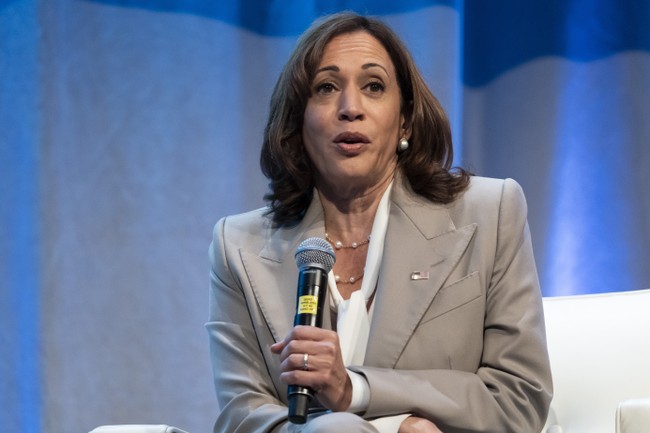
2024-07-31 22:00:00, http://s.wordpress.com/mshots/v1/https%3A%2F%2Ftownhall.com%2Ftipsheet%2Fsaraharnold%2F2024%2F07%2F31%2Fan-alarming-number-of-people-dont-think-kamala-harris-can-beat-trump-n2642792?w=600&h=450, , , , , , https://media.townhall.com/cdn/hodl/2022/203/c1d77403-56bc-4c24-bc40-41f679a9f18d.jpg, Townhall, Townhall is the leading source for conservative news, political cartoons, breaking stories, election analysis and commentary on politics and the media culture. An information hub for conservatives, republicans, libertarians, and liberty-loving Americans., , https://townhall.com/feed, ,
2024-07-31 21:30:00, http://s.wordpress.com/mshots/v1/https%3A%2F%2Ftownhall.com%2Ftipsheet%2Fsaraharnold%2F2024%2F07%2F31%2Fdnc-plans-to-dedicate-entire-first-night-to-boast-about-joe-bidens-accomplishments-n2642788?w=600&h=450, , , , , , https://media.townhall.com/cdn/hodl/2024/196/9339a863-bc67-44c9-9431-165672682815.jpg, Townhall, Townhall is the leading source for conservative news, political cartoons, breaking stories, election analysis and commentary on politics and the media culture. An information hub for conservatives, republicans, libertarians, and liberty-loving Americans., , https://townhall.com/feed, ,
2024-07-31 20:45:00, http://s.wordpress.com/mshots/v1/https%3A%2F%2Ftownhall.com%2Ftipsheet%2Fmadelineleesman%2F2024%2F07%2F31%2Fhouse-managed-phones-will-delete-tiktok-n2642741?w=600&h=450, , , , , , https://media.townhall.com/cdn/hodl/2023/32/08848423-d5a3-4fda-a2e1-efa95fe0833a.png, Townhall, Townhall is the leading source for conservative news, political cartoons, breaking stories, election analysis and commentary on politics and the media culture. An information hub for conservatives, republicans, libertarians, and liberty-loving Americans., , https://townhall.com/feed, ,
2024-07-31 19:45:00, http://s.wordpress.com/mshots/v1/https%3A%2F%2Ftownhall.com%2Ftipsheet%2Frebeccadowns%2F2024%2F07%2F31%2Fjd-vance-continues-to-push-back-against-the-weird-label-n2642795?w=600&h=450, , , , , , https://media.townhall.com/cdn/hodl/2024/197/f3f5fd23-8f24-47f0-ad29-4991c501def8.jpg, Townhall, Townhall is the leading source for conservative news, political cartoons, breaking stories, election analysis and commentary on politics and the media culture. An information hub for conservatives, republicans, libertarians, and liberty-loving Americans., , https://townhall.com/feed, ,
2024-07-31 17:45:00, http://s.wordpress.com/mshots/v1/https%3A%2F%2Ftownhall.com%2Ftipsheet%2Fmattvespa%2F2024%2F07%2F31%2Fincident-involving-kamalas-stepdaughter-n2642785?w=600&h=450, , , , , , https://media.townhall.com/cdn/hodl/2018/297/7e042d2c-ff04-4150-bcba-27c127b18dbd.jpg, Townhall, Townhall is the leading source for conservative news, political cartoons, breaking stories, election analysis and commentary on politics and the media culture. An information hub for conservatives, republicans, libertarians, and liberty-loving Americans., , https://townhall.com/feed, ,
2024-07-31 14:45:00, http://s.wordpress.com/mshots/v1/https%3A%2F%2Ftownhall.com%2Ftipsheet%2Fmadelineleesman%2F2024%2F07%2F31%2Fheres-what-happened-to-illegal-aliens-who-attacked-nypd-cops-n2642772?w=600&h=450, , , , , , https://media.townhall.com/cdn/hodl/2019/228/8b2ad574-fcba-4330-a0fa-030b2be7d04b.png, Townhall, Townhall is the leading source for conservative news, political cartoons, breaking stories, election analysis and commentary on politics and the media culture. An information hub for conservatives, republicans, libertarians, and liberty-loving Americans., , https://townhall.com/feed, ,
2024-07-31 14:15:00, http://s.wordpress.com/mshots/v1/https%3A%2F%2Ftownhall.com%2Ftipsheet%2Frebeccadowns%2F2024%2F07%2F31%2Fgoing-after-wounded-vets-the-weird-campaign-is-really-getting-out-of-hand-n2642756?w=600&h=450, , , , , , https://media.townhall.com/cdn/hodl/2024/201/05b3f33a-2071-4157-ac16-99045b63636c.jpg, Townhall, Townhall is the leading source for conservative news, political cartoons, breaking stories, election analysis and commentary on politics and the media culture. An information hub for conservatives, republicans, libertarians, and liberty-loving Americans., , https://townhall.com/feed, ,
Post-election protests are far from uncommon in Venezuela. In 2018, people took to the streets to contest President Nicolás Maduro’s reelection; they did so again in 2019 when the Venezuelan opposition proclaimed National Assembly representative Juan Guaidó as interim president in defiance of a vote they said was rigged.
It isn’t surprising, then, that there have been widespread demonstrations in the country after Maduro claimed victory again, this time over challenger Edmundo González in the disputed election held July 28, 2024.
Many in the country had viewed the vote as a chance to avoid six more years of “Chavismo” – a political project Maduro inherited from former president and left-wing populist Hugo Chávez. Since 2013, Maduro has led the country while it has faced a severe economic crisis, resulting from a combination of falling oil prices, corruption and mismanagement, and international sanctions. The crisis has resulted in massive inflation and food shortages, with the majority of the population facing the choice of living in poverty or leaving the country.
But the current protests – sparked by the disputed election results but fomented by years of economic crisis – look different. From our analysis of news reports, social media and the protests themselves, it appears they involve a wider segment of society than in the past, and include many poor and working-class Venezuelans – the very groups from which Chavismo has traditionally drawn support.
The big question now is whether this more diverse base of protesters will have any impact, or, as has happened in the past, Maduro will be able to ride out the post-election unrest by using suppressive tactics.
Disputed result
The nature of Maduro’s claimed victory meant that protests were always likely.
The fairness of the elections had been called into question for months leading up to the actual vote due to government interference, such as the disqualification of Maria Corina Machado – the opposition’s de facto leader – and the arrest of campaign workers and activists.
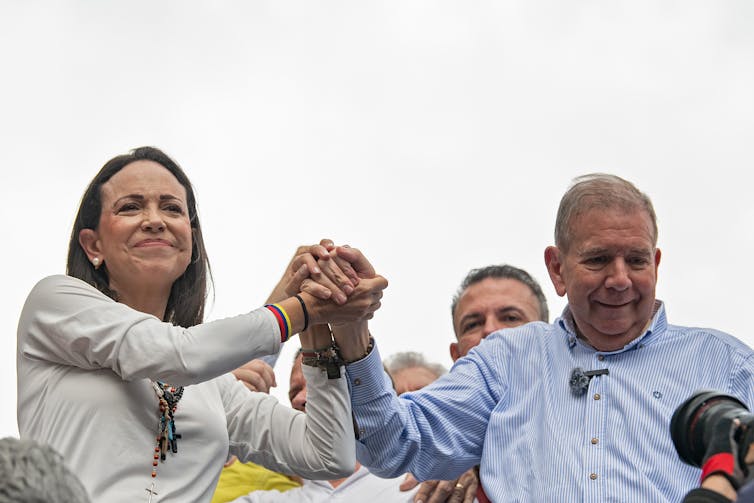
Opposition leader Maria Corina Machado and presidential candidate Edmundo Gonzalez.Alfredo Lasry R/Getty Images
While in the past the opposition has been quick to call for a boycott of the polls, Machado and her replacement candidate, González, remained committed to the electoral path this time.
Venezuela’s Electoral Council released the results shortly after midnight on July 29, indicating that Maduro won with 51.2% of the vote, while González received 44.2%. This contrasted with exit polls and documentation the opposition had collected from around 40% of voting centers that seemed to show González winning with 70% of the vote.
The opposition immediately called the results into question, claiming that they had not been verified. International observers likewise cast doubt on the result’s validity.
The Carter Center, which has provided international observation of elections in Venezuela for years, released a statement saying the presidential election could not be considered democratic, adding that the vote “did not meet international standards of electoral integrity at any of its stages and violated numerous provisions of its own national laws.”
The statement continued that the election had taken place in “an environment of restricted freedoms for political actors, civil society organizations and the media” and that there had been “a clear bias in favor of the incumbent.”
Actions taken by Maduro’s government have further fueled speculations. According to the opposition, on the night of the election, documents used by citizen observers to verify results were not handed over in most voting centers. According to Venezuelan journalist Eugenio Martínez, paper counts were handed over in only half of the country’s 30,026 voting centers.
The government has yet to publish voting tallies that could be used to verify or debunk either side’s claim to victory. Leaders from across the region, including Chilean President Gabriel Boric, the Biden administration and Brazilian President Luiz Inacio Lula da Silva, have since called on Maduro to release the full results.
Pots-and-pans protest
Protests against this lack of transparency began the day after the election and have continued. While such mobilization against the government has become a feature of Chavista Venezuela, the current protests are notable for the range of people coming out onto the streets.
Middle- and upper-class Venezuelans have often turned out en masse hoping to remove Maduro from office, sometimes encouraged by radical opposition voices urging undemocratic means to do so. Such opposition has been fueled by a multiplicity of factors, including the government’s clear turn toward authoritarianism and maneuvers to stay in power that have eroded democratic institutions.
But this round of protests has been characterized by mass participation from low-income and working-class people, too. While protests involving Venezuelans did break out across poorer neighborhoods in 2019, they were smaller and less sustained than the ones seen in recent days.
Videos of residents in low-income areas like Petare, Catia, Valles del Tuy and other historical strongholds of Chavismo have been shared across social media, with residents banging pots, burning tires and marching in the streets.
“Cacerolazos” – a traditional protest practice that involves banging pots and pans together – have even been heard throughout the former Chavista bastion that houses the Cuartel de la Montaña, where the mausoleum of Chávez – who died in office in 2013 – is located.
Elsewhere, statues of Chávez and posters of Maduro have been torn down and pummeled amid the outrage over what is perceived as blatant manipulation that crossed a threshold.
“They went too far” is a refrain that has been heard among protesters since the election.
While media outlets have pointed to protests in the barrios – the term used for urban, low-income neighborhoods in Venezuela – that range from spontaneous to slightly more organized, the government has written off the demonstrations as coordinated events staged by the “fascist right” and funded by the United States.
Offering an alternative
Maduro’s refusal to recognize that people who used to back him are now protesting against him reveals the vast distance that has opened between Venezuela’s Chavista government and its traditional base.
To be sure, protests in low-income neighborhoods should not be conflated with committed support for the opposition. Indeed, for years we’ve observed that people in Venezuela’s barrios distrust and are disillusioned with both the government and the opposition.
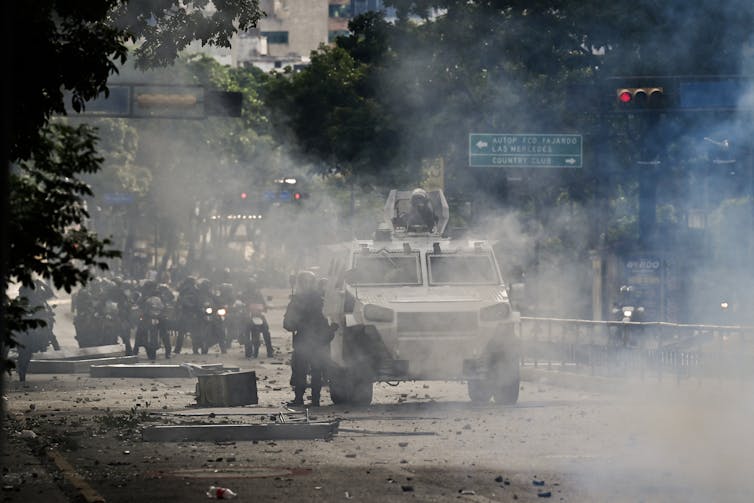
Tear gas is deployed against protesters in Caracas on July 29, 2024.Photo by Raul Arboleda/AFP via Getty Images
But these protests suggest that disgust with the current political system and outrage over suspected electoral fraud are now driving that discontent.
The protests are a response to years of crisis, corruption, fiscal irresponsibility and shortages, all of which have led to families being torn apart. An estimated 7.7 million Venezuelans have left the country to escape these problems. The issues affect everyone in Venezuela, but are particularly devastating for low-income people.
At the same time, many Venezuelans have felt more hopeful due to Machado’s rising popularity. After spending significant time campaigning in rural and working-class communities, she and González seemed to offer an alternative to the current situation.
Maduro’s response
The question now is whether this change in the protesters’ demographics will make a difference.
The Maduro government has signaled that it will remain inflexible in the face of widespread demonstrations, taking whatever actions necessary to stay in power. Still, while unlikely, protests in low-income neighborhoods could convince certain factions within the government that Chavismo has lost the support of the people it claims to represent.
Pressure from within the government, combined with objections from regional leaders, could perhaps influence the political calculations of Maduro.
But past experience points to a different response. After waves of protests in 2017 and 2019, Maduro turned to extreme repression by state security forces and nonstate armed groups – known as “colectivos” – whose members are loyal to the government and have much to lose if there is a regime change. Increasingly, the government has unleashed massive lethal violence in low-income neighborhoods when it has felt threatened. Much of this repression, consisting of police and military raids, has been framed as crime-fighting. But as our research has shown, it is also aimed at tamping down social unrest.
Maduro’s response will likely involve violence against traditional opposition groups that have long mobilized against the government. But we believe poorer Venezuelans, turning out to protest in numbers not seen before, will suffer the most.
2024-07-31 21:46:00, http://s.wordpress.com/mshots/v1/https%3A%2F%2Ftheconversation.com%2Fmassive-protests-erupt-again-over-disputed-venezuelan-elections-but-they-look-different-this-time-235840?w=600&h=450, Post-election protests are far from uncommon in Venezuela. In 2018, people took to the streets to contest President Nicolás Maduro’s reelection; they did so again in 2019 when the Venezuelan opposition proclaimed National Assembly representative Juan Guaidó as interim president in defiance of a vote they said was rigged. It isn’t surprising, then, that there,
Post-election protests are far from uncommon in Venezuela. In 2018, people took to the streets to contest President Nicolás Maduro’s reelection; they did so again in 2019 when the Venezuelan opposition proclaimed National Assembly representative Juan Guaidó as interim president in defiance of a vote they said was rigged.
It isn’t surprising, then, that there have been widespread demonstrations in the country after Maduro claimed victory again, this time over challenger Edmundo González in the disputed election held July 28, 2024.
Many in the country had viewed the vote as a chance to avoid six more years of “Chavismo” – a political project Maduro inherited from former president and left-wing populist Hugo Chávez. Since 2013, Maduro has led the country while it has faced a severe economic crisis, resulting from a combination of falling oil prices, corruption and mismanagement, and international sanctions. The crisis has resulted in massive inflation and food shortages, with the majority of the population facing the choice of living in poverty or leaving the country.
But the current protests – sparked by the disputed election results but fomented by years of economic crisis – look different. From our analysis of news reports, social media and the protests themselves, it appears they involve a wider segment of society than in the past, and include many poor and working-class Venezuelans – the very groups from which Chavismo has traditionally drawn support.
The big question now is whether this more diverse base of protesters will have any impact, or, as has happened in the past, Maduro will be able to ride out the post-election unrest by using suppressive tactics.
Disputed result
The nature of Maduro’s claimed victory meant that protests were always likely.
The fairness of the elections had been called into question for months leading up to the actual vote due to government interference, such as the disqualification of Maria Corina Machado – the opposition’s de facto leader – and the arrest of campaign workers and activists.
Opposition leader Maria Corina Machado and presidential candidate Edmundo Gonzalez.Alfredo Lasry R/Getty Images
While in the past the opposition has been quick to call for a boycott of the polls, Machado and her replacement candidate, González, remained committed to the electoral path this time.
Venezuela’s Electoral Council released the results shortly after midnight on July 29, indicating that Maduro won with 51.2% of the vote, while González received 44.2%. This contrasted with exit polls and documentation the opposition had collected from around 40% of voting centers that seemed to show González winning with 70% of the vote.
The opposition immediately called the results into question, claiming that they had not been verified. International observers likewise cast doubt on the result’s validity.
The Carter Center, which has provided international observation of elections in Venezuela for years, released a statement saying the presidential election could not be considered democratic, adding that the vote “did not meet international standards of electoral integrity at any of its stages and violated numerous provisions of its own national laws.”
The statement continued that the election had taken place in “an environment of restricted freedoms for political actors, civil society organizations and the media” and that there had been “a clear bias in favor of the incumbent.”
Actions taken by Maduro’s government have further fueled speculations. According to the opposition, on the night of the election, documents used by citizen observers to verify results were not handed over in most voting centers. According to Venezuelan journalist Eugenio Martínez, paper counts were handed over in only half of the country’s 30,026 voting centers.
The government has yet to publish voting tallies that could be used to verify or debunk either side’s claim to victory. Leaders from across the region, including Chilean President Gabriel Boric, the Biden administration and Brazilian President Luiz Inacio Lula da Silva, have since called on Maduro to release the full results.
Pots-and-pans protest
Protests against this lack of transparency began the day after the election and have continued. While such mobilization against the government has become a feature of Chavista Venezuela, the current protests are notable for the range of people coming out onto the streets.
Middle- and upper-class Venezuelans have often turned out en masse hoping to remove Maduro from office, sometimes encouraged by radical opposition voices urging undemocratic means to do so. Such opposition has been fueled by a multiplicity of factors, including the government’s clear turn toward authoritarianism and maneuvers to stay in power that have eroded democratic institutions.
But this round of protests has been characterized by mass participation from low-income and working-class people, too. While protests involving Venezuelans did break out across poorer neighborhoods in 2019, they were smaller and less sustained than the ones seen in recent days.
Videos of residents in low-income areas like Petare, Catia, Valles del Tuy and other historical strongholds of Chavismo have been shared across social media, with residents banging pots, burning tires and marching in the streets.
“Cacerolazos” – a traditional protest practice that involves banging pots and pans together – have even been heard throughout the former Chavista bastion that houses the Cuartel de la Montaña, where the mausoleum of Chávez – who died in office in 2013 – is located.
Elsewhere, statues of Chávez and posters of Maduro have been torn down and pummeled amid the outrage over what is perceived as blatant manipulation that crossed a threshold.
“They went too far” is a refrain that has been heard among protesters since the election.
While media outlets have pointed to protests in the barrios – the term used for urban, low-income neighborhoods in Venezuela – that range from spontaneous to slightly more organized, the government has written off the demonstrations as coordinated events staged by the “fascist right” and funded by the United States.
Offering an alternative
Maduro’s refusal to recognize that people who used to back him are now protesting against him reveals the vast distance that has opened between Venezuela’s Chavista government and its traditional base.
To be sure, protests in low-income neighborhoods should not be conflated with committed support for the opposition. Indeed, for years we’ve observed that people in Venezuela’s barrios distrust and are disillusioned with both the government and the opposition.
Tear gas is deployed against protesters in Caracas on July 29, 2024.Photo by Raul Arboleda/AFP via Getty Images
But these protests suggest that disgust with the current political system and outrage over suspected electoral fraud are now driving that discontent.
The protests are a response to years of crisis, corruption, fiscal irresponsibility and shortages, all of which have led to families being torn apart. An estimated 7.7 million Venezuelans have left the country to escape these problems. The issues affect everyone in Venezuela, but are particularly devastating for low-income people.
At the same time, many Venezuelans have felt more hopeful due to Machado’s rising popularity. After spending significant time campaigning in rural and working-class communities, she and González seemed to offer an alternative to the current situation.
Maduro’s response
The question now is whether this change in the protesters’ demographics will make a difference.
The Maduro government has signaled that it will remain inflexible in the face of widespread demonstrations, taking whatever actions necessary to stay in power. Still, while unlikely, protests in low-income neighborhoods could convince certain factions within the government that Chavismo has lost the support of the people it claims to represent.
Pressure from within the government, combined with objections from regional leaders, could perhaps influence the political calculations of Maduro.
But past experience points to a different response. After waves of protests in 2017 and 2019, Maduro turned to extreme repression by state security forces and nonstate armed groups – known as “colectivos” – whose members are loyal to the government and have much to lose if there is a regime change. Increasingly, the government has unleashed massive lethal violence in low-income neighborhoods when it has felt threatened. Much of this repression, consisting of police and military raids, has been framed as crime-fighting. But as our research has shown, it is also aimed at tamping down social unrest.
Maduro’s response will likely involve violence against traditional opposition groups that have long mobilized against the government. But we believe poorer Venezuelans, turning out to protest in numbers not seen before, will suffer the most.
, Post-election protests are far from uncommon in Venezuela. In 2018, people took to the streets to contest President Nicolás Maduro’s reelection; they did so again in 2019 when the Venezuelan opposition proclaimed National Assembly representative Juan Guaidó as interim president in defiance of a vote they said was rigged. It isn’t surprising, then, that there have been widespread demonstrations in the country after Maduro claimed victory again, this time over challenger Edmundo González in the disputed election held July 28, 2024. Many in the country had viewed the vote as a chance to avoid six more years of “Chavismo” – a political project Maduro inherited from former president and left-wing populist Hugo Chávez. Since 2013, Maduro has led the country while it has faced a severe economic crisis, resulting from a combination of falling oil prices, corruption and mismanagement, and international sanctions. The crisis has resulted in massive inflation and food shortages, with the majority of the population facing the choice of living in poverty or leaving the country. But the current protests – sparked by the disputed election results but fomented by years of economic crisis – look different. From our analysis of news reports, social media and the protests themselves, it appears they involve a wider segment of society than in the past, and include many poor and working-class Venezuelans – the very groups from which Chavismo has traditionally drawn support. The big question now is whether this more diverse base of protesters will have any impact, or, as has happened in the past, Maduro will be able to ride out the post-election unrest by using suppressive tactics. Disputed result The nature of Maduro’s claimed victory meant that protests were always likely. The fairness of the elections had been called into question for months leading up to the actual vote due to government interference, such as the disqualification of Maria Corina Machado – the opposition’s de facto leader – and the arrest of campaign workers and activists. Opposition leader Maria Corina Machado and presidential candidate Edmundo Gonzalez. Alfredo Lasry R/Getty Images While in the past the opposition has been quick to call for a boycott of the polls, Machado and her replacement candidate, González, remained committed to the electoral path this time. Venezuela’s Electoral Council released the results shortly after midnight on July 29, indicating that Maduro won with 51.2% of the vote, while González received 44.2%. This contrasted with exit polls and documentation the opposition had collected from around 40% of voting centers that seemed to show González winning with 70% of the vote. The opposition immediately called the results into question, claiming that they had not been verified. International observers likewise cast doubt on the result’s validity. The Carter Center, which has provided international observation of elections in Venezuela for years, released a statement saying the presidential election could not be considered democratic, adding that the vote “did not meet international standards of electoral integrity at any of its stages and violated numerous provisions of its own national laws.” The statement continued that the election had taken place in “an environment of restricted freedoms for political actors, civil society organizations and the media” and that there had been “a clear bias in favor of the incumbent.” Actions taken by Maduro’s government have further fueled speculations. According to the opposition, on the night of the election, documents used by citizen observers to verify results were not handed over in most voting centers. According to Venezuelan journalist Eugenio Martínez, paper counts were handed over in only half of the country’s 30,026 voting centers. The government has yet to publish voting tallies that could be used to verify or debunk either side’s claim to victory. Leaders from across the region, including Chilean President Gabriel Boric, the Biden administration and Brazilian President Luiz Inacio Lula da Silva, have since called on Maduro to release the full results. Pots-and-pans protest Protests against this lack of transparency began the day after the election and have continued. While such mobilization against the government has become a feature of Chavista Venezuela, the current protests are notable for the range of people coming out onto the streets. Middle- and upper-class Venezuelans have often turned out en masse hoping to remove Maduro from office, sometimes encouraged by radical opposition voices urging undemocratic means to do so. Such opposition has been fueled by a multiplicity of factors, including the government’s clear turn toward authoritarianism and maneuvers to stay in power that have eroded democratic institutions. But this round of protests has been characterized by mass participation from low-income and working-class people, too. While protests involving Venezuelans did break out across poorer neighborhoods in 2019, they were smaller and less sustained than the ones seen in recent days. Videos of residents in low-income areas like Petare, Catia, Valles del Tuy and other historical strongholds of Chavismo have been shared across social media, with residents banging pots, burning tires and marching in the streets. “Cacerolazos” – a traditional protest practice that involves banging pots and pans together – have even been heard throughout the former Chavista bastion that houses the Cuartel de la Montaña, where the mausoleum of Chávez – who died in office in 2013 – is located. Elsewhere, statues of Chávez and posters of Maduro have been torn down and pummeled amid the outrage over what is perceived as blatant manipulation that crossed a threshold. “They went too far” is a refrain that has been heard among protesters since the election. While media outlets have pointed to protests in the barrios – the term used for urban, low-income neighborhoods in Venezuela – that range from spontaneous to slightly more organized, the government has written off the demonstrations as coordinated events staged by the “fascist right” and funded by the United States. Offering an alternative Maduro’s refusal to recognize that people who used to back him are now protesting against him reveals the vast distance that has opened between Venezuela’s Chavista government and its traditional base. To be sure, protests in low-income neighborhoods should not be conflated with committed support for the opposition. Indeed, for years we’ve observed that people in Venezuela’s barrios distrust and are disillusioned with both the government and the opposition. Tear gas is deployed against protesters in Caracas on July 29, 2024. Photo by Raul Arboleda/AFP via Getty Images But these protests suggest that disgust with the current political system and outrage over suspected electoral fraud are now driving that discontent. The protests are a response to years of crisis, corruption, fiscal irresponsibility and shortages, all of which have led to families being torn apart. An estimated 7.7 million Venezuelans have left the country to escape these problems. The issues affect everyone in Venezuela, but are particularly devastating for low-income people. At the same time, many Venezuelans have felt more hopeful due to Machado’s rising popularity. After spending significant time campaigning in rural and working-class communities, she and González seemed to offer an alternative to the current situation. Maduro’s response The question now is whether this change in the protesters’ demographics will make a difference. The Maduro government has signaled that it will remain inflexible in the face of widespread demonstrations, taking whatever actions necessary to stay in power. Still, while unlikely, protests in low-income neighborhoods could convince certain factions within the government that Chavismo has lost the support of the people it claims to represent. Pressure from within the government, combined with objections from regional leaders, could perhaps influence the political calculations of Maduro. But past experience points to a different response. After waves of protests in 2017 and 2019, Maduro turned to extreme repression by state security forces and nonstate armed groups – known as “colectivos” – whose members are loyal to the government and have much to lose if there is a regime change. Increasingly, the government has unleashed massive lethal violence in low-income neighborhoods when it has felt threatened. Much of this repression, consisting of police and military raids, has been framed as crime-fighting. But as our research has shown, it is also aimed at tamping down social unrest. Maduro’s response will likely involve violence against traditional opposition groups that have long mobilized against the government. But we believe poorer Venezuelans, turning out to protest in numbers not seen before, will suffer the most., , , https://images.theconversation.com/files/610659/original/file-20240731-18-v35nfa.jpg?ixlib=rb-4.1.0&rect=16%2C306%2C5493%2C2746&q=45&auto=format&w=1356&h=668&fit=crop, Politics + Society – The Conversation, , , https://theconversation.com/us/politics/articles.atom, Rebecca Hanson, Assistant Professor of Latin American Studies, Sociology and Criminology, University of Florida,
Israel’s apparent assassinations of Fuad Shukr, Hezbollah’s top military leader, in Beirut, and Hamas political leader Ismail Haniyeh, in Tehran, have raised again the specter of a regional war involving regional adversaries – one that could potentially drag the United States into the fray.
By targeting these two leaders, the Israeli government has demonstrated that it is willing to risk an escalation of conflict into new fronts. This comes despite some senior defense chiefs sending, at best, conflicting messages in recent months over whether the Israeli Defense Forces are adequately prepared, after nine months of confrontation in Gaza, for a full-scale war in Lebanon or elsewhere.
As a scholar of Lebanon and Israel, I have followed the recent events in the region with growing concern. Israeli Prime Minister Benjamin Netanyahu may be betting that Iran and Hezbollah have no real appetite for full-scale war and would rather continue a policy of continued attrition against Israel.
If so, it is a risky strategy, and any miscalculation could be catastrophic.
Raising the ante
Shukr was assassinated as part of the tit-for-tat exchanges between Israel and Hezbollah that have been going on since Oct. 8, the day after Hamas terrorists attacked Israel, prompting the heavy and ongoing response in Gaza. In particular, it was in retaliation for the killing of 12 children on July 28, 2024, in the Israeli-controlled Golan Heights, blamed on Hezbollah.
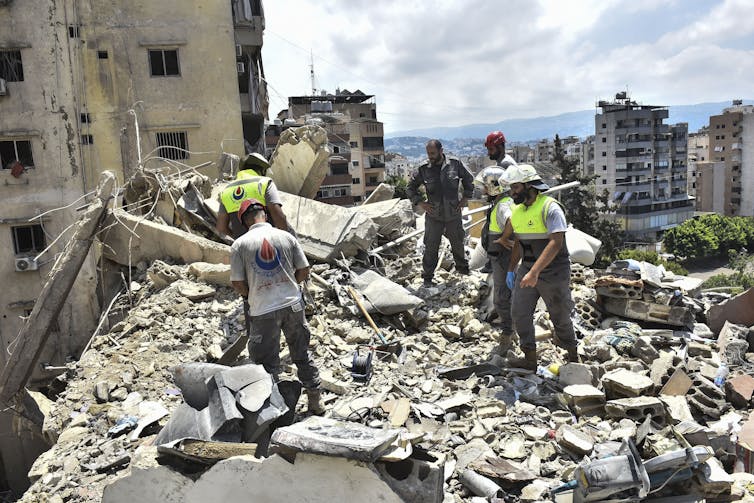
The aftermath of an airstrike in Beirut, Lebanon, on July 31, 2024.Fadel Itani/NurPhoto via Getty Images
The Beirut killing was a bold and risky move by Israel, carried out in broad daylight in the city despite repeated requests by the U.S. and other Western countries not to target Lebanon’s capital.
In carrying through with the Beirut operation, Israel has pushed the limits of the “rules of the game” in its post-Oct. 7 war of attrition with Hezbollah. Until now, the Lebanese capital was targeted only once by Israel with the Jan. 2, 2024, assassination of Saleh Arouri, another Hamas leader, not far from where Shukr was killed.
Back then, it was assumed that Hezbollah would not escalate the conflict for the sake of the death of a Palestinian leader, important as he may have been.
But there is little doubt that Hezbollah will respond to this new attack; the questions are how and when, and whether its response will bring the adversaries another step closer to a full war.
An embarrassment to Iran
The assassination of Haniyeh in Tehran was done in the context of Israel’s declared commitment to kill all Hamas leaders involved in the Oct. 7 massacre, although the country has not officially claimed responsibility for the strike, as is its usual practice.
Israel reportedly guaranteed Qatar, Haniyeh’s host country, that it would not target Hamas leaders within its borders. Israel also chose not to kill him during Haniyeh’s recent visit to Turkey, potentially out of concern of further alienating Turkish President Recep Tayyip Erdoğan.
Instead, it appears Israel waited for the right opportunity at a different spot that would send a clear message, not only to Hamas but more broadly to Israel’s main regional adversary, and Hamas’ main sponsor, Iran.
Haniyeh’s killing in Tehran puts the Iranian regime in an embarrassing position. The strike by a foreign country openly violated Iran’s sovereignty at the time when the regime was preparing to celebrate the appointment of a new president. The Hamas chief was among international dignitaries invited to the inauguration.
The attack demonstrates two things: Iran’s vulnerability and Israel’s ability to carry out an attack based on precise intelligence and superior technology. Either way, it exposes the Iranian regime’s weaknesses.
The last time Iran claimed its sovereignty was violated by Israel – during the April 1, 2024, attack on its embassy in Damascus – it responded by launching hundreds of missiles and attack drones against Israel.
Iran could use its proxies, including Hezbollah, this time around, or it could respond directly, using its own military from its own territory, as it did in April. On July 31, it was reported that Iran’s supreme leader, Ayatollah Ali Khamenei, had ordered a direct strike.
Israel’s domestic fissures
The assassinations have, I presume, closed the door on chances of any cease-fire agreement in Gaza, including the release of Israeli hostages, any time soon.
The killings likely also make the war of attrition between Israel and Hezbollah more volatile and riskier.
All parties, including Israel, are seemingly aware that full-scale war is not in anyone’s interests, which would explain why that level of escalation hasn’t been seen, despite months of provocation by all involved.
But at the same time, the region inches toward that possibility; the Middle East is in a moment of extreme fragility.
And all of this is happening while, domestically, Israel is facing major challenges to its political system and the rule of law. The war in Gaza has brought to the fore forces within Israeli society that are openly seeking to change its political system and challenge both the command structure and combat culture of the military.
A recent mob attack, led by far-right Knesset members, on military police investigating charges of torture and sexual assault of Hamas prisoners in Israel is only one example of the fissures developing within the Jewish-Israeli society.
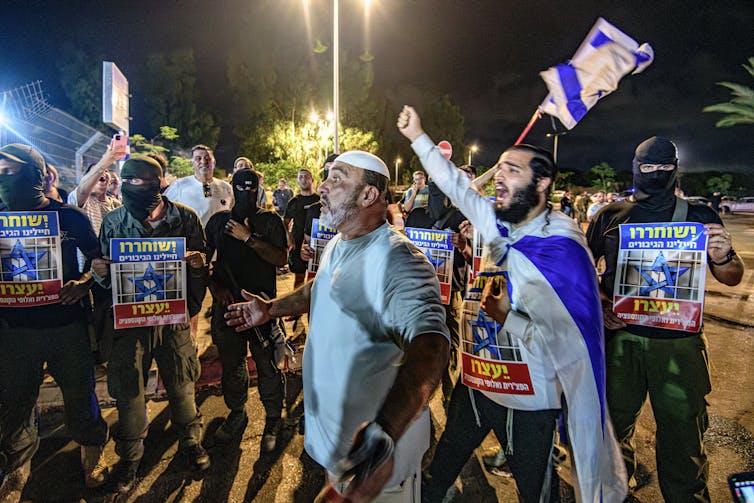
Right-wing Israeli activists protest the detention of nine military reservists accused of sexual abuse of detainees.Matan Golan/SOPA Images/LightRocket via Getty Images
Toward full war?
Netanyahu, who critics say is mainly motivated by his desire to remain in power, has built his career by capitalizing on internal cleavages. His dependency on far-right members of his government, coupled with his exploitation of internal tensions within Israel, have only exacerbated the divisions.
His decision to authorize the assassinations in Beirut and Iran should be understood in the context of his fight for his political survival.
I believe all Netanyahu’s actions, including the prolonging of the war in Gaza, should be understood in this context. His political survival is reliant on the support of far-right parties that seek the continuation and expansion of the war and who have been openly calling for a more aggressive posture in regards to Hezbollah and Iran.
He is also buttressed by public opinion in Israel that supports confronting Hezbollah in “full force,” without taking into account the fact that such an action would likely be devastating for Hezbollah and Lebanon and would take an enormous human and infrastructural toll on Israel.
Netanyahu may be counting on the fact that so far Iran and Hezbollah have not shown an appetite for a full war, despite the fact that Hezbollah has said it is prepared for it.
So far, Israel also has not shown an appetite for a full war on multiple fronts. But I fear events such as the assassinations in recent days may lead us to a downward spiral that would be difficult to control.
2024-07-31 21:01:00, http://s.wordpress.com/mshots/v1/https%3A%2F%2Ftheconversation.com%2Fwith-hezbollah-and-hamas-assassinations-netanyahu-shows-willingness-to-risk-regional-war-for-political-survival-235846?w=600&h=450, Israel’s apparent assassinations of Fuad Shukr, Hezbollah’s top military leader, in Beirut, and Hamas political leader Ismail Haniyeh, in Tehran, have raised again the specter of a regional war involving regional adversaries – one that could potentially drag the United States into the fray. By targeting these two leaders, the Israeli government has demonstrated that,
Israel’s apparent assassinations of Fuad Shukr, Hezbollah’s top military leader, in Beirut, and Hamas political leader Ismail Haniyeh, in Tehran, have raised again the specter of a regional war involving regional adversaries – one that could potentially drag the United States into the fray.
By targeting these two leaders, the Israeli government has demonstrated that it is willing to risk an escalation of conflict into new fronts. This comes despite some senior defense chiefs sending, at best, conflicting messages in recent months over whether the Israeli Defense Forces are adequately prepared, after nine months of confrontation in Gaza, for a full-scale war in Lebanon or elsewhere.
As a scholar of Lebanon and Israel, I have followed the recent events in the region with growing concern. Israeli Prime Minister Benjamin Netanyahu may be betting that Iran and Hezbollah have no real appetite for full-scale war and would rather continue a policy of continued attrition against Israel.
If so, it is a risky strategy, and any miscalculation could be catastrophic.
Raising the ante
Shukr was assassinated as part of the tit-for-tat exchanges between Israel and Hezbollah that have been going on since Oct. 8, the day after Hamas terrorists attacked Israel, prompting the heavy and ongoing response in Gaza. In particular, it was in retaliation for the killing of 12 children on July 28, 2024, in the Israeli-controlled Golan Heights, blamed on Hezbollah.
The aftermath of an airstrike in Beirut, Lebanon, on July 31, 2024.Fadel Itani/NurPhoto via Getty Images
The Beirut killing was a bold and risky move by Israel, carried out in broad daylight in the city despite repeated requests by the U.S. and other Western countries not to target Lebanon’s capital.
In carrying through with the Beirut operation, Israel has pushed the limits of the “rules of the game” in its post-Oct. 7 war of attrition with Hezbollah. Until now, the Lebanese capital was targeted only once by Israel with the Jan. 2, 2024, assassination of Saleh Arouri, another Hamas leader, not far from where Shukr was killed.
Back then, it was assumed that Hezbollah would not escalate the conflict for the sake of the death of a Palestinian leader, important as he may have been.
But there is little doubt that Hezbollah will respond to this new attack; the questions are how and when, and whether its response will bring the adversaries another step closer to a full war.
An embarrassment to Iran
The assassination of Haniyeh in Tehran was done in the context of Israel’s declared commitment to kill all Hamas leaders involved in the Oct. 7 massacre, although the country has not officially claimed responsibility for the strike, as is its usual practice.
Israel reportedly guaranteed Qatar, Haniyeh’s host country, that it would not target Hamas leaders within its borders. Israel also chose not to kill him during Haniyeh’s recent visit to Turkey, potentially out of concern of further alienating Turkish President Recep Tayyip Erdoğan.
Instead, it appears Israel waited for the right opportunity at a different spot that would send a clear message, not only to Hamas but more broadly to Israel’s main regional adversary, and Hamas’ main sponsor, Iran.
Haniyeh’s killing in Tehran puts the Iranian regime in an embarrassing position. The strike by a foreign country openly violated Iran’s sovereignty at the time when the regime was preparing to celebrate the appointment of a new president. The Hamas chief was among international dignitaries invited to the inauguration.
The attack demonstrates two things: Iran’s vulnerability and Israel’s ability to carry out an attack based on precise intelligence and superior technology. Either way, it exposes the Iranian regime’s weaknesses.
The last time Iran claimed its sovereignty was violated by Israel – during the April 1, 2024, attack on its embassy in Damascus – it responded by launching hundreds of missiles and attack drones against Israel.
Iran could use its proxies, including Hezbollah, this time around, or it could respond directly, using its own military from its own territory, as it did in April. On July 31, it was reported that Iran’s supreme leader, Ayatollah Ali Khamenei, had ordered a direct strike.
Israel’s domestic fissures
The assassinations have, I presume, closed the door on chances of any cease-fire agreement in Gaza, including the release of Israeli hostages, any time soon.
The killings likely also make the war of attrition between Israel and Hezbollah more volatile and riskier.
All parties, including Israel, are seemingly aware that full-scale war is not in anyone’s interests, which would explain why that level of escalation hasn’t been seen, despite months of provocation by all involved.
But at the same time, the region inches toward that possibility; the Middle East is in a moment of extreme fragility.
And all of this is happening while, domestically, Israel is facing major challenges to its political system and the rule of law. The war in Gaza has brought to the fore forces within Israeli society that are openly seeking to change its political system and challenge both the command structure and combat culture of the military.
A recent mob attack, led by far-right Knesset members, on military police investigating charges of torture and sexual assault of Hamas prisoners in Israel is only one example of the fissures developing within the Jewish-Israeli society.
Right-wing Israeli activists protest the detention of nine military reservists accused of sexual abuse of detainees.Matan Golan/SOPA Images/LightRocket via Getty Images
Toward full war?
Netanyahu, who critics say is mainly motivated by his desire to remain in power, has built his career by capitalizing on internal cleavages. His dependency on far-right members of his government, coupled with his exploitation of internal tensions within Israel, have only exacerbated the divisions.
His decision to authorize the assassinations in Beirut and Iran should be understood in the context of his fight for his political survival.
I believe all Netanyahu’s actions, including the prolonging of the war in Gaza, should be understood in this context. His political survival is reliant on the support of far-right parties that seek the continuation and expansion of the war and who have been openly calling for a more aggressive posture in regards to Hezbollah and Iran.
He is also buttressed by public opinion in Israel that supports confronting Hezbollah in “full force,” without taking into account the fact that such an action would likely be devastating for Hezbollah and Lebanon and would take an enormous human and infrastructural toll on Israel.
Netanyahu may be counting on the fact that so far Iran and Hezbollah have not shown an appetite for a full war, despite the fact that Hezbollah has said it is prepared for it.
So far, Israel also has not shown an appetite for a full war on multiple fronts. But I fear events such as the assassinations in recent days may lead us to a downward spiral that would be difficult to control.
, Israel’s apparent assassinations of Fuad Shukr, Hezbollah’s top military leader, in Beirut, and Hamas political leader Ismail Haniyeh, in Tehran, have raised again the specter of a regional war involving regional adversaries – one that could potentially drag the United States into the fray. By targeting these two leaders, the Israeli government has demonstrated that it is willing to risk an escalation of conflict into new fronts. This comes despite some senior defense chiefs sending, at best, conflicting messages in recent months over whether the Israeli Defense Forces are adequately prepared, after nine months of confrontation in Gaza, for a full-scale war in Lebanon or elsewhere. As a scholar of Lebanon and Israel, I have followed the recent events in the region with growing concern. Israeli Prime Minister Benjamin Netanyahu may be betting that Iran and Hezbollah have no real appetite for full-scale war and would rather continue a policy of continued attrition against Israel. If so, it is a risky strategy, and any miscalculation could be catastrophic. Raising the ante Shukr was assassinated as part of the tit-for-tat exchanges between Israel and Hezbollah that have been going on since Oct. 8, the day after Hamas terrorists attacked Israel, prompting the heavy and ongoing response in Gaza. In particular, it was in retaliation for the killing of 12 children on July 28, 2024, in the Israeli-controlled Golan Heights, blamed on Hezbollah. The aftermath of an airstrike in Beirut, Lebanon, on July 31, 2024. Fadel Itani/NurPhoto via Getty Images The Beirut killing was a bold and risky move by Israel, carried out in broad daylight in the city despite repeated requests by the U.S. and other Western countries not to target Lebanon’s capital. In carrying through with the Beirut operation, Israel has pushed the limits of the “rules of the game” in its post-Oct. 7 war of attrition with Hezbollah. Until now, the Lebanese capital was targeted only once by Israel with the Jan. 2, 2024, assassination of Saleh Arouri, another Hamas leader, not far from where Shukr was killed. Back then, it was assumed that Hezbollah would not escalate the conflict for the sake of the death of a Palestinian leader, important as he may have been. But there is little doubt that Hezbollah will respond to this new attack; the questions are how and when, and whether its response will bring the adversaries another step closer to a full war. An embarrassment to Iran The assassination of Haniyeh in Tehran was done in the context of Israel’s declared commitment to kill all Hamas leaders involved in the Oct. 7 massacre, although the country has not officially claimed responsibility for the strike, as is its usual practice. Israel reportedly guaranteed Qatar, Haniyeh’s host country, that it would not target Hamas leaders within its borders. Israel also chose not to kill him during Haniyeh’s recent visit to Turkey, potentially out of concern of further alienating Turkish President Recep Tayyip Erdoğan. Instead, it appears Israel waited for the right opportunity at a different spot that would send a clear message, not only to Hamas but more broadly to Israel’s main regional adversary, and Hamas’ main sponsor, Iran. Haniyeh’s killing in Tehran puts the Iranian regime in an embarrassing position. The strike by a foreign country openly violated Iran’s sovereignty at the time when the regime was preparing to celebrate the appointment of a new president. The Hamas chief was among international dignitaries invited to the inauguration. The attack demonstrates two things: Iran’s vulnerability and Israel’s ability to carry out an attack based on precise intelligence and superior technology. Either way, it exposes the Iranian regime’s weaknesses. The last time Iran claimed its sovereignty was violated by Israel – during the April 1, 2024, attack on its embassy in Damascus – it responded by launching hundreds of missiles and attack drones against Israel. Iran could use its proxies, including Hezbollah, this time around, or it could respond directly, using its own military from its own territory, as it did in April. On July 31, it was reported that Iran’s supreme leader, Ayatollah Ali Khamenei, had ordered a direct strike. Israel’s domestic fissures The assassinations have, I presume, closed the door on chances of any cease-fire agreement in Gaza, including the release of Israeli hostages, any time soon. The killings likely also make the war of attrition between Israel and Hezbollah more volatile and riskier. All parties, including Israel, are seemingly aware that full-scale war is not in anyone’s interests, which would explain why that level of escalation hasn’t been seen, despite months of provocation by all involved. But at the same time, the region inches toward that possibility; the Middle East is in a moment of extreme fragility. And all of this is happening while, domestically, Israel is facing major challenges to its political system and the rule of law. The war in Gaza has brought to the fore forces within Israeli society that are openly seeking to change its political system and challenge both the command structure and combat culture of the military. A recent mob attack, led by far-right Knesset members, on military police investigating charges of torture and sexual assault of Hamas prisoners in Israel is only one example of the fissures developing within the Jewish-Israeli society. Right-wing Israeli activists protest the detention of nine military reservists accused of sexual abuse of detainees. Matan Golan/SOPA Images/LightRocket via Getty Images Toward full war? Netanyahu, who critics say is mainly motivated by his desire to remain in power, has built his career by capitalizing on internal cleavages. His dependency on far-right members of his government, coupled with his exploitation of internal tensions within Israel, have only exacerbated the divisions. His decision to authorize the assassinations in Beirut and Iran should be understood in the context of his fight for his political survival. I believe all Netanyahu’s actions, including the prolonging of the war in Gaza, should be understood in this context. His political survival is reliant on the support of far-right parties that seek the continuation and expansion of the war and who have been openly calling for a more aggressive posture in regards to Hezbollah and Iran. He is also buttressed by public opinion in Israel that supports confronting Hezbollah in “full force,” without taking into account the fact that such an action would likely be devastating for Hezbollah and Lebanon and would take an enormous human and infrastructural toll on Israel. Netanyahu may be counting on the fact that so far Iran and Hezbollah have not shown an appetite for a full war, despite the fact that Hezbollah has said it is prepared for it. So far, Israel also has not shown an appetite for a full war on multiple fronts. But I fear events such as the assassinations in recent days may lead us to a downward spiral that would be difficult to control., , , https://images.theconversation.com/files/610649/original/file-20240731-20-c0039d.jpg?ixlib=rb-4.1.0&rect=0%2C565%2C6274%2C3137&q=45&auto=format&w=1356&h=668&fit=crop, Politics + Society – The Conversation, , , https://theconversation.com/us/politics/articles.atom, Asher Kaufman, Professor of History and Peace Studies, University of Notre Dame,
 , https://media.townhall.com/cdn/hodl/2022/203/c1d77403-56bc-4c24-bc40-41f679a9f18d.jpg, Townhall, Townhall is the leading source for conservative news, political cartoons, breaking stories, election analysis and commentary on politics and the media culture. An information hub for conservatives, republicans, libertarians, and liberty-loving Americans., , https://townhall.com/feed, ,