President Biden argued that his disastrous debate performance actually converted more voters to his side than former President Trump.
Biden made the claim while surrounded by donors during a Saturday fundraiser at the home of New Jersey Gov. Phil Murphy. The president reportedly acknowledged that his performance at the debate left much to be desired, but he argued that polling was on his side.
“I didn’t have a great night, but I’m going to be fighting harder,” Biden told the several dozen people at the party, according to NJ.com.
“Research during the debate shows us converting more undecided voters than Trump did, in large part because of his conduct on Jan. 6,” he added. “People remember the bad things during his presidency.”
Biden’s attempt to spin his embarrassing Thursday night performance comes after multiple major newspapers called on him to drop out of the race. The New York Times editorial board argued that him staying in the race would be a “reckless gamble.” The Atlanta Journal-Constitution editorial board made a similar argument, calling on Biden to drop out “for the good of the nation.”
So far, the formal pressure on Biden to drop out has all been external, however. Top Democrats in Congress and across the country remain publicly supportive of his presidential bid, despite rumblings of internal panic.
Democratic National Committee (DNC) Chairman Jaime Harrison attempted to put rumors of Biden’s replacement to bed on Saturday.
Harrison told MSNBC host Al Sharpton that the people are still strongly supporting President Biden, saying that the “hand-wringing” is coming from the media.
“You hear the hand-wringing coming from pundits, Rev, and from op-eds like the New York Times, but you don’t hear from the people,” he said.
“What I have seen is that galvanization, particularly in the Black community,” he said. “I’m a Black man. I’ve seen the galvanization of support for Joe Biden because, you know, in the Black community, in your family, you can say all that you want to say about a member of your family, but don’t let somebody else.”
The DNC chairman said that people have Biden’s back because he has “always had our back.”
“That’s what I’ve seen in terms of support of Joe Biden, because for us, Joe Biden has always had our back, and we’re going to have his,” he said.
Fox News’ Sarah Rumpf-Whitten contributed to this report.
WASHINGTON, D.C. — Former Hawaii Rep. Tulsi Gabbard has become a fixture among conservatives since dumping the Democrat Party two years ago to become an independent.
The outspoken critic of President Biden and her former party is now rumored to be on former President Trump’s running mate shortlist — albeit as a long shot — something she hasn’t shied away from as discussions about the best choice for Republicans to reel in undecided and moderate voters ramp up ahead of the Republican National Convention (RNC) next month.
Fox News Digital caught up with Gabbard, who said in May she’d be “honored” to join Trump on the Republican ticket, during a recent trip to Washington, D.C., where she shared what she viewed as the required qualities for any individual hoping to be picked by the former president.
“In order to win, you have to be able to bring in people who may not already be with you or already be a part of your support base. This is important, not only for the election, to be able to bring in our fellow Americans,” Gabbard said.
“It is also important to do the tough work that will follow should President Trump win, to be able to actually root out the rot of corruption that exists within permanent Washington, to root out the deep state, root out those who believe that their function in government is more important than the people of this country,” she said.
“We’ve got to flip it on its head and remind people that we should have a limited government that exists to serve the people, not the other way around.”
Those who have mentioned Gabbard as a potential option for Trump point to what could be her ability to attract moderates and independents given her more liberal views on certain social positions, as well as her views on how the Democrat Party has become more radical over time.
Gabbard left the party in 2022, stating, “I can no longer remain in today’s Democratic Party that is now under the complete control of an elitist cabal of warmongers driven by cowardly wokeness, who divide us by racializing every issue & stoke anti-white racism.”
She detailed her thought process behind the decision in a book she published earlier this year, “For Love Of Country: Leave the Democrat Party Behind.”
“When I announced I was leaving the Democratic Party, I got a flood of messages and emails and notes and DMs from people who, as you just pointed out, felt the same way that I did,” Gabbard told Fox when asked about her book’s message.
“I saw the opportunity to be able to actually go into more detail, not only on the reasons why I left the Democratic Party, but the experiences that I’ve had that brought me to that decision to leave the party that I was associated with for over 20 years, recognizing that that may help others who are struggling through their political decision, both about whether or not they want to be associated with the party or leave the Democratic Party, but also really critically, how they will vote in this election.”
Gabbard said her book was “a very direct call to action” because of what the party had become.
It’s unclear when exactly Trump might announce his running mate, but he suggested last month he may make the announcement at the RNC in Milwaukee next month. He told Fox News last week he had decided who it was going to be, before later stating his pick would be in attendance at his first debate against Biden, which was held Thursday in Atlanta.
Those on the shortlist who joined Trump in Atlanta included Florida Sen. Marco Rubio, Ohio Sen. JD Vance, North Dakota Gov. Doug Burgum and New York Rep. Elise Stefanik. However, Gabbard was notably not present.
People will likely want to have a conversation about what the country saw on the presidential debate stage Thursday night, one Democratic congressman predicted after President Biden’s decidedly weak performance.
“That’s a question that people will, I’m sure, want to talk about,” Rep. Joe Morelle, D-N.Y., replied when asked by Fox News Digital whether he believed that Biden should be the Democratic nominee for president.
“But like I said, this is one night. I’m not going to judge the president’s performance based on one night,” he added.
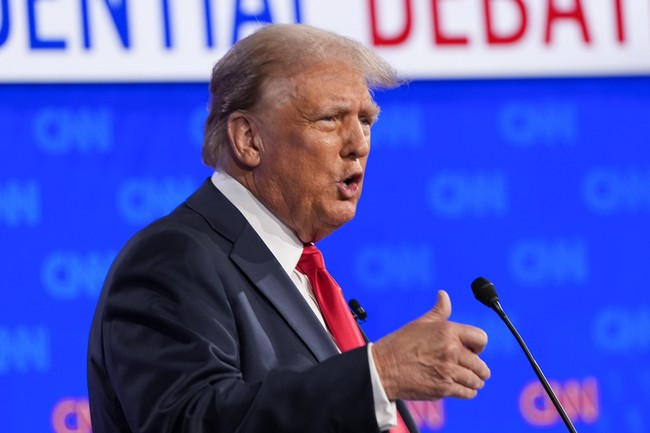
Reports quickly emerged, even before the Thursday night debate had ended, alleging Democratic panic taking place about Biden and his ability to take on former President Trump in the November election. A hoarse Biden took the stage in Atlanta for the debate and came across as soft-spoken and at times confused. The performance was concerning enough that analysts on CNN and MSNBC agreed that Biden had done poorly.
“No matter who you are as a lead performer, whether you’re a basketball player or you’re an opera singer, you can have a bad night,” Morelle explained. “So I’m going to chalk this up to him having a bad night.”
The Democrat’s acknowledgment that some may want to discuss Biden’s status on the ticket and potential alternate nominees comes as several other Democratic members of Congress were unwilling to say what they thought the president should do.
When asked by Fox News Digital, multiple vulnerable Democrats in swing districts avoided answering if they believed Biden should remain on the ticket.
However, a number of Democrats, including surrogates for Biden’s campaign, said they still support the president as the party’s nominee, even after the debate.
Rep. Debbie Dingell, D-Mich., said, “I’m not gonna sugarcoat it.It wasn’t Joe Biden, you know, the best. But I’m going to tell you, Donald Trump reinforced all the concerns that I’ve had.”
Asked about whether he should still be the nominee, she said, “You know what? I’m not going to be part of all the hand-wringing in Washington. I know the kind of person I want to see in the presidency.”
Despite concerns swirling about Biden following the debate, his campaign was clear on Friday, with spokesperson Seth Schuster telling Fox News Digital, “Of course he’s not dropping out.”
“I know I’m not a young man … I don’t debate as well as I used to,” Biden said at a campaign appearance in North Carolina. “But I know what I do know: I know how to tell the truth.”
The New Yorker magazine has joined other major publications in calling for President Biden to step aside after its editor said watching Biden perform during Thursday’s debate was an “agonizing experience.”
The New Yorker is now the third publication, alongside The New York Times and the Atlanta Journal-Constitution, to call upon Biden to step-aside for a younger Democratic nominee.
“We have long known that Biden, no matter what issue you might take with one policy or another, is no longer a fluid or effective communicator of those policies,” The New Yorker’s editor, David Remnick, wrote.
“Asked about his decline, the Biden communications team and his understandably protective surrogates and advisers would deliver responses to journalists that sounded an awful lot like what we all, sooner or later, tell acquaintances when asked about aging parents: they have good days and bad days,” he wrote.
Remnick wrote that watching Biden “wander into senselessness” moved observers to “pity” and “fear for the country.”
“Watching Thursday’s debate, observing Biden wander into senselessness onstage, was an agonizing experience, and it is bound to obliterate forever all those vague and qualified descriptions from White House insiders about good days and bad days,” he said.
“You watched it, and, on the most basic human level, you could only feel pity for the man and, more, fear for the country.”
Remnick made his remarks despite defensive comments from Biden’s loyalists, like former President Obama, First Lady Jill Biden and Gov. Gavin Newsom.
“Such loyalty can be excused, at least momentarily,” he wrote. “They did what they felt they had to do to fend off an immediate implosion of Biden’s campaign, a potentially irreversible cratering of his poll numbers, an evaporation of his fund-raising, and the looming threat of Trump Redux.”
The New Yorker editor said that Biden staying in the race would be in direct opposition to his years of public service.
“To stay in the race would be pure vanity, uncharacteristic of someone whom most have come to view as decent and devoted to public service,” Remnick wrote.
“To stay in the race, at this post-debate point, would also suggest that it is impossible to imagine a more vital ticket,” he wrote.
Remnick concluded his piece by noting that there “is no shame in growing old” but rather there would be “honor” to step down and out of the race.
“It is sad to go to pieces like this, but we all have to do it. There is no shame in growing old,” he wrote. “There is honor in recognizing the hard demands of the moment.”
The New Yorker article came after the Atlanta Journal-Constitution and The New York Times called for him to drop out of the race.
“Mr. Biden has said that he is the candidate with the best chance of taking on this threat of tyranny and defeating it,” The Times said. “His argument rests largely on the fact that he beat Mr. Trump in 2020. That is no longer a sufficient rationale for why Mr. Biden should be the Democratic nominee this year.”
“Mr. Biden answered an urgent question on Thursday night. It was not the answer that he and his supporters were hoping for,” the Times concluded. “But if the risk of a second Trump term is as great as he says it is — and we agree with him that the danger is enormous — then his dedication to this country leaves him and his party only one choice.”
Following the debate, Democrats and liberal media figures were reportedly in “panic” after Biden’s performance.
The optics led to a full-on meltdown in Democrat-friendly media, with journalists at various outlets reporting on dozens of Democratic Party officials who said the 81-year-old Biden should consider refusing his party’s nomination at the Democratic National Convention.
Biden gave no indication he would step down at his first rally following the debate Friday in Raleigh, North Carolina, insisting he is capable of beating Trump.
“I can do this job, because, quite frankly, the stakes are too high,” Biden energetically said. “Donald Trump is a genuine threat to this nation.”
President Biden also addressed his stumbling performance, saying, “I don’t debate as well as I used to.”
“I know how to do this job. I know how to get things done,” he told a roaring crowd that chanted “Four more years.”
Fox News Digital has reached out to the Biden campaign for comment.
The 2024 campaign for President Joe Biden blasted the Democratic “bedwetters” calling on him to should drop out after his poor debate performance last week, saying the ensuing chaos would become the “best possible way” for former President Donald Trump to win.
“First of all: Joe Biden is going to be the Democratic nominee, period. End of story. Voters voted. He won overwhelmingly,” Biden deputy campaign manager Rob Flaherty said in an email to supporters. “And if he were to drop out, it would lead to weeks of chaos, internal foodfighting, and a bunch of candidates who limp into a brutal floor fight at the convention, all while Donald Trump has time to speak to American voters uncontested.”
President Joe Biden speaks at a campaign rally in Raleigh, N.C., Friday, June. 28, 2024. (AP Photo/Matt Kelley)
Flaherty’s email was targeted against the Democratic panic that ensued during and after Biden’s first debate of the 2024 election season with Trump on Thursday, which prompted near-unanimous opinions from media pundits that the president failed to clear a low bar of expectations due in large part his hoarse voice and incoherent remarks.
“The bedwetting brigade is calling for Joe Biden to ‘drop out.’ That is the best possible way for Donald Trump to win and us to lose,” Flaherty added, according to ABC News.
Only one in five respondents in an Ipsos poll of more than 2,500 likely voters taken after the debate called Biden’s mental fitness “good” or “excellent.”
Just one day after the debate, the Biden campaign responded to the panic forcefully, hosting fundraisers on both Friday and Saturday in which the president aimed to reassure his supporters that he could take on the former president in November.
“Folks, I don’t walk as easy as I used to. I don’t speak as smoothly as I used to. I don’t debate as well as I used to, but … I know how to tell the truth. I know right from wrong, and I know how to do this job,” Biden said to a crowd of supporters in Raleigh, North Carolina on Friday. “I know, like millions of Americans know, when you get knocked down, you get back up.”
Another major factor that makes dropping out an improbability at this point is the fact that the president’s millions of dollars in campaign cash cannot simply be transferred to a different candidate, unless that candidate is Vice President Kamala Harris, according to the Wall Street Journal.
Flaherty’s email comes as the New York Times editorial board even called on the president to step down for the sake of the nation this weekend, saying his debate performance was a “shadow of a great public servant.”
Meanwhile, Biden has sought to own up to the shoddy curb appeal on display Thursday night despite his initial denial, saying, “It wasn’t my best debate ever as Barack [Obama] pointed out,” referencing the former president’s comment in defense of Biden after the debate.
The media commentariat largely professed that Trump’s worst mistakes of the night were the unchecked claims he told onstage, but many suggested his remarks became an afterthought in light of Biden’s unimpressive performance during the debate.
The Washington Examiner contacted the Biden campaign for comment.
New York has sided with parents in the battle between them and social media advocates, joining an increasing number of states pressing for or enacting legislation requiring social media companies to obtain parental consent before minors are permitted access.
When states such as New York and California align with states such as Texas, Louisiana, Georgia, and Florida in anything these days, there must be something going on. Could it be that we are finally willing to question the redeeming social value of new forms of technological products?
Social media has undoubtedly opened new vistas in personal and business interactions, facilitating connections between people and the global exchange of information. It has stimulated innovation, entrepreneurism, and new forms of communication. But it has proven to be a mixed bag providing both saints and sinners a megaphone to spread good, bad, and ugly information.
Advocates for the protection of children point to the growing amount of research suggesting that social media is a dangerous and addictive product in the hands of children. No less an authority than the U.S. surgeon general has labeled it a danger and suggested that Congress consider tobacco-like warnings, given the increasing correlation between the use of social media and harm to young people’s mental health.
Recent statistics reveal increasing incidents of depression, anxiety, eating disorders, and addiction, not to mention cyberbullying. Between 2007 and 2018, a period that experienced meteoric growth in the number of social media users, suicides between the ages of 10 and 24 reportedly increased nearly 60%.
It is not surprising that parents are exasperated and feel that they do not have the ability or technological tools to combat the impact social media is having on their children, particularly when they are not directly supervising them. Congress has not been much help.
Since enacting the Child Online Privacy Protection Act in 1998 and the Children’s Internet Protection Act in 2000, it has largely been missing in action as social media has all but supplanted parents’ roles by addictively subjecting their children to an emotional bombardment that some argue their brains are just not yet equipped to handle. States such as California, Florida, Utah, Texas, Georgia, and Louisiana have already taken legislative steps to impose age verification and parental consent requirements on the use of social media in their states.
The Supreme Court ruled last week on another social media skirmish involving the extent to which the government can restrict social media posts, saying that several states did not have the right to sue. Courts are beginning to establish a legal framework that may affect whether parents or social media companies ultimately prevail with it comes to children.
Proponents of social media point out that there is an equal number of studies concluding that there is no direct relationship between social media and children’s mental health. They also cite research that identifies benefits, including collaborative learning, the lowering of barriers that separate people, and the ability to express emotions and locate valuable mental health support.
But ultimately, lawyers for social media cling to the First Amendment, arguing that state laws are too broad and technologically unworkable and therefore are unconstitutional restraints of free speech. Ironically, both sides seem to claim there is no possibility of compromise, given the way the virtual world works.
While issues must be packaged certain ways for the courts, society should not necessarily be shackled to those frameworks when balancing the pros and cons of social media in our day-to-day lives. Technological challenges are multi-dimensional and, therefore, require multi-dimensional solutions. Too often we try to solve digital problems with analog tools.
With the challenges to the Section 230 status of content providers and their potential liability being tested in the courts, we are finally beginning to understand that much like real life, the virtual wild west that has been created must be governable. The involvement of parents on behalf of their children significantly shifts the battle. All content is not equal under the law.
Social media may be an active ingredient in the emotional combustion of children, but looking at the problem simply as a technology or child issue is not going to get us to reasonable solutions. Whatever damage that social media can inflict should be viewed as much as a people problem as a technological one. That means finding and deploying ways to convince, control, or incentivize people, businesses, and other nations to be responsible and civil, or suffer the consequences. That is an internet governance issue.
Limiting the content and availability of social media is, admittedly, a tricky business. But before the internet, we were able to figure out how to limit children’s access to alcohol, drugs, and pornography in reasonable ways that didn’t infringe on the rights of adults. It wasn’t foolproof, but nothing is. Surely we can find ways to interpret the First Amendment and deploy technologies in ways that are consistent with common sense and the law.
The smart people who created our online world should be able to muster the innovation and resources to propose options going forward beyond the binary choice of freedom of speech or protection of children. It will take an effort to elevate online protection above making money, and that is the real challenge. If a compromise is not found, parents will prevail one way or the other. They always do.
Thomas P. Vartanian is the executive director of the Financial Technology & Cybersecurity Center and author of The Unhackable Internet.
SAN JUAN, Puerto Rico (AP) — Hurricane Beryl is forecast to strengthen into a powerful Category 4 storm as it approaches the southeast Caribbean, which began shutting down Sunday amid urgent pleads from government officials for people to take shelter.
Hurricane warnings were in effect for Barbados, St. Lucia, Grenada, and St. Vincent and the Grenadines.
“This is a very serious situation developing for the Windward Islands,” warned the National Hurricane Center in Miami, which said that Beryl was “forecast to bring life-threatening winds and storm surge … as an extremely dangerous hurricane.”
Beryl strengthened into a Category 3 hurricane on Sunday morning, becoming the first major hurricane east of the Lesser Antilles on record for June, according to Philip Klotzbach, Colorado State University hurricane researcher.
Beryl is now only the third Category 3 hurricane ever recorded in the Atlantic in June, following Audrey in 1957 and Alma in 1966, according to hurricane expert Michael Lowry.
Beryl was located about 465 miles (750 kilometers) east-southeast of Barbados. It was a Category 2 storm with maximum sustained winds of 100 mph (155 kph) and was moving west at 21 mph (33 kph).
Two hurricane hunters were en route to the storm to gather more details about its intensity, according to the National Hurricane Center.
Beryl is expect to pass just south of Barbados early Monday and then head into the Caribbean Sea as a major hurricane on a path toward Jamaica. It is expected to weaken by mid-week but still remain a hurricane as it heads toward Mexico.
Forecasters warned of life-threatening storm surge of up to 9 feet (3 meters) in areas where Beryl will make landfall, with up to 6 inches (15 centimeters) of rain for Barbados and nearby islands.
Long lines formed at gas stations and grocery stores in Barbados and other islands as people rushed to prepare for a storm that has broken records and rapidly intensified from a tropical storm with 35 mph winds on Friday to a Category 1 hurricane on Saturday.
Warm waters were fueling Beryl, with ocean heat content in the deep Atlantic the highest on record for this time of year, according to Brian McNoldy, University of Miami tropical meteorology researcher.
Beryl marks the farthest east that a hurricane has formed in the tropical Atlantic in June, breaking a record set in 1933, according to Philip Klotzbach, Colorado State University hurricane researcher. If Beryl’s winds reach 125 mph, it would be the second earliest such storm in the Atlantic on record, surpassing Audrey in 1957, he said.
In addition, if Beryl reaches a Category 3, it would only be the third storm to do so in the Caribbean prior to August; Dennis and Emily both did so in July of 2005, according to Klotzbach.
“We have to remain vigilant,” Barbadian Prime Minister Mia Mottley said in a public address late Saturday. “We do not want to put anybody’s life at risk.”
Thousands of people were in Barbados for Saturday’s Twenty20 World Cup final, cricket’s biggest event, with Mottley noting that not all fans were able to leave Sunday despite many rushing to change their flights.
“Some of them have never gone through a storm before,” she said. “We have plans to take care of them.”
Mottley said all businesses should close by Sunday evening and warned the airport would close by nighttime.
Kemar Saffrey, president of a Barbadian group that aims to end homelessness, said in a video posted on social media Saturday night that those without homes tend to think they can ride out storms because they’ve done it before.
“I don’t want that to be the approach that they take,” he said, warning that Beryl is a dangerous storm and urging Barbadians to direct homeless people to a shelter.
Echoing his comments was Wilfred Abrahams, minister of home affairs and information.
“I need Barbadians at this point to be their brother’s keeper,” he said. “Some people are vulnerable.”
Meanwhile, St. Lucia Prime Minister Philip J. Pierre announced a national shutdown for Sunday evening and said schools and businesses would remain closed on Monday.
“Preservation and protection of life is a priority,” he said.
Caribbean leaders were preparing not only for Beryl, but for a cluster of thunderstorms trailing the hurricane that have a 70% chance of becoming a tropical depression.
“Do not let your guard down,” Mottley said.
Beryl is the second named storm in what is forecast to be an above-average hurricane season, which runs from June 1 to Nov. 30 in the Atlantic. Earlier this month, Tropical Storm Alberto came ashore in northeastern Mexico with heavy rains that resulted in four deaths.
The National Oceanic and Atmospheric Administration predicts the 2024 hurricane season is likely to be well above average, with between 17 and 25 named storms. The forecast calls for as many as 13 hurricanes and four major hurricanes.
An average Atlantic hurricane season produces 14 named storms, seven of them hurricanes and three major hurricanes.
The Gaza aid pier that President Joe Biden schemed up was always a ridiculous idea. It appears to now be reaching its predictable, pathetic conclusion.
U.S. officials are considering not reinstalling the pier after removing it to protect it from the weather. After at least $320 million in taxpayer dollars being lit on fire, the pier is going to have been in use for a shorter period of time than it took to build it, having been taken down by the weather and the natural movement of water, which is normally not a great sign for a pier.
Did the pier at least help get aid to Palestinian civilians? Probably not. The Pentagon admitted last month that it wasn’t likely any of the aid being funneled into Gaza through the pier had reached civilians at all. That aid most likely went right into the stockpiles of Hamas terrorists, meaning Biden wasted $320 million in taxpayer dollars to help feed terrorists responsible for Gaza’s woes in the first place.
From the terrible idea to the atrocious execution down to the fact that it no doubt helped terrorists more than anyone else, this is the perfect Biden pet project to represent his terrible presidency. Biden wasted taxpayer dollars, embarrassed the U.S. military (who he used to build the pier), and strengthened terrorists, all to pander to the rabid activist minority of his base that is going to hate him unless he accuses Israel of genocide.
This is yet another failure to add to Biden’s long list of failures in just three and a half years in office. It perfectly showcases his shortsightedness, financial recklessness, and the overall impotence of his administration, proving once again that he simply is not up for this job.
Junior water rights users in Southeastern Idaho have come to a mitigation agreement for the 2024 farming season, but farmers are calling on serious water reform legislation to prevent future disputes from arising.
Idaho Gov. Brad Little (R) signed an executive order on June 26 in response to the conflict between senior and junior water rights holders being settled for this season.
The Protecting Idaho Water Sovereignty Act will “chart a path forward on a new long-term agreement between water users that works for all farmers while providing for a healthy aquifer,” according to Little. Measures within the executive order include calls on state agencies to make improvements to the Aquifer, a portion of rock that contains groundwater, and water management, as well as to ensure that groundwater users and surface water users agree upon an improved mitigation plan.
Farmer Jake Stander remained unimpressed with Little’s executive order.
“I don’t understand how groundwater users “negotiate” with an entity that has everything in their favor, including the appearance of captured state funded departments like the IDWR and the IDWRB,” Stander said in a message to the Washington Examiner. “The state officials’ favorite line is “our hands are tied.” It’s time we get them some scissors and figure out who keeps supplying them with rope.”
For weeks, Stander, along with his neighbor and farmer Brian Murdock, grew wary as the curtailment order issued by the Idaho Department of Water Resources threatened to dry up 500,000 acres of farmland.
“We’ve been made second class citizens by this water call,” Stander said. “It’s a take from our government because they are taking our land and absolutely devaluing it.”
Calls for water curtailment on junior groundwater rights users of the Eastern Snake River Plain Aquifer began in May when the IDWR the senior water right holder, Twin Falls Canal Company, would see a 74,100-acre-foot shortfall of surface. Senior water right holders have first priority to the water supply.
Twin Falls noticed that their springs hadn’t been as full as previously, likely due to a drop in the Aquifer reserves. The total amount of water in the aquifer is unknown, but the IDRW used a model to calculate how much of a shortfall senior right water users were losing, thus calling on junior right users like Murdock and Stander to decrease their usage through with mitigation measures from a 2016 agreement.
Murdock had grievances with the methodology the state used to calculate the shortfall and said it didn’t make sense how there could be a dwindling water supply when the reservoirs were full.
“And for Idaho to have a full reservoir starting July 4 weekend, that’s not something that happens very often,” Murdock said.
Murdock recounts how he laughed while watching the news at a story about the curtailment being lifted followed by a story warning people of dangerously high river levels.
“Somehow this canal down there’s claiming that they don’t have enough water and so they have to curtail all of us and yet the very next story is about the flooding and the river being so high,” Murdock said.
But according to Jay Barlogi, general manager of Twin Falls Water Company, surface water right users rely on the Eastern Snake River Plain Aquifer for 80% of its water needs and only 20% from the reservoirs.
“So there’s a really common misunderstanding and we hear a lot that we had a good winter, we had a good snowpack, the reservoir systems fall, in fact, there’s water flowing past and out of the state,” Barlogi said. “And here’s the truth we rely on water that comes out of the Eastern snake plant aquifer.”
Barlogi points to the groundwater users being responsible for “deteriorating” the health of the Aquifer; while Murdock states that the canal company is failing to be most efficient with its watering practices.
“It’s like we’re driving a Prius,” Murdock said. “This is how our sprinklers are. You could compare them to a Prius hybrid car that’s getting 60 to 70 miles a gallon. These canals down south, they’re still because they’re so old, because they’re still you using this old method of watering. Basically horse and buggy.”
But Barlogi fights back on the accusations that the canal company fails to be efficient with its water use. A 2023 report by Twin Falls Soil and Water Conservation District revealed improvements made over the past decade have improved efficiency from around 50% to nearly 70%.
“Even though the conversion to sprinklers and the decision to pipe laterals in the last few years has improved the overall system efficiency, prolonged drought makes it difficult to run the SRCC system effectively,” the report read.
Idaho’s water supply is governed by prior appropriations doctrine, which attorney TJ Budge with the Surface Water Coalition calls as first in time, first in right.
While senior water right users have always taken priority over junior water right users, consistent disputes over the supply didn’t arise until the 1990s when the state decided that groundwater and surface water would be conjunctively managed.
“When you try to regulate surface water, which is rivers, and aquifers as an integrated resource, conjunctive management is really difficult because aquifers behave much differently than rivers,” Budge said.
The surface water system will reset every winter; whereas aquifers water levels change over the course of years, making it difficult to manage the two entities as one, according to Budge.
“Idaho is on the leading edge of conjunctive management so we’re learning a lot of these lessons the hard way,” Budge said. “A lot of other western states have just tried to avoid conjunctive management, because it’s really, thorny and difficult and problematic … This is something that other western states and probably Midwestern states are looking at and watching and trying to learn their lessons from.”
Although less important than it once was, every four years, both Republicans and Democrats gather within their parties to write up their party platforms for the next four years.
The party platform dates back to the 1800s and serves as a way for those within the party, from national to local politicians, to navigate political conversations and policy ideas. In a process between party leaders, interest groups, and others, there can be much back and forth before a platform gets adopted by the party for the next four years. In 2020, however, Republicans did not adopt a new platform and decided to reinstate the 2016 platform instead.
Now, both Democrats and Republicans are likely deep into their phase of designing or redesigning how their party will look as they gear up for their respective conventions. Here’s what goes into creating a party platform.
History of the party platform
In 1840, Martin Van Buren, a Democrat, was believed to have written the first party platform, which consisted of nine of his positions explained in 536 words. Andrew Jackson’s, his Democratic predecessor, departure from office forced the Democratic Party to contend with how to create a party identity when such a strong personality, such as Jackson’s, was leaving.
In 1856, Republicans launched their first party platform. By the end of the Civil War, leaders from opposing parties were reading each other’s party platforms in order to create their own platform in opposition.
In 1924, parties began writing their platforms in a way that would highlight their own party, notably if their party was in power, and celebrate their accomplishments. When Calvin Coolidge took over the office of the presidency after Warren Harding’s death, he took the opportunity to use the GOP platform to talk about Republican accomplishments rather than putting down the Democrats.
“[Platforms] matter within the party and among party activists there, they’re sending signals to certain groups within the party. I don’t think they matter much at all, and nor have they ever really mattered, for the general electorate,” Geoff Layman, chairman of the political science department at the University of Notre Dame, told the Washington Examiner.
“It’s almost even less about the actual policy position and more about sort of winners and losers within intra-party battles,” Layman continued.
How it gets written
Longtime party leaders, people from the presumed nominee’s campaign, and those who represent special interest groups all gather over the course of a few months to write their party manifesto.
The convention, either the Democratic National Convention or the Republican National Convention, ratifies the party platform as official. A typical platform is 50-70 pages, typically beginning with an overall vision for the nation, an outline of problems facing the county, and a way to solve those matters.
While the nominee can sometimes have final say if there is something in the platform they believe they simply cannot get on board with or sell to voters, it’s a mixed bag of who gets final say over what’s included or not in the platform: Whether that be the nominee or the party itself.
Layman pointed to one instance, however, in which the party won over the candidate when Bob Dole ran against President Bill Clinton for president.
“In 1996, there was some tension between the Bob Dole campaign and the Republican Party over the abortion stance. The Dole campaign wanted sort of a softer pro-life stance, and the party wanted a bit harder line on abortion,” Layman said.
The party ended up getting their way. He did note that Dole was “a real long shot candidate running against a popular incumbent,” so the Dole campaign may have been more inclined to “move a little bit more to the middle from the Republican Party’s traditional abortion stance.”
“I’m not sure that the nominee always has sort of absolute control over the platform, but their preferences are certainly strongly considered,” Layman said.
When asked about how parties change their platforms, whether that be for social movements making the current stance unpopular or other events, Layman pointed to a specific policy Republicans abruptly switched on.
“The Republicans had always endorsed the equal rights amendment for like 40 consecutive years, up through 1976 and then when Ronald Reagan was the nominee 1980, they completely reversed and opposed the Equal Rights Amendment,” Layman said.
What to expect in 2024 platforms
“In recent years, the platforms have become less important because the parties internally are sort of so homogenous ideologically. But every now and again, something rears its head, like Israel for the Democrats. It may be abortion for the Republicans,” Layman said.
In 2020, the Republican Party platformadopted the 2016 platform, which they chalked up to having limited availability to write it during COVID-19. The party did, however, lay out an agenda in 2020 for a second term under former President Donald Trump with an incredibly short list of wishful items without much explanation about how to get there, said in just 600 words.
Some items include “return to normal in 2021,” “cut prescription drug prices,” “create 10 million new jobs in 10 months,” and “create 1 million new small businesses.”
“If you are trying to stick a platform on one page, I’d submit to you that there will be no real platform,” Rep. Chip Roy (R-TX) said.
The room is set, and delegates begin to arrive for the first day of the Republican National Convention, Monday, Aug. 24, 2020, in Charlotte, North Carolina. (Travis Dove/The New York Times via AP, Pool)
Scott Cooley, an assistant professor at the University of Chicago, told the Washington Examiner that Republicans’ choice to adopt the 2016 party platform in its entirety was also strange because it alluded to former President Barack Obama saying the former president was doing a “terrible job,” but in 2020 that would have been their own nominee, Trump.
“The lawyers at the Republican National Committee said ‘you can’t start amending it or you have to open it up for all kinds of amendments,’” Cooley said.
In 2020, Axios reported Jared Kushner, Trump’s son-in-law who was spearheading the platform rewrite, was butting heads with social conservatives on the abortion matter. In the end, with Republicans simply adopting the old platform, the problem was muted.
Since 1980, the Republican Party has had an item calling for the “protection of the right to life for unborn children” via a constitutional amendment. Some social conservatives, as Cooley pointed out, are concerned with any change in that language.
“The 2020 Republican National Convention will adjourn without adopting a new platform until the 2024 Republican National Convention,” the resolution from the decision to adopt the old platform states.
Crafting this year’s platform
Some predict the Republican Party in 2024 may not include anything on the topic of abortion in their platform. Republicans have switched their tune since Roe v. Wade was overturned, as many in the once anti-abortion party have now taken a ‘state’s right’ approach to the matter.
“Republicans [in 2024] are kind of grappling with this because there’s a part of the party that said, ‘Look, we were dedicated to overturning Roe v. Wade, it’s gone back to the States, we should be done with this.’ And there’s a part of the party that says ‘no, we want a Human Life Amendment,’” Cooley said.
“The trouble is social conservatives. They can deliver votes, they don’t have money, but they can deliver voter registration drives, they distribute voting guides to churches and things like that,” Cooley said.
Democrats have been torn on their own concern: Israel, notably after the Oct. 7 attacks and the war against Hamas resulting in mass casualties in Gaza. Because this conflict is so divisive within the party, Democrats will likely not touch on it and instead prefer a narrow approach.
“A fairly standard approach is you either don’t say anything, or you say something that’s sort of so broad and inclusive. And I suspect that is how the Biden campaign and the Democratic Party leadership will want to go,” Layman said.
“It will be a very broad statement of, ‘We respect the sovereignty of Israel. The Democratic Party has long supported a two-state solution. We’re very concerned about the violence and the loss of life on both sides.’ That’s sort of so milk toast that it will at least be meant to make everyone happy, although it will probably make no one happy,” Layman predicted.
Each party’s platforms are expected to be rolled out at their conventions. The Democratic National Convention is August 19-22 in Chicago, and the Republican National Convention is July 15-18 in Milwaukee.