Voters in France will head to the polls for a second round of voting to determine the course of the country’s future — or at least the makeup of its National Assembly.
The hard right in the country saw victories in the first round of voting, after a dominant victory in European Parliament elections in the country last month, but recent actions from some coalitions are seeking to stop the National Rally’s momentum. Here is what to know about the high stakes election in France that could move the country rightward politically — days after a pivotal election in the United Kingdom moved the country to the left.
When is the election?
The first round of the French parliamentary elections was held on June 30, with the second — and final — round being held on Sunday, July 7.
The snap election was called by French President Emmanuel Macron shortly after the hard right won the most seats in France’s European Parliament elections at the beginning of June. Macron’s reasoning for calling the election was that he believed the French public would reject the hard right, but his attempt to stymie the National Rally’s momentum could backfire spectacularly weeks ahead of the Olympic Games in Paris — when the world will turn its attention to the country.
What is at stake?
The members of parliament are elected to five-year terms, meaning the results of the election will decide the makeup for France’s legislative chamber for potentially the next five years. Snap elections, like the one occurring this year, may be called — but the makeup of the parliament voted in will hold for at least one year due restrictions on how often snap elections may be called.
French President Emmanuel Macron and his wife Brigitte Macron stand in the voting booth before voting in Le Touquet-Paris-Plage, northern France, Sunday, June 30, 2024. (Yara Nardi, Pool via AP)
If the French public rejects Macron’s centrist platform in favor the hard right National Rally again, it would be another bruising defeat for the man who was elected to a second term as president two years ago. The size of the victory for the winning coalition will also determine what direction the country’s legislature takes for the near future.
What happened in the first round of voting?
In the first round of voting, the National Rally won the most votes with roughly 33.2% of the vote total, followed by the hard left New Popular Front with roughly 27.9%, and Macron’s centrist Ensemble with roughly 20.7%.
Of the 577 seats in the National Assembly up for election, only 76 seats were filled via a candidate winning outright in the first round of voting. The National Rally won 39 seats, the New Popular Front won 32 seats, while Ensemble only won two, among those 76 seats.
For the remaining seats there will be either a two-way runoff, or a runoff with the top two candidates in the first round along with those who received more than 12.5% in the first round. In runoffs where there are more than two candidates, the hard right candidates are expected to see a boost.
What is expected to happen?
Pollsters are projecting that the National Rally will win the most seats after Sunday’s election, but that they will fall short of the 289 needed for a majority in the chamber.
In response to the hard right’s strong showing in the first round, several third place hard-left and centrist candidates withdrew from the second round in a bid to hurt National Rally’s chances of winning an outright majority.
More than 200 candidates have dropped out as part of the plan to block the hard right.
Results from the French elections are expected to be known by end of day Sunday, and could be the latest instance of a right-wing party rising into power in Europe in recent years.
DUBAI, United Arab Emirates (AP) — Reformist candidate Masoud Pezeshkian won Iran’s runoff presidential election Saturday, besting hard-liner Saeed Jalili by promising to reach out to the West and ease enforcement on the country’s mandatory headscarf law after years of sanctions and protests squeezing the Islamic Republic.
Pezeshkian promised no radical changes to Iran’s Shiite theocracy in his campaign and long has held Supreme Leader Ayatollah Ali Khamenei as the final arbiter of all matters of state in the country. But even Pezeshkian’s modest aims will be challenged by an Iranian government still largely held by hard-liners, the Israel-Hamas war in the Gaza Strip, and Western fears over Tehran enriching uranium to near-weapons-grade levels.
A vote count offered by authorities put Pezeshkian as the winner with 16.3 million votes to Jalili’s 13.5 million in Friday’s election. Overall, Iran’s Interior Ministry said 30 million people voted in an election held without internationally recognized monitors.
A vote count offered by authorities put Pezeshkian as the winner with 16.3 million votes to Jalili’s 13.5 million in Friday’s election. Overall, Iran’s Interior Ministry said 30 million people voted in an election held without internationally recognized monitors.
“Dear people of Iran, the elections are over and this is just the beginning of our cooperation,” Pezeshkian wrote on the social platform X, still banned in Iran. “The difficult path ahead will not be smooth except with your companionship, empathy and trust. I extend my hand to you and I swear on my honor that I will not leave you alone on this path. Do not leave me alone.”
Pezeshkian’s win still sees Iran at a delicate moment, with tensions high in the Mideast over the Israel-Hamas war, Iran’s advancing nuclear program, and a looming election in the United States that could put any chance of a detente between Tehran and Washington at risk. Pezeshkian’s victory also wasn’t a rout of Jalili, meaning he’ll have to carefully navigate Iran’s internal politics as the doctor has never held a sensitive, high-level security post.
The first round of voting June 28 saw the lowest turnout in the history of the Islamic Republic since the 1979 Islamic Revolution. Iranian officials have long pointed to turnout as a sign of support for the country’s Shiite theocracy, which has been under strain after years of sanctions crushing Iran’s economy, mass demonstrations and intense crackdowns on all dissent.
Government officials up to Khameni, the supreme leader, predicted higher turnout as voting got underway, with state television airing images of modest lines at some polling centers. However, online videos purported to show some polls empty while a survey of several dozen sites in Tehran saw light traffic and a heavy security presence on the streets.
Authorities put turnout in Friday’s vote at 49.6%, still historically low for an Iranian presidential election. They counted 607,575 voided votes — which often are a sign of protest by those who feel obligated to cast a ballot but reject both candidates.
“I don’t expect anything from him — I am happy that the vote put the brake on hard-liners,” said bank employee Fatemeh Babaei, who voted for Pezeshkian. “I hope Pezeshkian can return administration to a way in which all people can feel there is a tomorrow.”
Taher Khalili, a Kurdish-origin Iranian who runs a small tailor shop in Tehran, offered another reason to be hopeful while handing out candy to passersby.
“In the end, someone from my hometown and the west of Iran came to power,” Khalili said. “I hope he will make economy better for small businesses.”
Pezeshkian, who speaks Azeri, Farsi and Kurdish, campaigned on outreach to Iran’s many ethnicities. He represents the first president from western Iran in decades — something people hope will aid the county as those in the western part are considered more tolerant because of the ethnic and religious diversity in their area.
The election came amid heightened regional tensions. In April, Iran launched its first-ever direct attack on Israel over the war in Gaza, while militia groups armed by Tehran — such as the Lebanese Hezbollah and Yemen’s Houthi rebels — are engaged in the fighting and have escalated their attacks.
Iran is also enriching uranium at near weapons-grade levels and maintains a stockpile large enough to build several nuclear weapons, should it choose to do so. And while Khamenei remains the final decision-maker on matters of state, whichever man ends up winning the presidency could bend the country’s foreign policy toward either confrontation or collaboration with the West.
Crown Prince Mohammed bin Salman of Saudi Arabia, which has reached a detente with Iran, sent his congratulations to Pezeshkian that stressed his “keenness to develop and deepen the relations that bring our two countries and peoples together.” Russian President Vladimir Putin, who has relied on Iranian-made drones in his war on Ukraine, similarly congratulated Pezeshkian.
There was no immediate response from the U.S.
The campaign also repeatedly touched on what would happen if former President Donald Trump, who unilaterally withdrew America from the Iran nuclear deal in 2018, won the November election. Iran has held indirect talks with President Joe Biden’s administration, though there’s been no clear movement back toward constraining Tehran’s nuclear program for the lifting of economic sanctions.
Though identifying with reformists and relative moderates within Iran’s theocracy during the campaign, Pezeshkian at the same time honored Iran’s paramilitary Revolutionary Guard, on one occasion wearing its uniform to parliament. He repeatedly criticized the United States and praised the Guard for shooting down an American drone in 2019, saying it “delivered a strong punch in the mouth of the Americans and proved to them that our country will not surrender.”
More than 61 million Iranians over the age of 18 were eligible to vote, with about 18 million of them between 18 and 30. Voting was to end at 6 p.m. but was extended until midnight to boost participation.
Still, many knew him for his involvement in the mass executions that Iran conducted in 1988, and for his role in the bloody crackdowns on dissent that followed protests over the 2022 death of Mahsa Amini, a young woman detained by police over allegedly improperly wearing the mandatory headscarf, or hijab.
“If the Lord Almighty came down and said, ‘Joe, get out of the race,’ I’d get out of the race. But the Lord Almighty’s not coming down,” Biden said.
That doesn’t bode well for Senate Majority Leader Chuck Schumer (D-NY), Sen. Mark Warner (D-VA), House Minority Leader Hakeem Jeffries (D-NY), former House Speaker Nancy Pelosi (D-CA), or even former President Barack Obama.
George Stephanopoulos conducted the interview for ABC News like it was an intervention. The former Clinton White House communications director almost pleaded with Biden to consider whether he was misjudging his ability to win the race and his fitness to continue to serve in office until age 86.
Biden did not lose his cool. But he mostly swatted away every concern about his age, health, and electability by citing times he proved doubters wrong in the past, praising his record in the Oval Office, or trying to shift the focus to former President Donald Trump.
Although Biden once again acknowledged he did poorly in the debate, he disputed that he was trailing Trump or had a low job approval rating. “That’s not what our polls show,” Biden said in response to the 36% approval figure Stephanopoulos cited. “All the pollsters I talk to tell me it’s a toss-up,” he said of the race with Trump.
Biden also insisted his life in the White House and on the campaign trail was the only cognitive test he needed. “Watch me between — there’s a lot of time left in this campaign,” he said.
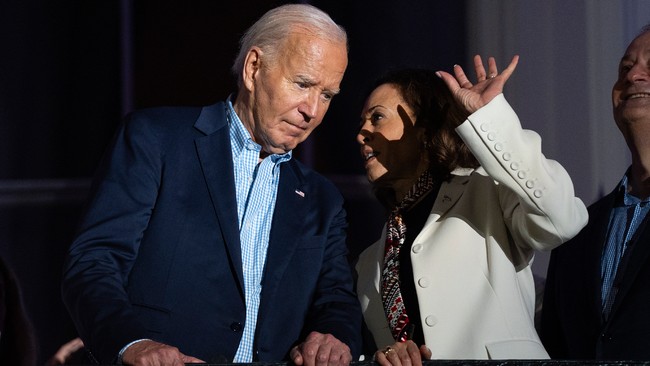
If prominent Democrats thought they were going to be able to coax him out of the race easily in favor of Vice President Kamala Harris, Biden cast considerable doubt on that Friday. “It’s not going to happen,” Biden told Stephanopoulos, insisting the Democratic leaders he talked to wanted him to stay in.
“There’s been a lot of speculation: What’s Joe going to do? Is he going to stay in the race?” Biden told a crowd in the swing state of Wisconsin earlier in the day. “Well, here’s my answer: I am running and going to win again.”
“Some folks don’t seem to care who you voted for,” he said. “Well, guess what? They’re trying to push me out of the race. Well, let me say this as clearly as I can: I’m staying in the race. I’ll beat Donald Trump.” He briefly got the election years mixed up.
The debate highlighted concerns about the 81-year-old’s fitness for office. Leading Democrats then viewed the White House and the campaign as being slow to do damage control afterward, taking days to make contact with party leaders to reassure them.
Biden continued to speak with a weak voice in his Friday interview and complained of a severe cold interfering with his recovery from foreign travel but overall did better answering questions and following his train of thought.
But even before the debate, many Democrats worried Biden and his team were misreading the dynamics of the race. The president is seen as being too insular, too dependent on an inner circle committed to the idea that the presidential election will be more about Trump than Biden.
“The president is rightfully proud of his record. But he is dangerously out-of-touch with the concerns people have about his capacities moving forward and his standing in this race,” former top Obama adviser David Axelrod wrote on X after the interview. “Four years ago at this time, he was 10 points ahead of Trump. Today, he is six points behind.”
Trump still came within 43,000 votes in three states of topping Biden in the Electoral College in 2020 and winning a second consecutive term. The presumptive Republican nominee has led for most of this cycle and is now up by 3.3 points nationally in the RealClearPolitics polling average, which includes some predebate polls.
The odds are increasing that Democrats may have to consider fighting Biden for the nomination at the convention in Chicago next month. This would require a massive shift among the pledged delegates who are committed to Biden, though a Democratic lawmaker reminded party activists they can choose other alternatives under the rules.
There may be enough concern among delegates to make a convention coup a live possibility if Biden neither withdraws nor shows serious signs of improvement in the coming weeks. But Democrats passed on a competitive primary process earlier this year because they feared it would only further weaken Biden in the general election rather than produce a different nominee.
Democrats are now struggling with that dilemma ahead of the convention.
“The best way forward right now is a decision for the President to make. Over the coming days, I urge him to listen to the American people and carefully evaluate whether he remains our best hope to defeat Donald Trump,” Gov. Maura Healey (D-MA) said in a statement. “Whatever President Biden decides, I am committed to doing everything in my power to defeat Donald Trump.”
President Joe Biden’s electoral path to staying in the White House runs through a handful of battleground states. But that route is quickly fading.
The continued fallout from his disastrous debate performance that raised questions about his mental acuity and his electability against former President Donald Trump includes key states shifting in the GOP’s favor and more Democrats hitting the panic button.
The University of Virginia Center for Politics’s election forecaster, Larry Sabato’s Crystal Ball, downgraded a state that’s historically been a Democratic stronghold, Minnesota, from “likely Democratic” to “leans Democratic,” putting it one notch away from the toss-up states of Arizona, Nevada, Pennsylvania, and Wisconsin.
Michigan was also moved into the toss-up category from “leans Democratic.”
“We are solidly behind President Biden here in Michigan, and we’re very focused on the work that we know we need to do to win in November,” Michigan Democratic Party Chairwoman Lavora Barnes told the Washington Examiner.
New Hampshire and Virginia, where Democrats likewise typically perform well, are also being closely watched.
A spokesperson for Sen. Mark Warner (D-VA) did not deny aWashington Post report Friday that said the Virginia Democrat was organizing a group of Democratic senators to lobby Biden to exit the race.
The PR messaging that emerged from a White House meeting this week between Biden and 20 Democratic governors was they were on board with their party leader, in contrast to the trickle of sitting House Democrats who say he needs to withdraw.
But behind the scenes and reading between the lines, there are signs that the cracks continue to widen throughout the party.
Govs. Michelle Lujan Grisham (D-NM) and Janet Mills (D-ME) questioned whether Biden could still win their blue states, according to Politico. The president in 2020 carried New Mexico by 11 percentage points and Maine by nine.
Gov. Maura Healey (D-MA), a close Biden ally who sits on his campaign advisory board, on Friday called on the president to consider dropping out and “carefully evaluate” his political future.
In another sign of splintering support on Capitol Hill, Rep. Brad Sherman (D-CA) noted in a series of social media posts that “counter to popular belief, the rules of the Democratic Party do NOT require that pledged delegates vote for Biden at the convention.”
“Party rules require delegates’ votes, ‘reflect the sentiments of those who elected them,’ at the time the delegates cast their ballots,” Sherman wrote. “Democratic Primary voters have one overarching sentiment: We need a candidate who will beat Donald Trump.”
Four sitting members of Congress have said Biden should no longer be the name at the top of the ticket: Reps. Raul Grijalva (D-AZ), Lloyd Doggett (D-TX), Seth Moulton (D-MA), and Mike Quigley (D-IL).
Washington Examiner White House Reporter Naomi Lim joins Magazine Executive Editor Jim Antle to discuss the mood of the CNN debate in Atlanta; very little attempt in promoting how well the debate went, and even President Joe Biden hasn’t said anything positive about his performance; Democrats keep their loyalty to Biden, while others are finding ways to replace him.
Mayor Cavalier Johnson, a Democrat, secured a national stage for Milwaukee when Republicans agreed to hold their presidential convention there later this month.
Yet the Wisconsin confab is also pulling Johnson into the spotlight as he criticizes a coronation of former President Donald Trump that he helped bring to his city.
Johnson, in coordination with officials all the way up to Gov. Tony Evers (D-WI), convinced the Republican National Committee to choose Milwaukee by promising a “welcoming environment” in a battleground that could decide the November election.
His office holds weekly meetings with RNC officials to make sure the event, which will bring tens of thousands of visitors and a large financial windfall, goes smoothly.
The close coordination underscores what’s at stake for Johnson, a rising Democratic star elected to a second term as mayor in April. He has ambitious plans for the city, including growing the population to a million residents, and sees the convention as part of a longer-term project to attract business.
But Johnson’s desire for a successful convention is running into a second imperative. He is a loyal Democrat hosting a Republican convention and must still be an effective messenger for President Joe Biden.
When the Washington Examiner first sat down with Johnson in early December, weeks before Trump trounced his way to the GOP nomination, he struck a conciliatory tone that emphasized the economic opportunity the event promises to bring. Everyone, Republican or Democrat, supports the “green party,” Johnson joked when asked about the unorthodox relationship he’d forged with the RNC.
But Johnson has begun to take his gloves off in the lead-up to the convention. He called Trump “unhinged” in a string of cable news appearances and press gaggles last month after the former president reportedly disparaged Milwaukee as a “horrible city” in a private meeting on Capitol Hill.
Johnson said as a Milwaukee native, the remarks, which Trump denies ever making, were personal.
“I take offense when anybody comes in and says that my home is a horrible place,” he said in a Wednesday phone interview.
But the comments were also part of a rhetorical shift for Johnson, who plans to make himself available for Democratic counterprogramming when the convention kicks off on July 15.
On the call, Johnson delivered his most scathing remarks on the former president to date, casting him as a threat to democracy whose policies would set back the rights of minority voters in Milwaukee.
“We saw the blunder that was his first administration. I think this next time around, though, it potentially spells some really dark days for American democracy, and that is really, really troubling for me,” Johnson said.
The comments reflect the more overtly political role Johnson is stepping into. Until now, he has largely sought to prove his mettle as a steward of his city.
He became the first black mayor elected in Milwaukee in 2022 at the age of 35 by addressing local concerns, including crime and reckless driving. The convention and other draws like it provide a chance to sell Milwaukee, a state suffering from a long-term decline in population, as a desirable place to live and invest.
“He’s a fabulous man. I think he’s a rising star with a really tough job,” Sen. Tammy Baldwin (D-WI) said of Johnson.
Milwaukee Mayor Cavalier Johnson, left, speaks with Cam Henderson, right, from the Republican National Committee, at the JW Marriott in Chicago ahead of Milwaukee’s expected selection to host the 2024 Republican National Convention, Friday, Aug. 5, 2022. (Jovanny Hernandez/Milwaukee Journal-Sentinel via AP)
Yet the convention is offering Johnson another avenue to elevate his political stock. He helped land Milwaukee as the host city but is now using his office as a bully pulpit.
He, similar to the Biden campaign, attempted to tie Trump to Project 2025, a presidential blueprint put forward by the Heritage Foundation, calling its agenda part of a “darker, dystopian view and vision for the future of our country.”
On Friday, Trump disavowed the platform, pitched as a way to dislodge a “permanent political class” that conservatives say is hostile to them.
“I have nothing to do with them,” Trump wrote in a post on Truth Social.
Meanwhile, the former president is relying on state officials to act as surrogates. Rep. Bryan Steil (R-WI), who represents parts of Milwaukee County in Congress, panned Biden’s policies on the economy and border with an allusion to his poor debate performance last week.
“He’s incapable of defending the policies because the policies he has put forward are indefensible,” he said in a press call ahead of Biden’s visit to Madison on Friday.
Johnson, for his part, chided Democrats who believe Biden should step aside over the debate, during which the president struggled to complete thoughts and, at times, challenge Trump. So far, four House Democrats have called for a new name atop the presidential ticket, with more waiting in the wings when Congress returns on Monday.
“Ultimately, Joe Biden is going to be our nominee,” Johnson told the Washington Examiner. “Unless Joe Biden were to come forward and say, ‘Hey, I’m not going to do this,’ then folks should rally around him.”
But Johnson reserved most of his criticism for Trump, suggesting racial animus on the part of the former president given his repeated depiction of American cities as corrupt, crime-ridden places.
“I mean, folks can read between the lines there about what Donald Trump thinks about places that have significant amounts of diversity,” he said.
Trump has previously defended himself as the “least racist person on earth.”
Johnson maintains that he has a good relationship with the RNC even as he faulted the party for returning to Trump despite his efforts to overturn the 2020 election.
“It’s their candidate. It’s the candidate that got the requisite amount of delegates that has posed to be the problem,” Johnson said, noting Republicans were far less deferential to Trump when Wisconsin officials were vying to bring the convention to Milwaukee.
Yet the tension between pragmatism and party loyalty for Johnson was there from the start.
Milwaukee County is a liberal bastion that Biden won by 40 points in 2020, but if Republicans make even a dent in that support, it could swing a state decided by 20,000 votes in the last two presidential races into the GOP column.
Republicans dismissed the idea that Trump was bad for black voters on Friday’s press call, predicting the same concerns hobbling Biden’s campaign nationally will hurt him with people of all ethnicities.
“They’re in trouble. They’re in trouble for a reason, and if somebody needs a rescue plan with those voters, it’s not Donald Trump, it’s Joe Biden,” Brian Schimming, chairman of the Wisconsin GOP, told the Washington Examiner.
Johnson emphasized the outreach the Biden campaign has done to the black community in Milwaukee while panning Trump’s attempts to win their support. He suggested his debate reference to immigrants stealing lower-wage “black jobs” would turn those voters off.
But Johnson also cast the race in economic terms, predicting Milwaukee, part of the Midwestern Rust Belt, will vote for Biden because of the manufacturing jobs created in the last three years.
“Whoever wins the state of Wisconsin wins the White House, and I think that’ll be Joe Biden,” he said.
The payments, which are received by those living with a serious disability that negatively affects their income, according to the Social Security Administration, can vary based on recipients filing status.
Those who file individually can receive a maximum of $943 per month, couples filing jointly can receive up to $1,415, and essential persons who provide SSI recipients to give them needed care could receive up to $472. Due to inflation, these amounts have increased by 3.2% since last year.
To be eligible, filers need to be at least partially blind or have a “physical or mental condition(s) that seriously limits their daily activities for a period of 12 months or more, or may be expected to result in death.”
SSI payments are separate from regular Social Security benefits. Those who receive Social Security payments don’t automatically qualify for SSI payments.
Recipients can use a calculator from the SSA to determine their total payment.
This November, Arizona voters will be given the chance to move their state away from semi-closed primaries and open them to all registered voters.
A referendum on the ballot from Make Elections Fair Arizona asks whether the current system, in which independents are forced to pick up either a Republican or Democratic ballot on primary day, is unjust. If approved, the referendum would reform the Arizona Constitution to do away with the current primary system and replace it with a single, open primary.
Chuck Coughlin, a longtime political consultant in the state who is running the campaign for Make Elections Fair Arizona, told the Washington Examiner the measure “permits every voter in every candidate to be treated identically, and any voter can participate in any election. Very much like how municipal races are run throughout Arizona today. Partisans and anybody can run and everybody can vote.”
If successful, rules would change for primary voting. On primary day, no matter what party affiliation one may have, all candidates would be placed on a single ballot. Candidates could choose whether or not to say what party they belong to or not say at all. Some local elections in Arizona, notably for mayoral elections, already run on a nonpartisan basis, in which candidates do not list affiliation but rather explain their ideas.
“It doesn’t matter if you get a majority in the primary, you’re going to have a general election,” Coughlin said. “Because we want that candidate to be in front of a majority of the voters, and want them to participate because a majority of the voters showed up in the general election.”
The ballot organizers have left it up to the state legislature to decide what happens if more than two candidates advance to the general election. It could be ranked choice voting, or the legislature could decide to cap the number of candidates at two.
“The Make Elections Fair Act will require that everybody runs in a competitive general election: That could be a Democrat running against another Democrat or Republican against another Republican,” Coughlin said. “It could be an independent running, but you know, it’s no longer ‘we’ll be able to win a race outright in a primary.’”
Arizona’s voter registration is largely split three ways: There are 1.4 million registered Republicans, 1.4 million registered independents, and 1.2 million registered Democrats. Young Arizonans are registering themselves less and less with either party.
“We have a whole generation of young people who don’t belong to one of the parties, and they have no interest in joining the parties,” saidThom Reilly, co-director of the Center for an Independent and Sustainable Democracy and a professor in the School of Public Affairs at Arizona State University.
“The defining feature of independents is that candidates and issues, not party loyalty, drive their choices,” Reilly added.
Arizona independents face hurdles, whether that be as a candidate or as a voter. Independent voters must pick up either a Democratic or Republican ballot when voting in the primary, preventing them from voting for different parties in different races.
Independent candidates must gather up to six times the number of signatures compared to candidates with a partisan affiliation. An independent candidate would need to gather 43,492 signatures to make the ballot, compared to Republicans, who need 7,378, and Democrats, who need 7,035.
The group also believes this ballot measure would make Arizona’s elections more competitive. According tothe Hill, half of all general election races for the state legislature in the 2022 midterm elections were uncontested or won easily. Less than a quarter were deemed competitive to begin with.
“The vast majority of Republicans and a vast majority of Democrats are all elected in primaries, where there’s only 30% of voters participating, so that’s their only customer,” Coughlin said.
Arizona often splits its tickets at the ballot. In 2016, the same year former President Donald Trump won Maricopa County and the state, Maricopa County voters ousted longtime conservative Sheriff Joe Arpaio, who had occupied the role since 1997.
“I’m fond of saying we are State 48 for a reason,” Coughlin said. “Still behave like that, totally young kid in the room that wants to create chaos and create differences and so, this ballot initiative reflects Arizona’s attitude because we’re not we’re not married to one side or the other.
“We just want good candidates who have good answers, and so that’s what hopefully we’ll get out of this,” Coughlin concluded.
Over the past 12 months, illegal aliens have been arrested in connection with the deaths of at least 13 Americans. Seven of those victims were… Read More