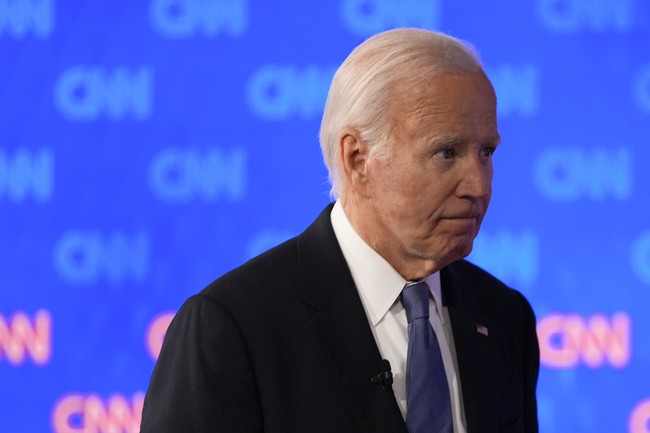
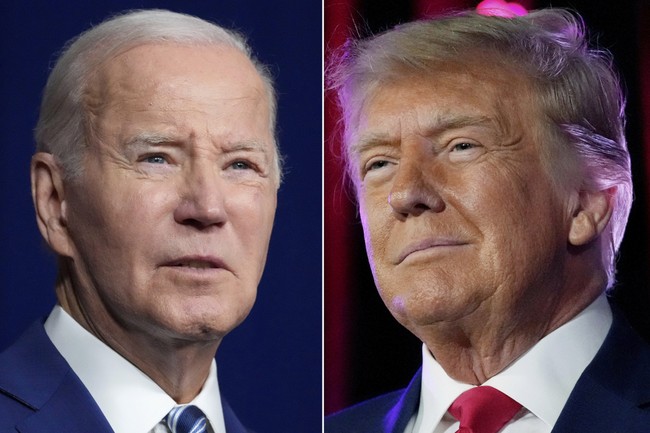
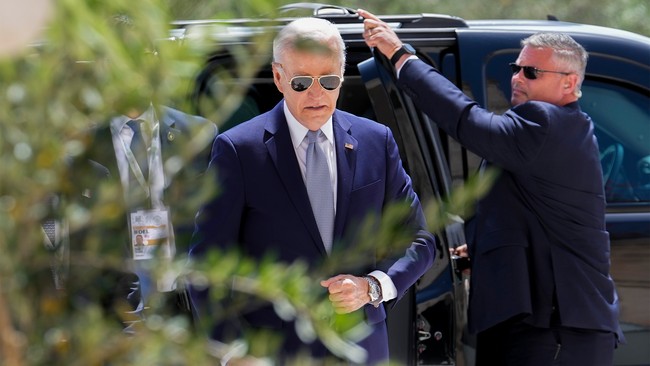
President Joe Biden’s performance in the presidential debate last Thursday has drawn much criticism. Many have claimed that he looked lost and confused. Others have suggested it revealed a decline in his abilities. With most polls showing he lost the debate to former President Donald Trump, a growing number of people have suggested that he should be replaced as the Democrat’s nominee. However, the Philadelphia Inquirer took an alternative position over the weekend and suggested that Trump, not Biden, should withdraw from the race.
“PresidentJoe Biden’s debate performance was a disaster. His disjointed responses and dazed look sparked calls for him to drop out of the presidential race,” the Inquirer’s editorial read. “But lost in the hand wringing wasDonald Trump’s usual bombastic litany of lies, hyperbole, bigotry, ignorance, and fear mongering. His performance demonstrated once again that he is a danger to democracy and unfit for office.”
The suggestion that Trump should step down from Philadelphia’s main newspaper comes after four major newspapers from around the country called for Biden to step down as the Democratic nominee. The Atlanta Journal-Constitution, Chicago Tribune, New York Times, and Wall Street Journal all suggested Biden should step down.
“At Thursday’s debate, the president needed to convince the American public that he was equal to the formidable demands of the office he is seeking to hold for another term. Voters, however, cannot be expected to ignore what was instead plain to see: Mr. Biden is not the man he was four years ago,” read the New York Times editorial.
“Mr. Trump at least looked vigorous and reminded voters of the pre-Covid economy. Mr. Biden looked like a feeble man no American should want going head to head with Mr. Putin or China’s Xi Jinping,” the Wall Street Journal wrote.
The Philadelphia Inquirer, however, disagreed. Despite briefly acknowledging Biden’s troubling performance, the publication considered Biden a lesser threat and provided a number of reasons why Trump should indeed leave the race.
“To build himself up, Trump constantly tears the country down. There is noshining city on the hill. It’s just mourning in America,” the Inquirer editorial board wrote. “Throughoutthe debate, Trump repeatedly said we are a ‘failing’ country. He called the United States a ‘third world nation.’ He said, ‘we’re living in hell’ and ‘very close to World War III.’
“Yes, Biden had a horrible night,” read the editorial. “He’s 81 and not as sharp as he used to be. But Biden on his worst day remains lightyears better than Trump on his best.”
Philly’s newspaper’s editorial redundantly praised Biden and bashed Trump. It concluded with the idea that the country would be better off without Trump running for president.
“There was only one person at the debate who does not deserve to be running for president,” the Inquirer’s editorial proclaimed. “The sooner Trump exits the stage, the better off the country will be.”
Americans are gearing up to celebrate the Fourth of July, and their thoughts are most likely on how many hot dogs to buy for the cookout and whether a family member needs to go stake out a good spot to watch the parade and fireworks.
While the holiday is focused on revelry, July Fourth actually commemorates a solemn moment in the country’s history, when it declared independence from the colonial power Great Britain. The institutions of government imagined by the founders and their successors over the following decades – among them the presidency, Congress, the departments of State and Treasury, the Supreme Court – have retained their authority and legitimacy for more than 200 years, weathering challenges from wars both internal and abroad and massive economic, political and social upheaval.
But now, the Supreme Court, in the wake of a series of highly controversial rulings and ethical questions about some justices, is experiencing historically low public standing. And that has prompted a national conversation about the court’s legitimacy. It’s even drawn rare public comment from three sitting Supreme Court justices.
What’s referred to by experts as the problem of “judicial legitimacy” may seem abstract, but the court’s faltering public support is about more than popularity.
Eroding legitimacy means that government officials and ordinary people become increasingly unlikely to accept public policies with which they disagree. And Americans need only look to the relatively recent past to understand the stakes of the court’s growing legitimacy problem.
Cost ‘paid in blood’
The Supreme Court’s 1954 decision in Brown v. Board of Education shined a light on many white Americans’ tenuous loyalty to the authority of the federal judiciary.
In Brown, the court unanimously held that racial segregation in public education violates the equal protection clause of the 14th Amendment. The justices were abundantly aware that their decision would evoke strong emotions. So Chief Justice Earl Warren worked tirelessly to ensure that the court issued a unanimous, short and readable opinion designed to calm the anticipated popular opposition.
Warren’s efforts were in vain. Rather than recognizing the court’s authoritative interpretation of the Constitution, many white Americans participated in an extended, violent campaign of resistance to the desegregation ruling.
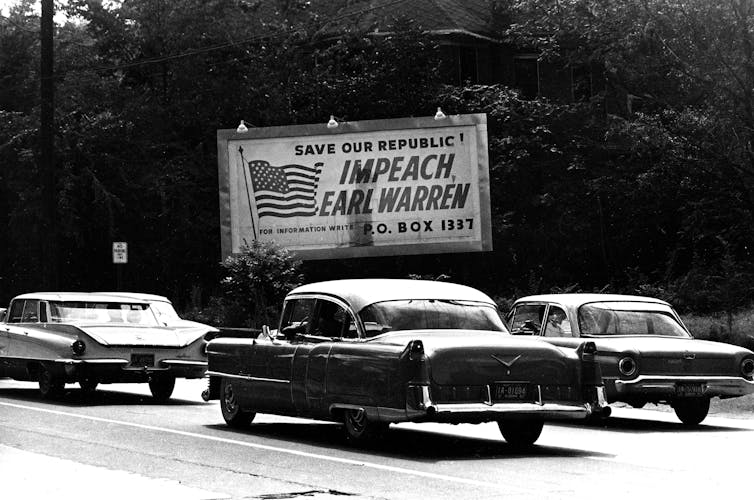
Resistance in the South to the Supreme Court’s school desegregation order was strong and often violent. This billboard urged impeachment of the court’s then-chief justice, Earl Warren.AP photo
The integration of the University of Mississippi in 1962 provides a pointed example of this resistance.
The Supreme Court had backed a lower federal court that ordered the university to admit James Meredith, a Black Air Force veteran. But Mississippi Gov. Ross Barnett led a wide-ranging effort to stop Meredith from enrolling at Ole Miss, including deploying state and local police to prevent Meredith from entering campus.
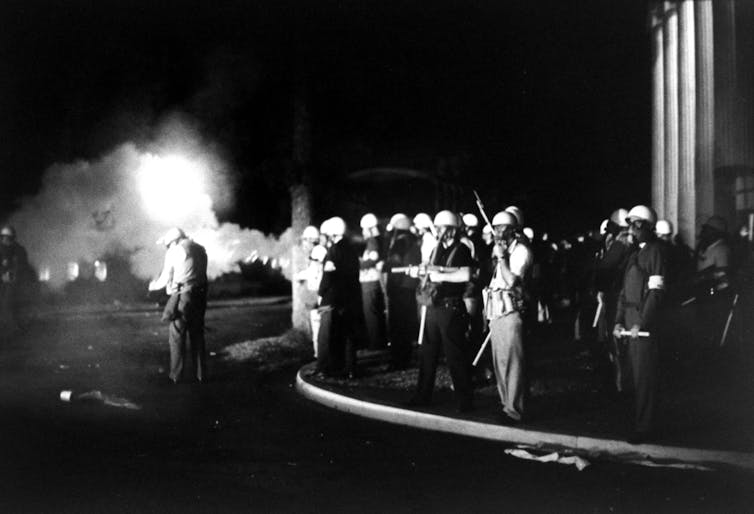
On Sunday, Sept. 30, 1962, Meredith nevertheless arrived on the university’s campus, guarded by dozens of federal marshals, to register and begin classes the next day. A crowd of 2,000 to 3,000 people gathered on campus and broke into a riot. Meredith and the marshals were attacked with Molotov cocktails and gunfire. The marshals fired tear gas in return.
In response, President John F. Kennedy invoked the Insurrection Act of 1807 and ordered the U.S. Army onto campus to restore order and protect Meredith. Overnight, thousands of troops arrived, battling rioters.
President John F. Kennedy called in federal troops to quell the violence against James Meredith’s enrollment in the University of Mississippi in 1962.Lynn Pelham/Getty Images
The violence finally ended after 15 hours, leaving two civilians dead – both killed by rioters – and dozens of wounded marshals and soldiers in addition to hundreds of injuries among the insurgent mob.
The next day, Oct. 1, Meredith enrolled in the university and attended his first class, but thousands of troops remained in Mississippi for months afterward to preserve order.
What some call “the Battle of Oxford” was fueled by white racism and segregation, but it played out against the backdrop of weak judicial legitimacy. Federal courts did not command enough respect among state officials or ordinary white Mississippians to protect the constitutional rights of Black Mississippians. Neither Gov. Barnett nor the thousands of Oxford rioters were willing to follow the court order for Meredith to enroll at the university.
In the end, the Constitution and the federal courts prevailed only because Kennedy backed them with the Army. But the cost of weak judicial legitimacy was paid in blood.
Legitimacy leads to acceptance
In contrast, when people believe in the legitimacy of their governing institutions, they are more likely to accept, respect and abide by the rules the government – including the courts – ask them to live under, even when the stakes are high and the consequences are far-reaching.
For example, two decades ago, the Supreme Court resolved a disputed presidential election in Bush v. Gore, centered on the counting of ballots in Florida. This time, the court was deeply divided along ideological lines, and its long, complicated and fragmented opinion was based on questionable legal reasoning.
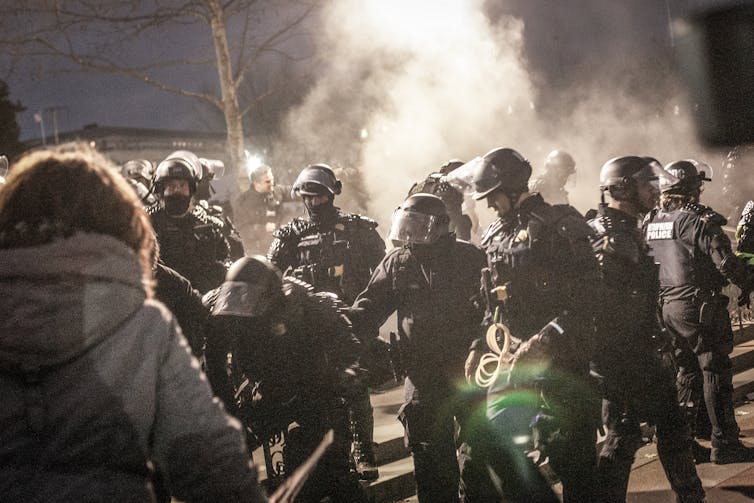
Clashes between riot police and Donald Trump supporters near the U.S. Capitol on Jan. 6, 2021, in Washington.Shay Horse/NurPhoto via Getty Images
But in 2000, the court enjoyed more robust legitimacy among the public than it does today. As a consequence, Florida officials ceased recounting disputed ballots. Vice President Al Gore conceded the election to Texas Gov. George W. Bush, specifically accepting the Supreme Court’s pivotal ruling.
No Democratic senator challenged the validity of Florida’s disputed Electoral College votes for Bush. Congress certified the Electoral College’s vote, and Bush was inaugurated.
Democrats were surely disappointed, and some protested. But the court was viewed as sufficiently legitimate to produce enough acceptance by enough people to ensure a peaceful transition of power. There was no violent riot; there was no open resistance.
Indeed, on the very night that Gore conceded, the chants of his supporters gathered outside tacitly accepted the outcome: “Gore in four!” – as if to say, “We’ll get you next time, because we believe there will be a next time.”
Risks ahead
But what happens when institutions fail to retain citizens’ loyalty?
The Jan. 6, 2021, insurrection showcased the consequences of broken legitimacy. The rioters who stormed the Capitol had lost faith in systems that undergird American democracy: counting presidential votes in the states, tallying Electoral College ballots and settling disputes over election law in the courts.
The men and women who stormed the Capitol may have believed their country was being stolen, even if such beliefs were baseless. So, they rebelled in the face of a result they didn’t like.
The threat of further unrest is real. Polls show the 2024 presidential election between President Joe Biden and former President Donald Trump will be a close call, and it is likely that election results in several states will be challenged in federal courts. Some of these claims may raise good-faith questions about the administration of elections, while others advance more spurious claims intended to undermine faith in the election’s outcome.
In the end, Americans’ faith in the timely resolution of those cases and their peaceful acceptance of the presidential election’s result will hinge on whether the losing candidate’s supporters accept the legitimacy of the Supreme Court and the judiciary more broadly.
Nothing is certain in politics, but the specter of constitutional crisis looms over the United States. It’s dangerously unclear whether the Supreme Court retains enough legitimacy to ensure acceptance of decisions addressing the upcoming election among those who find themselves on the losing side. If it doesn’t, the court’s abstract legitimacy problem could once again lead to violence and insurrection.
This story is an updated version of a story that was originally published on Oct. 31, 2022.
Signed into law 60 years ago, the Civil Rights Act of 1964 outlawed discrimination in the U.S. based on “race, color, sex, religion, or national origin.”
Yet, as a historian who studies social movements and political change, I think the law’s most important lesson for today’s movements is not its content but rather how it was achieved.
As firsthand accounts from the era make clear, the movement won because it directly hurt the interests of white business owners. The 1955 Montgomery bus boycott, the 1963 boycott of Birmingham businesses and many lesser-known local boycotts inflicted major costs on local business owners and forced them to support integration.
The conventional narrative
A view common among scholars, activists and the general public holds that the Civil Rights Movement succeeded because violent attacks against peaceful Black protesters mobilized white public opinion in the movement’s favor.
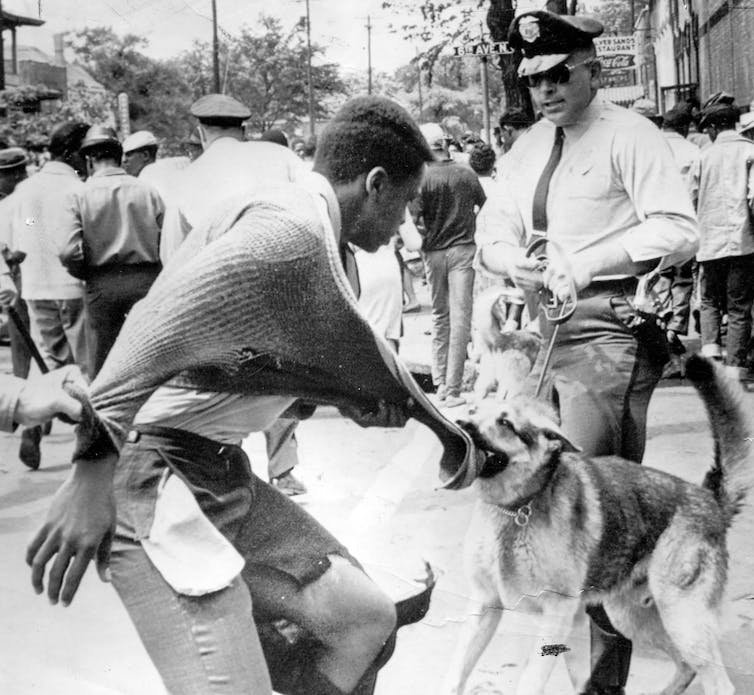
One of the most famous incidents occurred in Birmingham, Alabama, in May 1963, when the city’s public safety commissioner, Eugene “Bull” Connor, turned fire hoses and dogs on Black demonstrators.
A Black protester is attacked by a police dog on May 4, 1963, during demonstrations against segregation in Birmingham, Ala.Afro American Newspapers/Gado/Getty Images
The conventional wisdom is that Connor’s actions outraged Northern whites, and in response, the Kennedy administration sent federal troops to Birmingham and a civil rights bill to Congress.
But this view misunderstands the source of the movement’s power.
For one thing, it overstates public sympathy for the Civil Rights Movement. Three months after the attacks against Black protesters in Birmingham, for instance, almost two-thirds of the public opposed the famous March on Washington for Jobs and Freedom of August 1963.
Moreover, the Kennedy administration predicted that civil rights legislation would hurt the Democrats electorally. “The President never had any illusions about the political advantages of equal rights,” wrote Kennedy aide Arthur Schlesinger in his memoir “A Thousand Days.” “But he saw no alternative” given the movement’s actions.
So what were those actions?
Black organizers aimed to inflict maximal disruption on the white power structure, particularly economic elites. As Martin Luther King Jr. later recounted, “The political power structure listens to the economic power structure.”
By disrupting white businesses, often in a highly organized way, Black activists won social change.
A ‘devastatingly effective’ weapon
Economic boycotts in Southern cities such as Birmingham and Nashville, Tennessee, played crucial roles during the civil rights era.
A 20-month boycott by Black shoppers of downtown businesses in Greenwood, Mississippi, brought legal changes to the city’s hiring practices in 1964.
The most famous boycott occurred in 1955–56 in Montgomery, Alabama, where the nearly 13-month protest against segregated public transportation caused the city’s bus service to lose an estimated US$3,000 a day in fares.
Rosa Parks sits in the front of a bus in Montgomery, Ala., in 1956 after the U.S. Supreme Court ruled segregation illegal on the city’s bus system. Behind Parks is Nicholas C. Chriss, a UPI reporter covering the event.United Press photo
Black people made up about 75% of public transportation riders. Instead of using city buses, they walked, formed car pools and used Black-owned taxi services. The boycott ended on Dec. 20, 1956, when the U.S. Supreme Court ruled in Browder v. Gayle that segregation on buses was unconstitutional.
By 1960, civil rights organizers were widely embracing this “economic weapon to fight segregation,” reported the national magazine Business Week.
Three years later, Time magazine wrote that boycotts had proved “devastatingly effective” in pushing white business owners and government officials to desegregate.
In Birmingham, for example, real estate tycoon Sidney Smyer led the elite push for integration. Smyer was a staunch racist, but he capitulated amid the boycott and related disruption.
“I’m still a segregationist,” he said in May 1963, but “I’m not a damn fool.”
During five weeks of boycotts, sit-ins and marches, Birmingham businesses had lost millions in sales.
Smyer and his fellow executives decided to cut their losses by integrating. They then dragged along the politicians, judges, school administrators and law enforcement officials.
That had been civil rights strategists’ plan from the start.
According to civil rights organizer Abraham Woods, they hoped that business owners hurt by the boycott in Birmingham would “pressure the city” to integrate.
Andrew Young, an adviser to King, later said that “Bull Connor made the impact greater, but the dynamics would have taken effect without Bull Connor and the dogs. … When the demonstrations were so massive and the economic withdrawal program was so tight, literally, the town was paralyzed.”
Changing the law after Birmingham
The Birmingham victory inspired other Black people to rise up. Kennedy’s Department of Justice reported another 2,062 Black protests in 40 states by the end of 1963.
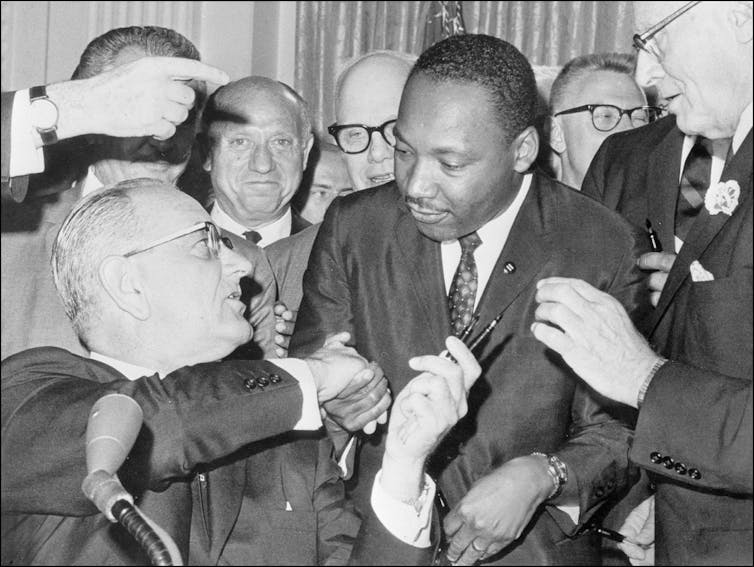
U.S. President Lyndon B. Johnson shakes hands with Martin Luther King Jr. after signing the Civil Rights Act on July 2, 1964, at the White House.AFP via Getty Images
It also led Kennedy – 28 months into his presidency – to propose a civil rights bill, in June 1963.
Even as he tried to dissuade Black leaders from marching on Washington, Kennedy admitted that the disruptive boycotts and protests “had made the executive branch act faster and were now forcing Congress to entertain legislation,” as Schlesinger reported in his book “A Thousand Days.”
Kennedy also feared the radicalization of Black consciousness after Birmingham. If the federal government didn’t deliver moderate reform, the “colored masses” might embrace “the mindless radicalism of the Negro militants,” as Schlesinger described the president’s logic.
Kennedy’s assassination in November 1963 meant the civil rights bill fell to his successor, Lyndon Johnson. After a heated battle in Congress, Johnson signed the bill into law on July 2, 1964.
By causing massive and sustained disruption to ruling-class interests, particularly businesses, Black organizers who were formally excluded from political power were able to force legal change.
The lesson is that major legislative reform requires mass disruption outside the electoral and legislative spheres. Without that disruption, it will be very difficult to win any law that negatively affects entrenched power-holders.
The rise of the radical far right in Europe poses a threat not only to the continent but also to Americans at home and abroad.
But while the U.S. government tends to be quick to use sanctions against perceived bad actors across the globe, when it comes to the transnational threat that far-right violence poses, successive U.S. administrations have been more coy about using another critical and effective tool: terrorist designations.
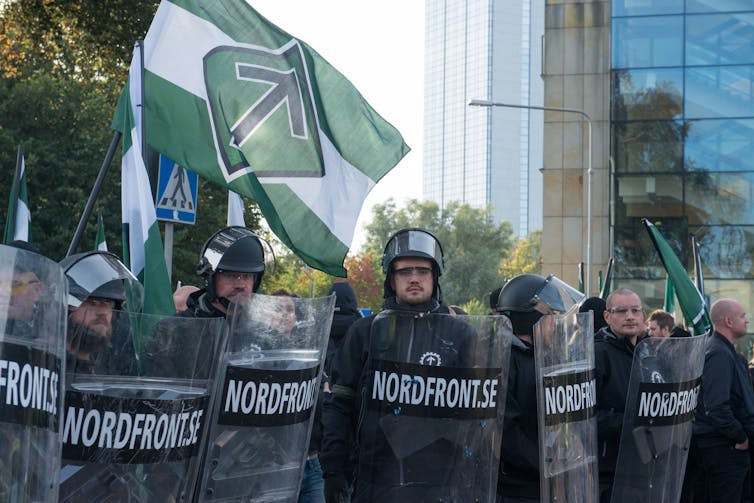
It wasn’t until mid-June 2024 that the Biden administration’s State Department sanctioned its first violent far-right group, the Nordic Resistance Movement. A neo-Nazi group based in Sweden but with a footprint that extends throughout Scandinavia, the NRM has built a reputation for brutality and espousing a vision of totalitarian rule. As the State Department noted in its designation, the group is also stockpiling weapons and explosive materials.
Prior to the Nordic group’s listing as a terrorist entity, the Trump administration designated the far-right Russian Imperial Movement as a terrorist group in 2020.
Both groups are now officially deemed “specially designated global terrorists” by the United States. As a result, the groups are subject to an asset freeze, and anyone trying to support them risks prosecution for financing terrorism.
As a former State Department counterterrorism official with more than a decade of experience sanctioning terrorists under U.S. law, I know that it’s no accident that the groups U.S. officials are targeting now are based in Europe rather than in America.
Targeting the far right overseas
The threat posed by violent far-right actors is certainly as serious in Europe as in the United States. But United States agencies do not have authority to legally sanction groups such as the U.S.-based Oath Keepers, Proud Boys or the Atomwaffen Division as terrorists.
Constitutional rights that protect freedom of speech, assembly and the right to bear arms make it exceedingly difficult to sanction domestic groups. Further, all of the relevant executive orders and statutory laws in the anti-terrorism space are explicit that the State Department must designate foreign-based groups.
With limited power to crack down on far-right groups in the U.S., agencies are instead looking to curtail the influence of violent far-right ideology from overseas.
Yet the designations of only two violent far-right groups as “specially designated global terrorists” – separated by four years – is disappointing to me, especially when considering the range of far-right threats that dot the European continent.
The EU’s crime-fighting agency, Europol, reported in its December 2023 report that there were 45 arrests of far-right extremists in 2022 and the “threat posed from right-wing terrorist lone actors, radicalized online, remained significant.”
The most significant attack was an October 2022 shooting carried out in Bratislava, Slovakia, in front of an LGBTQ+ bar that resulted in two deaths. Interestingly, the State Department’s designation of the Nordic Resistance Movement highlighted that the group’s violent actions include an anti-LGBTQ+ platform.
Anti-immigration attacks
The Biden administration designated the Nordic Resistance Movement as a terrorist group shortly after EU parliamentary elections, in which far-right political groups made significant gains.
Far-right groups, such as Germany’s Alternative for Germany, won seats – 15 of them – for the first time. The group encourages violence against immigrants – communities often singled out by violent radical-right extremists such as the Nordic Resistance Movement.
In fact, the Nordic group’s most notorious attack was carried out at a refugee center in Gothenburg, Sweden, in January 2017, during which an attempted bomb attack left one person seriously injured.
The perpetrators of the attack were trained at a camp in Russia by the Russian Imperial Movement – the group that the U.S. State Department designated as a terrorist group in 2020.
More recently, on June 18, a former member of the Nordic group carried out a knife attack on a foreign-born 12-year-old child in Finland.
Migration policy has long been a focus for violent far-right extremists, and increasingly politicians have been the targets.
In May 2024, for instance, a center-left German politician was beaten up while hanging campaign posters in an ideologically motivated attack.
In another assault, a politician in Dresden, Germany, was assaulted by a group that allegedly called out, “Heil Hitler.”
In fact, according to the Middlebury Institute’s Center on Terrorism, Extremism and Counterterrorism, the Nordic group’s goal is to “overthrow democracy across the Nordic region and Scandinavia in favor of establishing a Third Reich-inspired Nazi dictatorship.”
Groups like the Nordic Resistance Movement are leveraging a fragile and polarized European society, playing on fears that migrants are a threat to the continent.
Members of the Nordic Resistance Movement rally in a frozen zone after Gothenburg police blocked their planned march through the central parts of the city on Sept. 30, 2017.Julia Reinhart/NurPhoto via Getty Images
Protecting democracies
Against the backdrop of recent violent far-right attacks against politicians and immigrants, along with recent European election results, the timing of the Biden administration’s designation of the Nordic Resistance Movement reflects growing fear in Washington that the far-right’s political rise in Europe may inspire violent extremists to move beyond chants, slogans and swastikas to mass shootings.
Nonetheless, the United States has been less inclined to sanction far-right groups than many of its partners. For example, the United Kingdom has designated seven far-right organizations as terrorist organizations; for Canada, the count is nine.
Simply put, the United States, despite its penchant to sanction enemies – from hostile states such as Russia to terrorist groups such as ISIS – appears reluctant to fully take advantage of its terrorist designation tools against violent far-right actors.
And that, I believe, could be a concern. U.S.-based far-right extremists are known to be very connected to similarly minded groups and individuals in Europe. Organizers of the 2017 white supremacist Unite the Right rally in Charlottesville, Virginia, had alleged links to the proscribed Russian Imperial Movement.
By designating groups such as the Nordic Resistance Movement as terrorists, the Biden administration is hoping to dissuade Americans from supporting Europe’s far right. Under the terms of the State Department order, if any American did offer support, they could end up behind bars.
At the same time, it may be that the Biden administration’s listing of the Nordic group is a signal to Europe that there are more far-right-related terrorist designations to come.
After all, the administration made a point to explain that the Nordic group’s designation was taken “following consultations with our European partners.”
And with multiple important elections on the horizon in Europe, Biden’s decision also represents an effort to champion democracy and push back against groups that promote us-versus-them narratives that define enemies as others worthy of attack.
If listing the Nordic Resistance Movement as a terrorist organization is a sign of more designations to come, it could further two of the Biden administration’s stated goals: promoting and protecting democracy overseas and combating domestic terrorism.